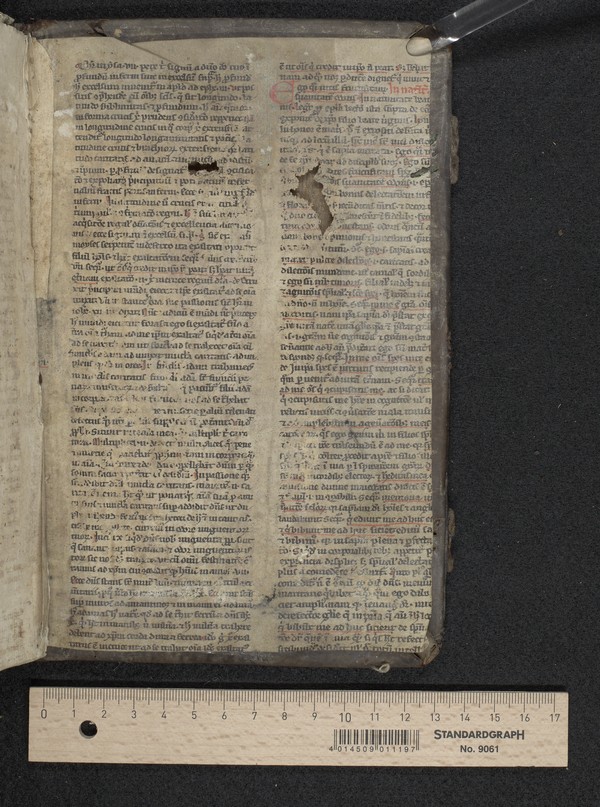
F-03xq: John of Abbeville, sermons for saints' days
The leaf is identified with high confidence as part of the sermons for feast days of John of Abbeville (Johannes Halgrinus de Abbatisvilla, d. 1237). Its four columns are one continuous passage: the second half of the sermon "Sicut exaltavit Moyses serpentem", on the cross, and the opening of the sermon "Ego quasi vitis fructificavi" for the Nativity of the Virgin. They agree, sentence for sentence, with a thirteenth-century manuscript of the collection.
The Fragmentarium record describes a trimmed parchment leaf used as the lower flyleaf of a volume in Oudenaarde, Stadsarchief, dated 1251–1300, catalogued as an unidentified biblical commentary with references to John 3:16 and the Book of Wisdom. The text is a sermon collection: John 3:14–16 is the theme of the first sermon and Ecclesiasticus 24 that of the second. The catalogue date has not been reassessed.
- Identification: identified, high. About 120 manuscript lines in three stretches correspond to the witness, including the end of one sermon ("ad quam nos perducere dignetur qui vivit"), the rubric for the Nativity of the Virgin, and the next sermon's opening, in that order. The cross-reference "illud scutum de quo dictum est in precedenti sermone" in the witness shows the passage belongs to an ordered collection. The work is not printed, so the comparison is with a manuscript, not an edition. A later collection that copies these two sermons whole was not excluded.
- Transcription: image-only first reading by an isolated reader, covering most of both sides, and a source-assisted selected reading. The middle of one column on the verso is rubbed and unread; line ends on the recto are lost under a turn-in. Accuracy has not been measured.
- Verification: a research reader found the candidate through a sermon repertory, then read ff. 38r–40r of the Charleville manuscript from its page images and compared them with the first reading. The coordinator compared two places on the fragment image with the Charleville page image (below). The witness is a bitonal microfilm scan, legible but small. No human review.
Textual evidence
Manuscript images: lower flyleaf r and lower flyleaf v. The text runs from the side labelled v (left column, then right) to the side labelled r, so the labelled verso is the earlier page. Abbreviations are resolved silently; square brackets mark text lost or not read.


| Fragment | Charleville-Mézières, BM, Ms. 218 |
|---|---|
| r, left column, native-pixel box 113,1229,1261,1980 (from "quos patiuntur" compared by the coordinator with f. 39v; the lines before it by the research reader with f. 39r): "... ut fortius ad se traheret omnia cum funiculis Adam adiunxit vincula caritatis, adimplens quod dicitur in Osee xi: In funiculis Adam traham eos in vinculis caritatis. Funiculi Adam sunt funiculi penarum et miseriarum et defectuum quos patiuntur filii Adam in corpore et anima. Hiis funiculis nos ad se trahebat [...] In passione quoque superaddidit dominus vincula caritatis. Maiorem enim caritatem nemo habet quam ut ponat quis animam suam pro amicis suis. Vincula caritatis superaddidit dominus ut du[plici ...]" | ff. 38v–39r and f. 39v, left column: "Nam ut fortius ad se traheret omnia cum funiculis Adam adiunxit vincula caritatis, implens quod dicitur in Osee xi: In funiculis Adam traham eos in vinculis caritatis. Funiculi Adam sunt funiculi penarum et miseriarum et defectuum quos patiuntur filii Adam in corpore et anima. Hiis funiculis trahebat nos ad se dominus ante passionem [...] In passione quoque superaddidit dominus vincula caritatis. Maiorem enim caritatem nemo habet quam ut animam suam ponat quis pro amicis suis, et vincula caritatis superaddidit dominus ut duplici ..." |
| r, right column, top, box 1015,91,2163,769: "[...] est ut omnis qui credit in ipsum non pereat sed habeat [vitam eter]nam, ad quam nos perducere dignetur qui vivit. [red initial] Ego quasi vitis fructificavi [rubric: In nat...] suavitatem odoris. In nativitate beate virginis legitur pro epistola lectio ista sumpta de Ecclesiastico et exponitur de Christo filio beate virginis" | f. 39v: "... ut qui credit in ipso non pereat sed habeat vitam eternam. Ad quam nos ducere dignetur qui vivit etc. [rubric: De nativitate beate Marie] Ego quasi vitis fructificavi suavitatem odoris. In nativitate beate virginis legitur pro epistola lectio ista sumpta de Ecclesiastico, que tota exponitur de Christo filio eiusdem beate virginis." |
| v, left column, from the research reader's comparison: "consignari nos oportet hoc signo ... sicut dicitur in Exodo xii ... Tales enim securi sunt a gladio [...], a gladio dampnationis eterne. Hoc signum ... per clipeum Iosue ... de urbe Hay. Sic habemus in Iosue ... Fuit enim clipeus de ligno et corio ... corium extensum in clipeo Christus ..." | ff. 37v–38r to f. 38v: "consignari nos oportet hoc signo super utrumque postem et in superliminaribus. Sic dicitur in Exodo xii ... Tales enim securi sunt a gladio fulgurante, a gladio dampnationis eterne. Hoc signum triumphale designatum est per clipeum Iosue in quo triumphavit de urbe Hai. Sic habetur in Iosue viii ... Fuit enim clipeus de ligno et corio supposito. Corium extensum in clipeo Christus est suspensus et extensus in ligno." |


The research reader's comparison also covers the rest of the left column on r (the four dimensions of the cross from Ephesians 3, the adamant that draws iron, from Amos 7 in the Septuagint reading) and about fifty lines of the Nativity sermon in the right column ("mater pulchre dilectionis, id est caritatis, ad differentiam dilectionis mundane vel carnalis ... Qui edunt me adhuc esurient"). The variants found are small: sic habemus for sicut habetur, adimplens for implens, perducere for ducere, et exponitur for que tota exponitur, figura crucis domini for significat mysterium crucis Christi. The comparison corrected several words of the first reading, for example "fractis portis inferni".
The work and its attribution
The witness is Charleville-Mézières, Bibliothèque municipale, Ms. 218, thirteenth century, digitised from microfilm by the IRHT (ARCA) and catalogued there as John of Abbeville's sermons de sanctis. J. B. Schneyer, Repertorium der lateinischen Sermones des Mittelalters, vol. 3, p. 529, lists the two sermons under Johannes Halgrinus de Abbatisvilla as nos. 271 and 272, for the Exaltation of the Cross and the Nativity of the Virgin, with the same opening and closing words. The attribution rests on Schneyer and the IRHT catalogue; no ascription was looked for in the manuscript, and Schneyer was seen in search snippets only.
No claim is made about the fragment's date or origin, or about its relation to other manuscripts of the collection.