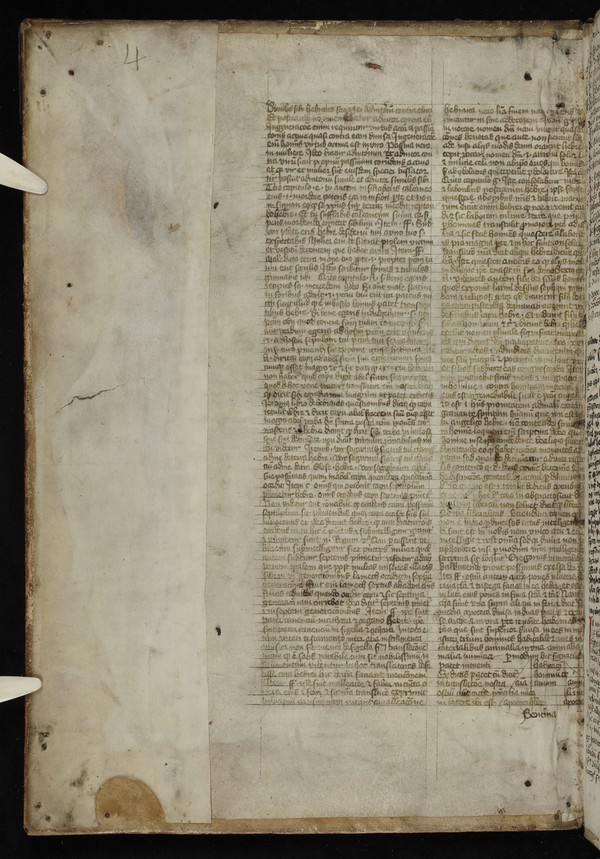
F-1exy — Nicholas of Lyra, De differentia
- Identification: identified, high confidence. Nicholas of Lyra, Tractatus de differentia nostrae translationis ab hebraica littera, Genesis section. Connected explanation of generation and the active/passive distinction agrees with the Rouen 1507 edition, beyond the biblical lemma itself.
- Transcription: selected source-assisted excerpts. The excerpts were checked against manuscript and edition images by a Codex reviewer; gaps and uncertain forms remain. These are expanded selections, not a certified full-leaf transcription. No human palaeographer reviewed them; no accuracy rate was measured.
- Verification: image-to-image sample. The front pastedown's upper left-column passage and immediate continuation were compared with edition scans n15–16. The complete Genesis endpoints and back pastedown are outside the checked sample.
Fragmentarium record · image manifest. Manuscript image Rekopisy_010_17_001.jpg, front pastedown. The image evidence consists of a cached upper-left crop and a shorter lossless selection. Its original exact canvas coordinates and scale were not recovered; the preserved record includes a checksum and that limitation.
Reading and comparison
The preserved image-only response precedes source comparison. Its physical lines 3–5 read, with uncertainty, In generacōe … virtutes? activa et passiva and enim hominis virtus activa est in viro Passiva vero. The abbreviation and singular/plural construction must not be settled solely from a fluent expansion.
Selected source-assisted comparison text, corresponding to the larger crop's lines 3–8. This is normalized text with expanded abbreviations; it does not record every visible letter or abbreviation boundary:
3 In generacione enim requiritur(?) virtus activa et passiva
4 correspondens active quasi contra eam divisa. In generacione
5 enim hominis virtus activa est in viro, passiva vero
6 in muliere. …
7 [line omitted from this selection]
8 … vir et mulier sunt eiusdem speciei …
The numbered rows preserve physical divisions; ellipses omit unverified words; ? marks an uncertain reading or expansion. The normalized singular requiritur … virtus remains uncertain against the isolated reader's requiruntur? virtutes?; it is not presented as a settled manuscript variant. The preserved notation generacōe with proposed expansion (generacione) is retained in the linked image-only response. Other abbreviation boundaries have not been systematically resolved, so the normalized comparison must not be reused as a diplomatic transcription. The isolated reader flagged crowded strokes around the subsequent adiutorium et adiutor passage. No definite scribal correction is established there.
The 1507 edition, n15, lower right column, has In generatione enim requiritur virtus activa et passiva correspondens active quasi contra eam divisa. It continues at the top left of n16 through the woman/man comparison and shared species. The connecting explanation supports the identification; Genesis 2:18 alone would not.
An additional check in the larger manuscript crop reaches Tercio capitulo … Tu autem insidiaberis calcaneo eius, agreeing with the transition at n16. This supports the local sequence; the full extent of the text on the pastedowns is unverified.
Limits and next step
The edition images establish a match to this tract. Complete front/back endpoints, other variants and physical arrangement need further collation if those claims are needed. Dating and provenance are not independently established by the text match.