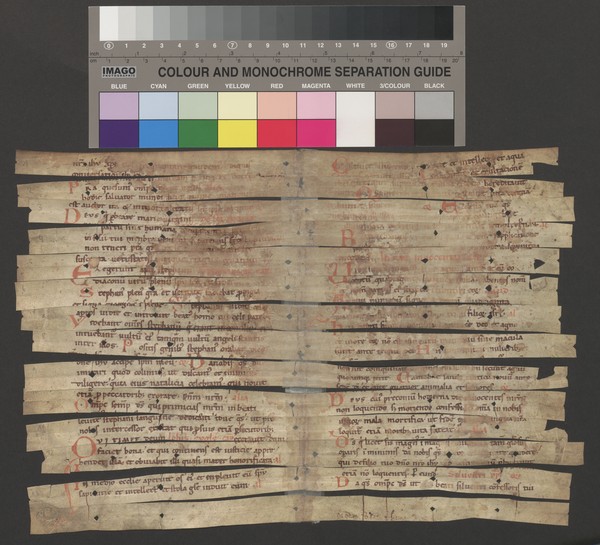
F-33ow: Gregorian sacramentary, Advent orations (Aliae orationes de adventu, with Porrige nobis and Deus qui nos conspicis)
The strip is cut from a leaf of Advent prayers of the Gregorian sacramentary (the Roman mass book of prayers in the form sent to Charlemagne, called the Hadrianum). It preserves four to six letters from each of 20 lines on one face and 16 on the other, and every one of these 36 letter groups falls, in order and one to a line, in a continuous series of prayers: the postcommunion Suscipiamus domine misericordiam tuam, the collect Excita ... ut ab imminentibus peccatorum nostrorum periculis, the six "other prayers for Advent" of the Hadrianum (Excita ... clementer operare, Conscientias nostras, Prope esto domine, Concede ... ut magnae festivitatis, Mentes nostras, Preces populi tui ... de adventu unigeniti), and then Porrige nobis domine dexteram and Deus qui nos conspicis ex nostra infirmitate destitui. Whether the book was a sacramentary, a missal or a collectar (a book of collects for the office) cannot be told from the strip.
The Fragmentarium record describes one parchment strip, Wien, Österreichische Nationalbibliothek, Fragm. 3b, 210 x 15 mm, dated 1101-1150, Caroline minuscule, at least 21 lines of 9 mm, used as a sewing guard in Cod. 3701 (Mondsee, 1454), with the title "Fragment (text unidentified)" and the note that only single words survive (pecca-, salua-, -enter, domine, filius, discip-). That description fits. The strips catalogued as Fragm. 3a from the same host volume (F-fjvt), which appear in the group photograph attached to this record, are from a different manuscript: they have 30 lines of 5 to 6 mm in a later transitional script, against lines of 9 mm in a larger Caroline hand here, and they carry chapters and collects from Christmas to the Circumcision and for Lent. Both books contained orations; nothing else connects them.
- Identification: identified, high, for the prayers and their sequence. The basis is positional: the 36 letter groups occur in the edited text in the manuscript's order with between 16 and 36 letters supplied from one group to the next (mostly 23 to 32), which is what a leaf with lines of even length requires, and the text runs on from the last line of one face to the first of the other. Lines 9 and 10 of the recto (misist, enter) fit the Hadrianum order "promisisti usque in finem saeculi clementer", not the order "usque in finem saeculi promisisti" of the eighth-century Gelasian books. The last two prayers are not in the Hadrianum's Advent series; they stand in the Advent series of the eighth-century Gelasian sacramentary of St Gall. The opening pair (a postcommunion followed by the collect of the first Sunday) is not the order of the Hadrianum mass, and the arrangement of the book at that point has not been matched to a particular sacramentary. A connection with Fragm. 3a was considered and set aside for the reasons above.
- Transcription: image-only first reading of both faces by an isolated reader, and a source-assisted reading in which a research reader reread all 36 lines on the native images and changed five groups (recto 4 and 15; verso 2, 3, 15). The last letter of recto line 4 and the red letters after the last prayer remain uncertain. Accuracy has not been measured.
- Verification: a research reader compared every line with page images of Wilson's edition of the Hadrianum (pp. 113, 116, 117) and of Mohlberg's edition of St Gall 348 (p. 216). The coordinator read recto lines 5 to 14 (pecca / mur / salua / am t / misist / enter / dne / filius / b; inu / exp) and verso lines 6 to 15 (tui / de ad / rne la / n mai / e uite / dne d / ueni / bsolu / nos co / tui) on the native images, and Excita ... promisisti usque in finem seculi clementer operare and Conscientias nostras on the page image of Wilson p. 116. The comparison rests on letter groups, not on connected words; no sacramentary manuscript was collated and Deshusses's edition was not consulted. No human review.
Textual evidence
Manuscript images: recto, onb_fragm_3b_2 and verso, onb_fragm_3b_1, each 699 x 5344 pixels. On the recto line n lies at about y = 260 + 222(n-1); on the verso at about y = 200 + 225(n-1); each line fills the width of the strip. In the table the letters outside square brackets are on the strip; the text inside is supplied from the editions in a twelfth-century spelling, and the number is the count of supplied letters between one group and the next.


| Line | On the strip | Edited text | Letters between |
|---|---|---|---|
| r1 | am t | [Suscipiamus domine misericordi]am t[uam | |
| r2 | ation | in medio templi tui et repar]ation[is | 26 |
| r3 | is ho | nostre uentura sollemnia congru]is ho[noribus | 30 |
| r4 | ntia. | precedamus. Excita domine quesumus pote]ntia[m tuam | about 35 |
| r5 | pecca | et ueni ut ab imminentibus] pecca[torum | 25 |
| r6 | mur | nostrorum periculis te merea]mur | 30 |
| r7 | salua | protegente eripi te liberante] salua[ri | 26 |
| r8 | am t | Excita domine potenti]am t[uam | 26 |
| r9 | misist | et ueni et quod ecclesie tue pro]misist[i | 29 |
| r10 | enter | usque in finem seculi clem]enter | 23 |
| r11 | dne | operare. Conscientias nostras quesumus] domine | 31 |
| r12 | filius | uisitando purifica ut ueniens Iesus Christus] filius | 32 |
| r13 | b; inu | tuus dominus noster paratam sibi in no]b(is) inu[eniat | 24 |
| r14 | exp | mansionem. Prope esto domine omnibus] exp[ectantibus | 36 |
| r15 | duen | te in ueritate ut in a]duen[tu | 28 |
| r16 | tib; p | filii tui domini nostri placitis tibi ac]tib(us) p[resentemur | 30 |
| r17 | ut m | Concede quesumus omnipotens deus] ut m[agne | 28 |
| r18 | mnia | festiuitatis uentura solle]mnia | 28 |
| r19 | riter | prospero celebremus effectu pa]riter[que | 27 |
| r20 | discip | reddamur et intenti celestibus] discip[linis | 30 |
| v1 | ibus | et de nostris tempor]ibus [letiores | 22 |
| v2 | s dne | Mentes nostras que]s(umus) d(omi)ne | about 22 |
| v3 | a · ut | lumine tue uisitationis illustr]a · ut | 29 |
| v4 | ter pr | esse te largiente mereamur et in]ter pr[ospera | 27 |
| v5 | secur | humiles et inter aduersa] secur[i | 26 |
| v6 | tui | Preces populi] tui | about 20 |
| v7 | de ad | quesumus domine clementer exaudi ut qui] de ad[uentu | 25 |
| v8 | rne la | unigeniti filii tui secundum ca]rne(m) la[etantur | 31 |
| v9 | n mai | in secundo cum uenerit i]n mai[estate | 26 |
| v10 | e uite | sua premium etern]e uite | 23 |
| v11 | dne d | percipiant. Porrige nobis] domine d[exteram | about 30 |
| v12 | ueni · | tue uenerationis et] ueni | 24 |
| v13 | bsolu | et peccata nostra propitiatus a]bsolu[e | 27 |
| v14 | nos co | Deus qui] nos co[nspicis | about 16 |
| v15 | tui · | ex nostra infirmitate desti]tui | 29 |
| v16 | cus | aduentus tui nos uisitatione] cus[todi | 25 |
The shorter intervals fall where one prayer ends and the next begins, where a rubric, an initial and the closing formula take up space that cannot be counted. Verso line 10 has e uite, the order "aeternae uitae" of the Hadrianum, where St Gall 348 has "uitae aeternae". In Porrige nobis the first hand of St Gall 348 has "dexteram tuae uenerationis" and its corrector "propitiationis"; the strip does not show the word. Recto line 4 ends in a letter that is not a clear t; "potentiam tuam" is what lines 5 to 7 require. After verso line 16 the parchment is blank for about three lines and then has two or three faint red capitals (an upright and an H or N), presumably the heading of the next section.
Editions used, on page images: H. A. Wilson, The Gregorian Sacramentary under Charles the Great (Henry Bradshaw Society 49, London 1915), p. 113 (first Sunday of Advent: Excita ... saluari, Suscipiamus), p. 116 and p. 117 ("Aliae orationes de aduentu"); K. Mohlberg, Das fränkische Sacramentarium Gelasianum in alamannischer Überlieferung (Codex Sangall. No. 348) (Münster 1918), p. 216, nos. 1405 and 1408. The prayers are anonymous liturgical texts; "Gregorian" is the traditional name of the book, and Wilson prints it from Cambrai 164 with two Vatican manuscripts.
Leaf order and limits
The face catalogued second (onb_fragm_3b_2) is the recto: its twentieth line ends in disciplinis and the first line of the other face continues the same prayer. The first image of the record is a group photograph of the Fragm. 3a strips with a colour chart and does not show this strip. No claim is made about the date or origin of the leaf, about the kind of book it came from, or about its relation to any particular sacramentary; the catalogue date has not been reassessed.