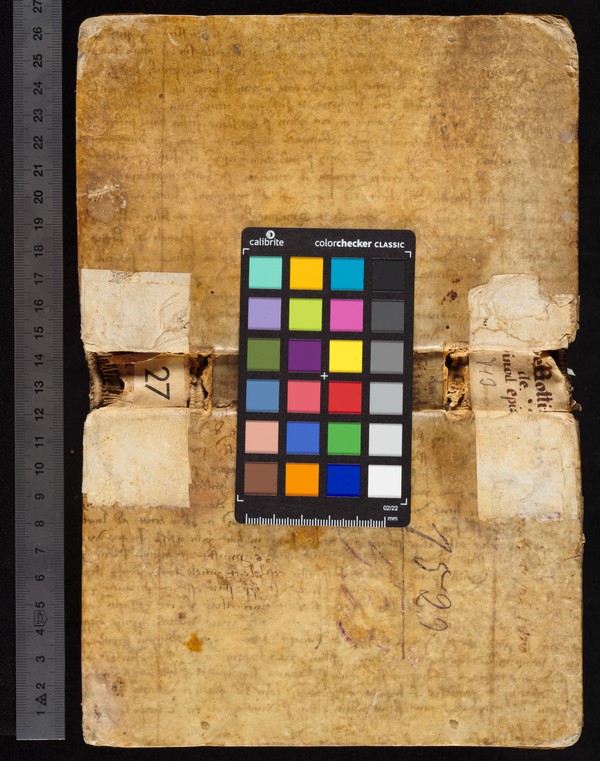
F-3wqe: Eberhard of Béthune, Graecismus, XIX 118-121
The lower of two written parchment strips in the spine of a sixteenth-century binding carries the middles of four consecutive verses of the Graecismus of Eberhard of Béthune, a Latin verse grammar of about 1200 that was a standard school text. The verses are chapter XIX, lines 118-121, on forms of the verbs redimo and como. The upper strip, in a small cursive hand with scholastic vocabulary, is not identified.
The Fragmentarium record describes Orselina-Locarno, Biblioteca Madonna del Sasso, MdS 58 Ba 27: two parchment spine strips (Frammento 2, 33 x about 80 mm, in a chancery minuscule; Frammento 3, 41 x about 80 mm, in a textualis), Italy (?), fourteenth century, titled "Unidentified philosophical (?) text". They line the spine of a volume of two Lyon law books of 1529 and 1533. The description suggests that one scribe wrote a main text (Frammento 3) and a commentary (Frammento 2) in two scripts, and prints the first and last words it could read; for Frammento 3 these are "ex se relig[...]" and "[...]es dicas g[...]le[...]", which are the words of verses 118 and 121. The record names no text. For the lower strip the title should be grammatical, not philosophical.
- Identification: identified, high, for the lower strip (Frammento 3) only. Each of its four lines is the middle of one verse, and the four verses follow one another in the edition: "ex se reliq-" (118), "orno como s-" (119), "-das huic quoque s-" (120), "-es dicas gale-" (121). No other text was found with these word groups; searches of the Corpus Corporum Latin text collection, Google Books and the Internet Archive for the phrases of single lines returned nothing else that fits the four lines together. Where the edition records a variant that the strip can show, verse 118 has "ex se", not the "in se" of one manuscript. The upper strip (Frammento 2) is unidentified. That it is commentary on the Graecismus is a guess from its place beside the verse text and from the catalogue's observation about the hand; no commentary on the Graecismus was compared. The commentaries of Thomas Aquinas on Physics III-IV and Metaphysics XI were searched for its phrases and do not contain them.
- Transcription: image-only first reading, which gave separate words and no connected text, and a source-assisted reading. A research reader reread all four lines of the lower strip and all seven lines of the upper strip on enlarged crops of the image. With the edition in view three lines of the lower strip changed: line 2 became "orno como", line 3 "-das" in place of "satis", and line 4 "gale-". The upper strip is read only as word groups, several of them doubtful. Accuracy has not been measured.
- Verification: a research reader compared the four lines of the lower strip with the machine-read (OCR) text of the Internet Archive scan of Wrobel's edition, not with the page image, and took the variants from the OCR text of the apparatus on the same page. The coordinator read the four lines of the lower strip ("-t ex se reliq-", "orno como s-", "-das huic q(uo)q(ue) s-", "-es dicas g[a]le-") on an enlargement of canvas 2, native box 3100,4000,4290,5250, against the page image of p. 186 of Wrobel's edition, verses 118-121; the upper strip was not checked. Gaps: only a slice about 23 mm wide of each strip is visible; no manuscript of the Graecismus was collated; the upper strip was compared with no candidate that fits. No human review.
Textual evidence
Manuscript image: mds_58Ba27_phyb (canvas 2, 5407 x 7982 pixels), which shows the exposed spine. The lower strip is in the native-pixel box 3100,4000,4290,5250, the upper strip in 3100,2155,4290,3432. Only the part of each strip that was once stuck to the spine can be seen, a slice about 23 mm wide, so every line is cut at both ends. Abbreviations are resolved in parentheses; square brackets mark what is cut away or damaged; a question mark marks a doubtful reading. In the right-hand column the words the strip preserves are in bold.


| Lower strip (Frammento 3) | Graecismus XIX, ed. Wrobel, p. 186 |
|---|---|
| 1: [...]t(?) ex se reliq[...] | 118 Hoc redimitus habet ex se, reliquumque redemptus. |
| 2: [...] orno como s[...] | 119 Como dum crines orno, como splendeo dicas, |
| 3: [...]das huic q(u)oq(ue) s[...] | 120 Huic comis subdas, huic quoque subde comas. |
| 4: [...]es dicas g[a]le[...] | 121 Comentes homines dicas galeasque comantes. |
In the letters that survive the strip does not differ from the edition. The letter before "ex" in line 1 is cut and doubtful; in line 4 the a of "gale-" is damaged. Wrobel's apparatus on the page records that one manuscript (P) has "habet in se" in verse 118 where the others have "habet ex se"; the strip has "ex se". The variants recorded for verse 119 (cum or dum, dico or dicas) fall in parts of the verse that the strip does not preserve. In line 4 the strip has "]es dicas gale[", that is, a word ending in -es before "dicas", which agrees with the order "homines dicas" of the edition's text. The four verse lines are set far apart, with more blank parchment between them than the height of the writing; this is an observation about the layout only.
Edition: Eberhardi Bethuniensis Graecismus, ed. Johannes Wrobel (Breslau 1887), chapter XIX (De verbis mixtis), verses 118-121, p. 186. The attribution to Eberhard of Béthune (died about 1212) is the edition's and was not examined further.
The upper strip and the leaves
The upper strip (Frammento 2) has seven lines in a small, heavily abbreviated cursive. The word groups read are "s(u)b(stanti)a" (line 1), "sicut albu(m)?" (line 2), "(con)tingit?" or "attingit?" and "s(u)b(stanti)am?" (line 3), "sig(nifica)re" (line 4), "s(u)b(stanti)am inf[...]" (line 5), "infinita f(or)ma?" (line 6) and "actu inf[...]" (line 7). No connected clause was recovered and no text was found that has these phrases in sequence. Grammarians used "infinita" of a substance left indefinite, so the vocabulary would suit a commentary on a grammar; that is the whole basis of the guess that the strip glosses the Graecismus, and it is no more than a guess.
Whether the two strips come from one leaf is open. The catalogue notes letter forms shared by the two scripts and suggests one scribe writing text and commentary; nothing here tests that. The other two images of the record, mds_58Ba27_ProfilE and mds_58Ba27_phya, show the cover, an erased charter that is not part of this record; no text of the strips is legible on them.


Not claimed: the date and origin, which are the catalogue's; the identity of the upper strip; that the two strips are one leaf or one book; any relation of the strip's text to a particular manuscript or family of the Graecismus; whether the parts of the strips that wrap onto the boards carry more text.