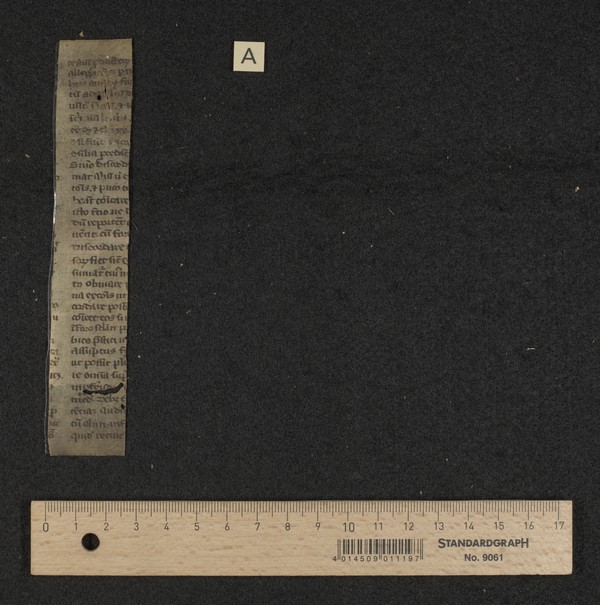

F-a07w: Aegidius de Fuscarariis, Ordo iudiciarius, cc. LXIX-LXX
The two parchment pieces are identified with high confidence as parts of one leaf of the Ordo iudiciarius of Aegidius de Fuscarariis (died 1289), a Bolognese canonist. An ordo iudiciarius is a manual of court procedure, here for church courts, with model forms for each step. The pieces carry the second half of chapter LXIX, "Conclusio causae" (how the judge consults his assessors and pronounces sentence), and the opening of chapter LXX, the model text of a final sentence given by the archpriest of Bologna in a marriage case.
The Fragmentarium record describes Antwerpen, Erfgoedbibliotheek Hendrik Conscience, Fragm. 140 a-b: four parchment strips, three of them contiguous and joined with tape, 139 x 24 mm, in Northern Textualis, dated 1301-1325, catalogued as an "Unidentified canon law text" with no further description. The subject label fits in the broad sense that the work was written by a canonist for ecclesiastical courts; it is a procedural manual, not a text or commentary of the Corpus iuris canonici. The record names neither author nor work. The catalogue date has not been reassessed.
- Identification: identified, high. All four faces agree with Ludwig Wahrmund's edition in wording and sequence over about 33 manuscript lines to a column, each line being a part of the column's width. The agreement covers the author's own connecting prose and opinions ("Et puto equum quod primi duo debeant communicare salarium eorum cum isto tertio, ne de ipsorum dolo commodum reportent"), the legal citations in their order, the chapter rubric in red, and the model sentence naming the archpriest of Bologna. The matched layer is therefore the work itself and not a source it quotes. Guilelmus Durantis's Speculum iudiciale, which treats the same two subjects in the same order, and Bernardus Dorna's Summa libellorum, which has a similar rubric, were considered from the subject only and set aside once this text matched; neither was collated. Differences from the edition's text are few and are listed below; several coincide with variants recorded in the edition's apparatus.
- Transcription: source-assisted selected reading of the lines collated. The image-only first reading covers every line of the four faces and had many words right or nearly right; a research reader reread all lines on enlarged images with the edition at hand, corrected them and expanded the abbreviations from it. The first eight lines of each face of strip A are rubbed and their reading leans on the edition. Accuracy has not been measured.
- Verification: a research reader compared the four manuscript faces with page images of Wahrmund's edition, pp. 124-126, text and apparatus. The coordinator read on the images of strip A, on the face labelled recto, isto tertio ne d / dum reportent / uerent cum for / discordare / sumatur cuius m / to obuiare p / na excommunicationis ut / cordare poss / excommunicet eos si / in foro seculari p / bito prestiti iu / assumptus / ut possit ple, and on the face labelled verso exemplum / quentius occurrit in / per istam et habebis for / (red) Qualiter formari debeat / Nos (red) diffinitiua / ardus archipresbiter (red) sententia / episcopi bononiensis cog / que uertitur inter Jo. / mulierem ex altera / ponatur totus libellus, and read p. 125 of the edition, with apparatus notes 2 and 21, on its page image (https://iiif.archive.org/iiif/p1p2quellenzurge03wahr$177/full/1100,/0/default.jpg); pp. 124 and 126 were not seen by the coordinator. Gaps: on the face of strip A labelled verso, lines 8, 12, 24 and 31-33 were read only in part and are not relied on; the one- or two-letter line ends of a neighbouring column on fragm. A recto were not identified. The edition's seven manuscripts were not consulted. No human review.
Textual evidence
Manuscript images: fragm. A recto, native-pixel box 170,130,530,1810; fragm. A verso, box 140,130,540,1810; fragm. B recto, box 130,130,530,670; fragm. B verso, box 130,130,530,670. Abbreviations are resolved silently; a slash marks a manuscript line break; square brackets mark text lost at the cut or not read; a question mark marks an uncertain reading. Each manuscript line is only part of a column's width, so the table sets the surviving words against the continuous text of the edition.


| Fragm. 140 a-b | Wahrmund's edition |
|---|---|
| A recto lines 1-9, line beginnings, with B verso lines 1-9, line ends of the same lines: "testium productorum [...] principali(?). debet(?) etiam uide[re] / allegationes parti[um] diligenter ut ex / hiis omnibus fo[r]ment(?) [...] mo/tum a[...]andum. ut extra de re/nunt.(?) [...] et ii[i]i. q. iii. item(?) / in criminali(?) [...] Nam iudicant/em oportet [...] q. ult. iudicantem / et si fuerint(?) in c[oncor]dia sequendo ipsorum / consilia(?) proced[at a]d sententiam in nomine d[omini]" | p. 124: "et dicta testium productorum in principali. Debent etiam videre allegationes partium diligenter, ut ex his omnibus forment motum animi sui ad consilium dandum, ut Extra, de renuntiatione, c. in nostra et IIII. q. III. item in criminali, circa princ. Nam iudicantem oportet cuncta rimari, XXX. q. ult. iudicantem. Et si fuerint in concordia, iudex sequendo ipsorum consilium procedat ad sententiam in nomine domini." |
| A recto lines 10-22, line beginnings: "Si uero discord[...] / mat alium ut ex[...] / tionis. et puto e[...] / beant(?) communicare [...] / isto tertio ne d[...] / dum reportent q[...] / uerent. cum for[...] / discordare [...] / sorum sicut se[...] / sumatur. cuius m[...] / to obuiare p[...] / na excommunicationis ut [...] / concordare poss[...]" | pp. 124-125: "Si vero discordaverint, iudex assumat alium, ut Extra, de officio delegati, c. suspitionis cum suis similibus. Et puto aequum, quod primi duo debeant communicare salarium eorum cum isto tertio, ne de ipsorum dolo commodum reportent, quod esset, si partes solverent, cum forsitan fingant, se discordare, ut ad excusationem ipsorum, sicut saepe vidi fieri, tertius assumatur. Cui malitiae iudex potest cito obviare, praecipiendo eis sub poena excommunicationis, ut dicant veritatem, si concordare possunt." |
| A recto lines 23-33, line beginnings: "excommunicet eos si [...] / in foro seculari p[...] / bito prestiti iu[...] / Assumptus f[...] / ut possit ple[...] / re omnia sup[...] / in proferend[is ...] / modum. Debet e[...] / tentiam audi[...] / cum olim. in f[...] / quidam retine[...]" | p. 125: "Et si opus fuerit, excommunicet eos, si non dixerint veritatem. In foro saeculari poterit hoc praecipere sub debito praestiti iuramenti. Si autem tertius assumptus fuerit, inducias habeat, ut possit plene videre et examinare omnia supradicta. Iudex autem in proferendis sententiis retineat istum modum. Debet enim partes citare ad sententiam audiendam, Extra, de testibus, c. cum olim, in fine cum similibus. Partibus vero praesentibus quidam retinent istum modum, ut in praesentia" |
| B recto lines 1-9, line beginnings, with A verso lines 1-9, line ends of the same lines: "Astantium summatim [...] recitant factum(?) / quod non credo exped[ire] et postmodum(?) le/gunt sententiam et n[...] hoc seruatur Bon[...] / in aliquo for[o ...] dico(?) quod pa[rti]/bus presentibus d[ebet] ipse iudex ore / proprio ferre sententiam et legere. ut extra de / ap. preterea. et non comm[...] sicut(?) qui/dam faciunt et male(?) [...] / sint(?) plures iud[i]ces omnes legant" | p. 125: "astantium summatim recitant factum, quod non credo expedire, et postmodum legunt sententiam. Nec de facto hoc servatur Bononiae in aliquo foro. Unde dico, quod partibus praesentibus debet ipse iudex ore proprio ferre sententiam et legere, ut Extra, de appellationibus, c. praeterea, et non committere alteri, sicut quidam faciunt et male, ut dixi. Et si sunt plures iudices, omnes legant" |
| A verso lines 10-23, line ends: "[...] credo sufficere quod / [...] presentibus. ad hoc(?) / [...] / [...] exemplum pri[...] / [...]quentius occurrit in / [...] per istam et habebis for[...] / (red) [...]aliter formari debea[t] / [...]. Nos (red) diffiniti[ua] / [...]rdus archipresbiter (red) senten[tia] / [...] episcopi Bononiensis. Cog[...] / [...]ue uertitur inter Jo. / [...] mulierem ex altera / [...] Singardo(?) a[...] / [...]atur totus libellus" | pp. 125-126: "Alias credo sufficere, quod unus legat aliis praesentibus; ad hoc faciunt, quae notantur Extra, de probationibus, c. quoniam contra. Forma vero sententiae erit haec. Et ponamus prius exemplum de causa matrimoniali, quae frequentius occurrit in foro ecclesiastico, et per istam habebis formam etiam aliarum. LXX. Forma sententiae diffinitivae [apparatus: B. Qualiter formari debeat diffinitiva sententia]. In dei nomine amen. Nos magister Sinigardus, archipresbyter Bononiensis et vicarius domini episcopi Bononiensis, cognitor causae matrimonialis, quae vertitur inter Jo. ex una parte et B. mulierem ex altera, quae talis erat: Coram vobis magistro Sinigardo, archipresbytero Bononiensi etc., et ponatur totus libellus." |
| A verso lines 25-30, line ends: "[...]to(?) de ueritate di[...] / [...] parte dicte mulieris(?) / [...]enter exami[...] / [...]niter publica[...] / [...]sionibus(?) / [...] factis. renuncia[...]" | p. 126: "praestito etiam iuramento de veritate dicenda et testibus pro parte mulieris productis et eis prudenter examinatis ac sollempniter publicatis, visis etiam positionibus et responsionibus hinc inde factis, renuntiatis deinde probationibus producendis" |
Differences. The fragment's rubric is "Qualiter formari debeat diffinitiua sententia" where the edition prints "Forma sententiae diffinitivae"; the edition's apparatus gives the fragment's wording as the rubric of its manuscript B (Bamberg, Staatsbibliothek, can. 86). The fragment reads "cuius malitie" for "Cui malitiae" (so the edition's manuscripts M and V), "et habebis" for "habebis", and, as read, "pro parte dicte mulieris" for "pro parte mulieris" (so the edition's P) and "consilia" for "consilium". Between "suspitionis" and "et puto" the lost part of the line has no room for "cum suis similibus", which the early printed edition also omits according to the apparatus; between "concordia" and "sequendo" there is little or no room for "iudex", which the edition's O and P omit. "Debet" for "Debent" in the first line and "sint" for "sunt" are uncertain readings. These coincidences with single witnesses are recorded as observed; they have not been tested against a fuller collation and no claim is made about the fragment's place in the tradition.
The edition compared is Aegidius de Fuscarariis, Ordo iudiciarius, ed. Ludwig Wahrmund, Quellen zur Geschichte des römisch-kanonischen Processes im Mittelalter, vol. III part 1 (Innsbruck 1916), p. 124, p. 125, p. 126, read as page images in the Internet Archive copy. The attribution rests on Wahrmund's edition, which establishes the text from seven manuscripts and an early print whose titles name "Egidius de Fuscarariis, civis Bononiensis, doctor decretorum", and which dates the work to the years after 1262 in its introduction; the introduction was consulted in the scan's machine-read text, and later scholarship on the author was not consulted. The forms themselves point to Bologna: the model sentence is given by "magister Sinigardus, archipresbyter Bononiensis", and the chapter twice cites Bolognese practice.


The leaf, the labels and limits
The two pieces belong to one leaf written in two columns. Fragm. B verso carries the ends of the first nine lines whose beginnings are on fragm. A recto, and fragm. B recto carries the beginnings of the first nine lines whose ends are on fragm. A verso; the catalogue's recto and verso labels for piece B are thus opposite to those for strip A with respect to the original leaf. Piece B has blank parchment above its first line and strip A blank parchment below its last, so top and foot of the column survive, and where both pieces are present only two to four letters are missing between them. The column on fragm. A recto ends "quidam retine[nt istum modum ut in presentia]" and the column on fragm. A verso begins "Astantium summatim", so the two columns are consecutive. Fragm. A recto also has one or two letters from the line ends of a column to its left, which would make its main column the second column of the recto and the column on fragm. A verso the first of the verso; those letters were not identified. A red bracket-shaped stroke stands in the space to the right of the column on fragm. A verso.
No claim is made about the date or origin of the leaf, about the manuscript it came from or the book it was later used to bind, about its relation to the manuscripts used for the edition, or about its value as a witness to the text.