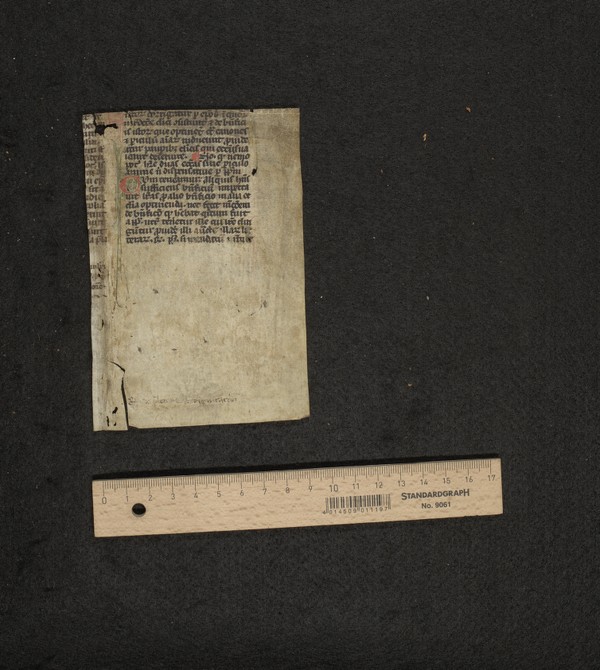
F-au0s: Bernard of Parma, Casus longi on the Decretals, book III
The fragment is identified with high confidence as the Casus longi super quinque libros Decretalium of Bernard of Parma (Bernardus Bottonius, d. 1266): the casus on X 3.4.11–12 on one face and on X 3.5.5–6 on the other. Selected lines on both faces agree in wording and sequence with the casus printed beside those chapters in a glossed edition of the Decretals. It is a run of casus one after another, without the decretal text or the gloss.
The Fragmentarium record describes a parchment fragment, Antwerpen, Erfgoedbibliotheek Hendrik Conscience, Fragm. 358, 138 × 94 mm, dated 1276–1325, catalogued as an unidentified commentary on the Decretals of Gregory IX. Those catalogue details have not been reassessed.
- Identification: identified, high. The basis is consecutive casus prose on two faces, including the transitions from one chapter's casus to the next. Material alternative: another work that copies Bernard's casus word for word; none is known to us, and later commentators who quote this casus (Panormitanus on X 3.5.6) surround it with their own commentary, which the fragment lacks.
- Transcription: source-assisted selected reading, sixteen lines of one face and parts of fifteen of the other, read by a model with the printed text to hand. The image-only reading recovered little and misread the opening lemma. Accuracy has not been measured.
- Verification: the manuscript images were compared with the OCR text of the printed edition by one model; the printed page images were not opened. A standalone printed Casus longi was not collated. No human review.
Textual evidence
Manuscript lines are from the reading linked above; parentheses expand abbreviations. The edition is Decretales D. Gregorii Papae IX ... cum glossis in the Turin 1588 printing of the Roman Corpus iuris canonici (archive.org scan, book III, titles 4–5, around printed column 1147), quoted from its OCR with long s and abbreviations normalised.
| Manuscript | Printed casus |
|---|---|
| [Canvas labelled fol. [1]r](https://fragmentarium.ms/loris/F-au0s/fol_1v.jp2/full/full/0/default.jpg), lines A1–A8: "... corrigatur per episcopos in quorum [iuris]dictione? clerici consistunt et de beneficiis istorum que optinent contra canones et periculum animarum inducunt provideatur pauperibus clericis qui ecclesiis valeant deservire. Nota quod nemo potest habere duas ecclesias sine periculo anime nisi dispensative per papam." | Casus on X 3.5.5 Quia in tantum: "... praecipit Lateranense concilium quod ambitio istorum corrigatur per episcopos in quorum iurisdictione clerici consistunt, et de beneficiis istorum, que obtinent contra canones et periculum animarum inducunt, provideatur pauperibus clericis, qui ecclesiis valeant deservire. Nota quod nemo potest habere duas ecclesias sine periculo anime nisi dispensative per Papam." |
| Same face, lines A9–A16: "Cum teneamur. Aliquis habens sufficiens beneficium impetravit litteras pro alio beneficio in alia ecclesia optinendo, nec fecit mencionem de beneficio quod habebat. Quesitum fuit a papa utrum teneretur ille cui littere diriguntur providere illi auctoritate illarum litterarum. Respondet papa: si mandatum ..." | Casus on X 3.5.6 Cum teneamur: "Aliquis habens sufficiens beneficium impetravit literas pro alio beneficio in alia ecclesia obtinendo, nec fecit mentionem de beneficio quod habebat: quesitum fuit a Papa utrum teneretur ille cui litere diriguntur providere illi auctoritate illarum literarum? Respondet Papa, si mandatum nostrum receperis ..." |
| [Canvas labelled fol. [1]v](https://fragmentarium.ms/loris/F-au0s/fol_1r.jp2/full/full/0/default.jpg), lines B4–B10: "... compesci non poterit cardinalis apostolice sedis legatus removeat eos ab administracione suarum ecclesiarum et ecclesiis illis de personis idoneis faciat provideri. Sed eos non deponat ut cum eis si expedierit misericorditer agi possit." | Casus on X 3.4.11 Ex tuae devotionis: "... et si eorum malitia sic compesci non poterit, cardinalis Apostolice sedis legatus removeat eos ab administratione suarum ecclesiarum, et ecclesiis illis de personis idoneis faciat provideri: sed eos non deponat, ut cum eis, si expedierit, misericorditer agi possit." |
| Same face, lines B11–B16: "[Nota quod] qui non comparet apud domicilium ... expectatur per vi menses. Item argumentum quod cum deposito non fit ... Quidam clerici obti[nuerunt]" | Same casus, continuing: "Nota quod qui non apparet, apud domicilium suum debet citari trinis edictis, et antequam ... debet expectari per sex menses. Item argumentum quod cum deposito non sit dispensandum." The next casus (X 3.4.12) opens "Quidam clerici obtinuerunt indulgentiam ..." |
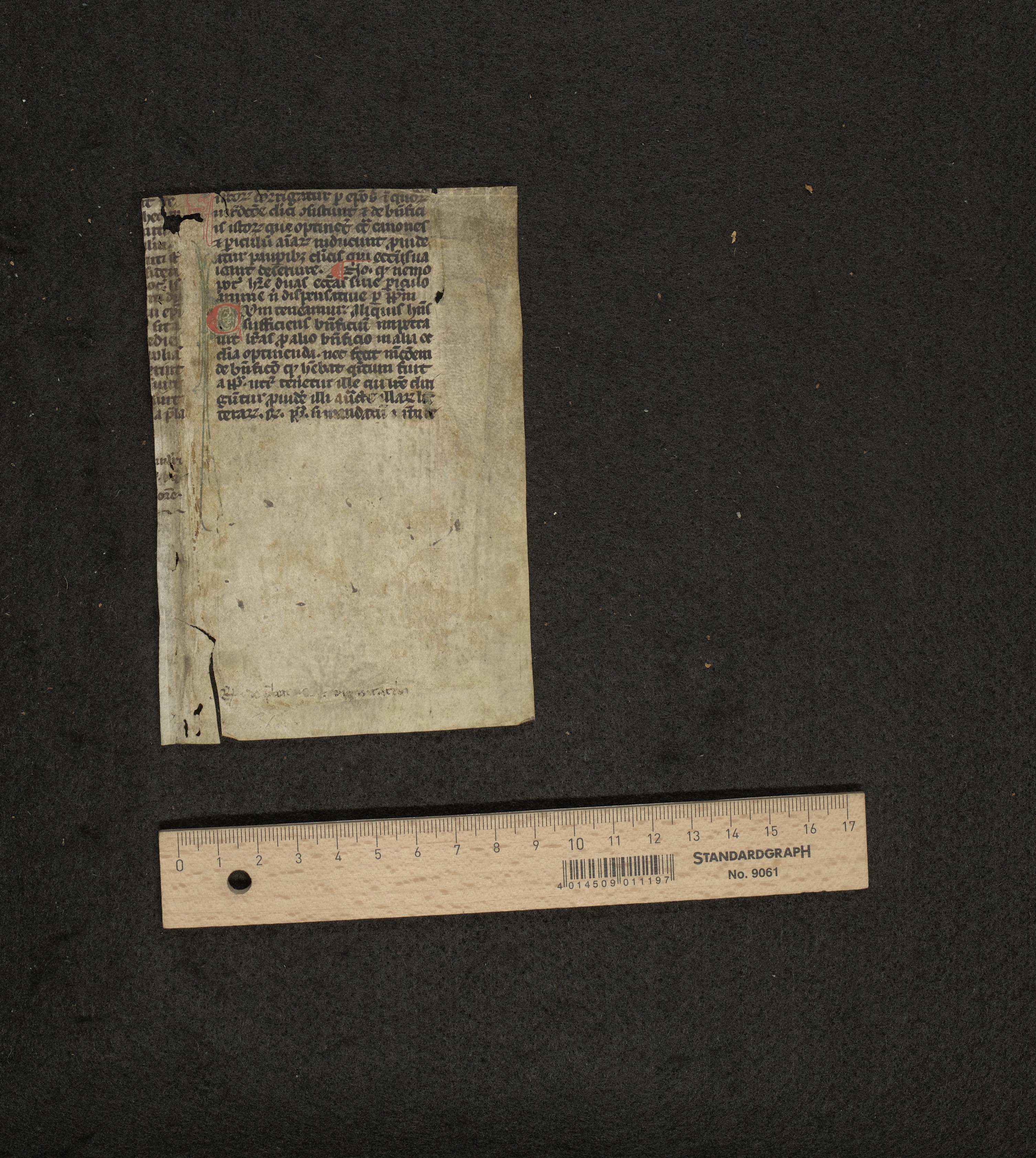

Differences noted: the manuscript has comparet where the print has apparet, and fit where the print has sit; line A2 is damaged. The rubric and decorated initial that open the next casus on the second face were not read. One column separates the two matched stretches, which is consistent with the casus on X 3.4.12–3.5.5 standing between them, but that intervening text is lost and the leaf order rests on this inference alone. The file names of the two images (fol_1v, fol_1r) are the reverse of their manifest labels; the text order agrees with the file names.
Edition and attribution
The casus printed with the gloss in the Roman edition of the Decretals are those of Bernard of Parma, the author of the ordinary gloss, whose Casus longi also circulated and was printed separately (Paris 1475, Venice 1477, Strasbourg 1488 and later, as listed in the Catholic Encyclopedia article on Bernard). That standard ascription is the basis for the author's name here. The comparison was made with the casus as printed beside the decretals, not with a separate Casus longi edition or manuscript, so nothing is claimed about recension. The fragment's form, casus following casus with no decretal text, is that of the separate work.
Not examined: the slivers of the neighbouring columns, the marginal notes, and the date or origin of the hand.