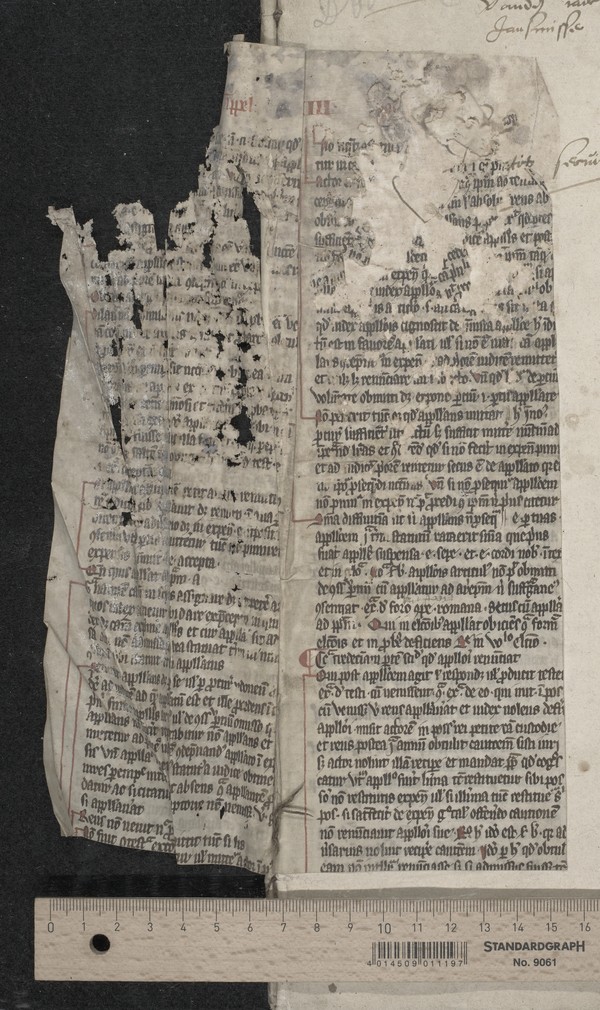
F-cckq: Tabula utriusque iuris attributed to Johannes de Erfordia, article "Appellatio"
The leaf is identified with high confidence as part of the article "Appellatio" in the Tabula utriusque iuris, an alphabetical repertory of canon and civil law attributed to the Franciscan Johannes de Erfordia. Three passages, two of them consecutive, agree with a fourteenth-century manuscript of the work at the same point of the article, on how an appeal is tacitly renounced. The leaf does not carry the same form of the text as that manuscript: wording, citations and the surrounding material differ.
The Fragmentarium record describes part of a parchment leaf, Leuven, Rijksarchief, 248 × 175 mm, dated 1250–1300, catalogued as an unidentified canon law text. The work's initial version is usually dated to about 1285, within the later part of the catalogue's range; the date of the leaf has not been reassessed here.
- Identification: identified, high, for the work and article; the recension is open. The matched passages share extended case discussions, a chain of citations and source sigla ("hoc b.", "Jo.", "In."). This identifies the text family; individual cases may themselves derive from earlier canonistic sources. Both witnesses have the same layout of bracketed distinctions and the same style of cross-reference ("Require in vocabulo electio" on the leaf). Alternatives opened on page images and excluded: Monaldus's Summa (Vatican, Pal. lat. 695) and the short "Appellatio" of Vatican, Pal. lat. 804, a manuscript catalogued under the same author and title whose article is nine lines of maxims. That manuscript shows that texts under this name differ widely, so the attribution should be read as the catalogues' label for this family of text.
- Transcription: image-only first reading by an isolated reader and a source-assisted selected reading. The left column of the recto is torn and was read with low confidence throughout. Accuracy has not been measured.
- Verification: a research reader read ff. 26r–31v of the Bremen manuscript from its page images and compared three passages; the coordinator compared the first passage, about fourteen lines, on the fragment image and the Bremen page image. The research reader then placed most of the recto in the same manuscript at f. 26r and checked the renunciation passage in a second manuscript at Bruges; the coordinator did not repeat those two checks. Codex also compared the renunciation passage on the fragment with Leipzig, Universitätsbibliothek, Ms 885, f. 22r, on page images. No edition was used. No human review.
Textual evidence
Manuscript images: [fol. [1]r](https://fragmentarium.ms/loris/F-cckq/RA_Leuven_20210901b_0016_KAB_1132.jp2/full/full/0/default.jpg) and [fol. [1]v](https://fragmentarium.ms/loris/F-cckq/RA_Leuven_20241106a_0016_KAB_1132.jp2/full/full/0/default.jpg). Abbreviations are resolved silently; square brackets mark text lost or not read.


| Fragment | Bremen, SuUB, msa 0137, f. 27v |
|---|---|
| verso, native-pixel box 121,1227,1210,2362: "... ipsum irrevocabiliter fuisse ligatum. e. sollicitudinem. Si post appellationem redit ad delegatum [...] Secus in ordinario [...] si aliquis appellavit ad papam et postea rediit ad ordinarium pro alia causa super qua non appellavit non per hoc videtur renunciasse appellationi cum ille adhuc iudex suus ordinarius in aliis causis sit. e. cum teneamur. Quando autem appellatur a delegato tunc nulla remanet ei iurisdictio. e. ut debitus. Unde si redit ad delegatum renunciare videtur appellationi. Jo. In. Si excommunicatur ab aliquo iudice appellans petit absolutionem cum protestatione quod salva sit sibi appellatio non videtur renunciasse appellationi cum in ea sit periculum. ex. de sen. ex. sacro. Sed si sine protestatione peteret absolvi renunciare videtur. Alii dicunt quod iudex a quo appellavit numquam potest absolvere nisi appellans renunciet appellationi." | left column, lower half: "... ipsum irrevocabiliter fuisse ligatum. e. sollicitudinem. Si post appellationem redit ad delegatum. ex. de of. del. gratum. Secus in ordinario. Unde si aliquis appellavit ab episcopo et postea redit ad episcopum pro alia causa super qua non appellavit non intelligitur per hoc renuntiare appellationi cum ille adhuc sit iudex suus in aliis causis. e. cum teneamur. Quando autem appellatur a delegato tunc nulla remanet iurisdictio ei. Unde si redit ad delegatum renuntiare videtur appellationi. Nota secundum In. si excommunicatur ab aliquo iudice appellans petit absolutionem cum protestatione quod salva sit sibi appellatio non videtur renuntiasse appellationi cum in ea sit periculum. ex. de sen. ex. sacro. [...] sine protestatione peteret absolvi renuntiare videretur. Hoc In. et Ht. [...] Alii dicunt quod iudex a quo appellavit numquam potest ipsum absolvere nisi appellans renuntiet appellationi." |
| verso, continuing, box from 121,2142: "Quando compositionem acceptat. ex. de el. cum inter. Jo. Si aliquis in causa appellationis vadit ad arbitros non propter hoc renuntiavit appellationi, immo postea potest prosequi appellationem nec currit ei tempus interim. C. de temp. ap. In aut. si tamen. Hoc b. ex. de renun. veniens. Si aliquis appellavit a sententia et postea solvit id in quo condempnatus fuit, si hoc fecit necessitate iudicis tunc repetere potest solutum tamquam indebitum si in causa appellationis pro ipso sententiatum fuit. Sponte, sic non potest repetere quia videtur renuntiasse appellationi. ff. e. cum ex causa. in tex. et in glo. Jo." | right column, top: "Quando compositionem acceptat. ex. de el. cum inter. Nota si aliquis in causa appellationis vadit ad arbitros non renuntiat propter hoc appellationi, immo potest prosequi appellationem nec currit ei tempus interim. C. de tem. app. In aut. si tamen. Hoc b. ex. de renuntia. veniens. Si aliquis appellavit a sententia et postea solvit in quo condempnatus fuit, si hoc fecit necessitate iudicis tunc repetere potest solutum tamquam indebitum si in causa appellationis pro ipso sententiatum fuit; sponte, sic non repetet quia videtur renuntiasse appellationi. ff. e. cum ex causa." |
| recto, right column, foot, box about 1050,2230,2076,3100: "... appellationi renuntiat qui post appellationem agit vel respondet vel producit testes. ex. de testi. cum venissent. Contra ex. de eo qui mit. in pos. cum venissent, ubi reus appellaverat et iudex nolens deferre appellationi misit actorem in possessionem rei petite causa custodie et reus postea infra annum obtulit cautionem sisti iuri sed actor noluit illam recipere et mandat papa quod cognoscatur utrum appellatio fuit legitima [...] ergo talem offerendo cautionem non renuntiavit appellationi sue. Responsio: hoc ideo est secundum b. quia adversarius noluit recipere cautionem ..." | left column, upper half: "appellationi renuntiat qui post appellationem agit vel respondet vel testes producit. ex. de test. cum venissent. Contra ex. de eo qui mit. in pos. cum venissent, ubi reus appellaverat et iudex nolens deferre appellationi misit actorem in possessionem rei petite causa custodie et reus postea infra annum obtulit cautionem sisti iuri sed actor noluit illam recipere et mandat papa quod cognoscatur utrum appellatio fuit legitima [...] ergo talem offerendo cautionem non renuntiat appellationi. Responsio: hoc ideo secundum b. quia adversarius noluit recipere cautionem ..." |
The third passage precedes the first in the Bremen manuscript, as the recto precedes the verso on the leaf, so the order of the two faces agrees with the order of the article. The rest of the recto's right column, as the research reader compared it, stands earlier in the article, on Bremen f. 26r, right column, in the same order: "sufficit mittere nuncium", "secus de appellato quia ei non imponitur prosequendi necessitas", "appellationis articulus non potest omitti de consensu partium ... nisi suffraganeus consentiat", "Qui in electione appellat ... Require in vocabulo electio". The middle of the recto's left column corresponds to f. 26r, left column; its foot is too damaged for a line-by-line check.
Differences between the witnesses
The leaf is not a copy of the Bremen text. Where Bremen has "appellavit ab episcopo et postea redit ad episcopum" the leaf has "ad papam ... ad ordinarium", which changes the case put; it has videtur renunciasse for intelligitur renuntiare; it adds two citations ("e. ut debitus", and, as the research reader read it, "ex. de testi. cum venissent"); and it marks opinions with the sigla "Jo." and "In." where Bremen writes "Nota secundum In." and "hoc In. et Ht.". The order also differs: on the leaf "Require in vocabulo electio" is followed at once by the renunciation section, while in Bremen about three columns stand between; one Bremen sentence in the matched stretch ("Quid si in libello appellationis non petuntur apostoli ... hoc Gwil.") is absent from the leaf. After the second passage the two diverge: Bremen continues "Utrum autem excommunicatus ...", the leaf "Aut appellatur super causis maioribus ...", which was not located in the inspected Bremen article. This is a negative search result, not proof of absence.
A second witness, Bruges, Grootseminarie, Ms. 46/57 (fourteenth century, from Ter Doest; IIIF manifest), was read by the research reader at the renunciation passage, f. 31v. It agrees with Bremen against the leaf in every one of the readings above, and it adds sentences citing the Liber Sextus that Bremen lacks. So three states of the text are visible: the leaf, Bremen, and Bruges with additions. The leaf cites Innocent IV's constitutions without reference to the Sext, which fits a text earlier than 1298 but does not prove it; whether the leaf is an earlier redaction or a reworked or abridged copy was not decided.
A third witness, Leipzig, Universitätsbibliothek, Ms 885, f. 22r, left column, provides a test of the early-redaction hypothesis. Its renunciation sequence agrees with the leaf from "Si post appellationem ..." through the cases of absolution, settlement, arbitration and payment after judgment. But Leipzig reads "ab episcopo ... ad episcopum", like Bremen, rather than the leaf's "ad papam ... ad ordinarium". It also lacks "e. ut debitus" at the corresponding point. After the payment case it discusses the appellate judge's jurisdiction ("ad quem appellatum ... extra ... iurisdictionem"), rather than the leaf's "Aut appellatur super causis maioribus". These are selected image comparisons, not a complete collation. Kurtscheid explicitly assigns Leipzig Ms 885 to the first redaction (p. 280), so the leaf's distinctive readings cannot be explained simply by contrasting an early text with the Bremen and Bruges copies. Its recension remains unresolved.

The work and its attribution
The witness is Bremen, Staats- und Universitätsbibliothek, msa 0137, fourteenth century, from the Bremen Franciscans, catalogued as Johannes de Erfordia, Tabula iuris utriusque. The attribution here is that catalogue's; no ascription was looked for in that manuscript. The Bruges catalogue quotes its copy as a "tabula iuris canonici et civilis cum novis addicionibus ... a fratre Iohanne alemanno", with an explicit naming "Iohannem de Saxonia". The Neue Deutsche Biographie dates the Tabula probably to 1285, with an enlarged form after 1304 and before 1317. B. Kurtscheid, "Die Tabula utriusque iuris des Joh. von Erfurt", Franziskanische Studien 1 (1914), 269–290, distinguishes the early form represented by Cues 267 and Leipzig 885, an anonymous rearrangement represented by Metz 117, and an enlarged form represented by Munich Clm 8705 (pp. 278–284). His argument for composition in 1285 rests on the Cues manuscript and the existence of the Metz copy dated 1292 (pp. 276–278). The fragment has not been collated with Cues or Metz. No claim is made about the leaf's date or origin beyond the note above.