F-cfry — Nicholas of Lyra, Postilla on Hebrews 5
- Identification: identified, high confidence. Nicholas of Lyra, Postilla litteralis super Epistolam ad Hebraeos, chapter 5. Connected explanation of the pontifical office agrees with the section explicitly headed Nicolaus de Lyra in the print.
- Transcription: selected source-assisted readings. A Codex reviewer checked selected wording in two passages against manuscript and printed images. Some abbreviations remain unresolved. No full transcription, human palaeographic review or measured accuracy assessment is claimed.
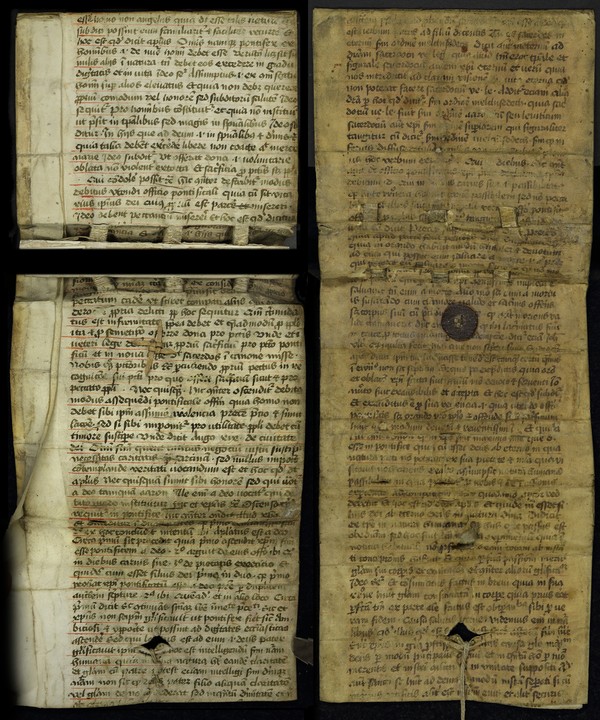
- Verification: manuscript and edition images. Upper-left and lower-left manuscript crops were compared with the lower Lyra section of edition scan n426, printed columns 841–842. Only the photographed outside of the binding was reviewed; the other catalogue image shows the same side with a colour chart.
Fragmentarium record · manifest. Image Cod4070_EB_ganzeAussenseite.jpg. Cached crops were reused without additional enhancement; exact original crop coordinates/scale were not recovered. The isolated packet is a shorter lossless selection of the upper-left crop.
Reading and diagnostic comparison
The image-only response preserves eight physical lines, the last clipped. It independently reads esse homo non angelus, cum familiaritate, Omnis namque pontifex ex, and much of the dignity/office explanation. Uncertain expansions and clipped ends remain in that record.
Selected assisted comparison text, upper crop lines 3–8. This is normalized text with expanded abbreviations, not a letter-by-letter transcription:
hoc est quod dicit apostolus. Omnis namque pontifex ex / hominibus … de numero hominum debet esse. Verumtamen licet sit si- / milis aliis in natura tamen debet eos excedere in gradu / dignitatis et in vita. Ideo … assumptus … / hominum super alios elevatus. Et quia non debet querere / proprium commodum vel honorem …
Slashes preserve represented physical divisions; ellipses omit uncertain or unchecked words. Expansions are proposed with the edition available. For comparison, the preserved image-only response records qd̄ (quod), apl̄s? (apostolus?), namqꝫ (namque), nūo (numero?), hom̄ (hominum?) and tn̄ (tamen?). These approximate signs and their uncertainty remain in that record. The normalized quotation does not resolve every abbreviation boundary or certify all its expanded letters; it must not be treated as diplomatic evidence. The biblical lemma is common evidence; the connected explanation of nature, dignity, elevation and the office-holder's proper aim carries the comparison.
The 1603 edition, scan n426, lower section headed Nicolaus de Lyra, prints the same progression under Hebrews 5:1. It phrases the preceding accessibility clause familiariter et faciliter recurrere, whereas the manuscript appears to have cum familiaritate et facilitate venire. This is not a verbatim match throughout.
An additional lower-left manuscript crop has the warning against assuming office through violencia, prece, precio et simulacione, followed by Augustine's Otium sanctum querit caritas. The same warning and ensuing quotation occur under Nec quisquam in the print. That sequence is more diagnostic than the Augustine quotation alone. Binding strips obscure portions of the manuscript; no reconstruction of those portions is certified.
Limits
The selected images support work and chapter identification. Full endpoints, every abbreviation and unread portions need their own collation. Identifying the biblical lemmata alone would not identify the commentator. The sample does not independently establish dating or provenance.