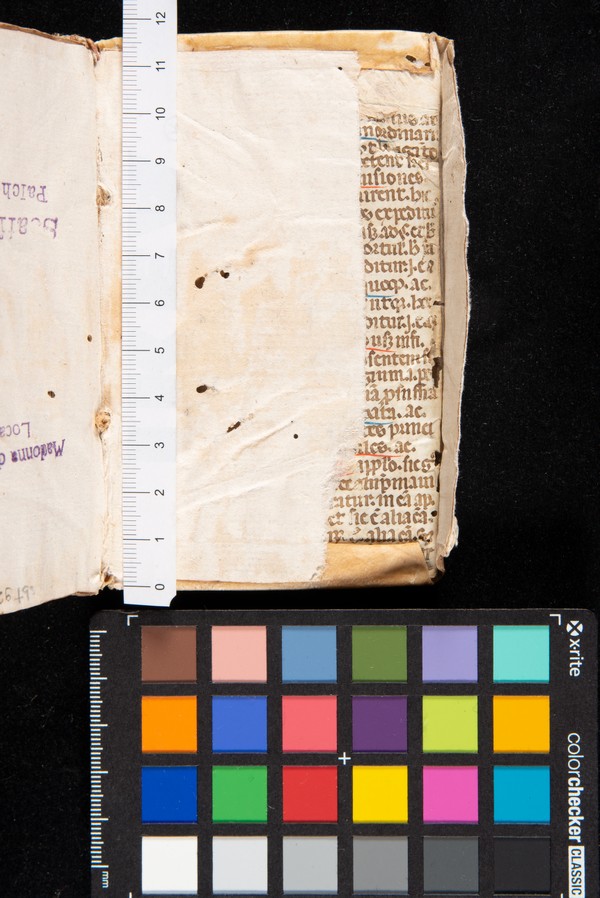
F-cjzj: Accursius, Glossa ordinaria on the Authenticum, Collatio IX, Nov. 125 (end) and Nov. 124 (rubric to c. 1)
The strip of parchment visible beside the pastedown is the gloss column of a glossed copy of the Authenticum, the Latin collection of Justinian's later laws (Novels) used in medieval law schools. The glosses are those of Accursius's standard apparatus, at the end of the constitution Ut iudices non expectent sacras iussiones (Novel 125) and the beginning of Ut litigantes iurent in exordio litis (Novel 124), in the ninth collation (the Authenticum is divided into nine parts called collations). The main text on the other face of the leaf has not been identified.
Catalogue record: Fragmentarium F-cjzj, Orselina-Locarno, Biblioteca Madonna del Sasso, MdS 63 Aa 6; part of one parchment leaf, 119 x 98 mm, Italy, dated 1301-1400, Gothic script, titled "Unidentified text with gloss", with no description. The description fits as far as it goes: this is a glossed text. The catalogue did not say that it is civil law, nor name the text or the gloss. Its date and origin were not reassessed.
- Identification: identified, confidence high, for the gloss only. Seven consecutive glosses on the strip match Accursius's gloss as printed in the 1566 Volumen legum parvum, col. 471, in the same order, with the same cross-references ("infra eodem § et hoc quoque", "usque ad finem") and with the signature "ac." (Accursius) written in the fragment after several of them. Only the ends of the lines are visible, 6 to 12 letters each, because the left part of the strip is under the paper pastedown, and one printed edition was compared, no manuscript. A gloss on the oath of calumny in the Codex (C. 2.58) was considered and set aside: the words glossed, Lites and Appellationes, are those of Novel 124 c. 1. The title and Novel numbers are those of the print (Collatio IX, titles 4 and 5); numbering differs between editions and manuscripts. Where the fragment can be read it differs from the print in small points, set out below. The main text on the other face is a lead only: by position it should be the Authenticum itself, and a few words read from a blurred photograph are compatible with the end of Novel 120 (De alienatione et emphyteusi), which precedes these titles in the print, but no connected phrase could be compared.
- Transcription: the image-only first reading was made without knowledge of the text. The source-assisted reading covers all 25 line-ends of the strip, reread on the image by a research reader; lines 6 to 25 were reread with the print open. The first reading's lines for the other face stand as they are and are not relied on. Accuracy has not been measured.
- Verification: a research reader compared the strip in the first image with the page image of the 1566 print. The coordinating model read lines 9 to 17 on the manuscript image (first image, native box 1950,1400,2650,2300: "[sp]ortulis hec secunda / [expe]ditur infra eo. / quoque ac. / ut que hec / ... usque in fi. / [pre]sentem suf- / gium id est pe- / [cun]ia pro suffra[gio]") and found them as the research reader gives them; it compared them with that reader's transcription of col. 471 of the print, glosses f, g and h, not with the page image. Gaps: the hidden left half of every line; the main text; no manuscript of the glossed Authenticum compared. No human review.
Textual evidence
Image: first image, canvas Quadrante anteriore_cont, 3446 x 5163 pixels, native box 1950,600,2650,3200 (the whole exposed strip). The third image shows the same strip upside down. Lines are numbered from the top of the strip; square brackets mark letters hidden or supplied, a question mark an uncertain word.

| Fragment, line-ends | 1566 print, col. 471 |
|---|---|
| 1-2: …]tis? ad / in ordinari[is] | gloss Sententiam, end: & hoc in ordinariis: in delegatis paribus expectatur declaratio delegantis |
| 4-5: [exp]ectent . sac[ras] / [i]ussiones | note at the rubric: Hic debet esse, Iudices non expectent sacras iussiones |
| 6-8: [I]urent . hec / […]s expeditur / [u]sque ad § . et hoc | Iurent. Hec prima pars expeditur infra eo. usque ad § et hoc |
| 9-11: [sp]ortulis . hec secunda / [expe]ditur . infra . eo. / quoque . ac. | De sportulis. Hec secunda expeditur infra eo. § et hoc quoque |
| 12-14: [u]t que . hec / [expe]ditur . infra . eo. / usque in fi. | Et ut que. Hec expeditur infra eo. § quia vero usque ad finem |
| 15-18: [pre]sentem . suf / gium . i. pe / [n]ia pro suffra / [d]ata . ac. | Presentem legem. Suffragium. id est pecunia pro suffragio data. Accursius |
| 19-20: [li]tes princi / ales . ac. | Lites. principales |
| 21-25: appellationes . sic ergo / …]ca? in prima in[…] / [iur]atur . in causa appellationis / et sic est alia causa . / Re. est alia causa . et | Appellationes. sic ergo iuratur de calumnia in causa appellationis, & sic est in alia causa? Respon. est alia causa: sed quod dicit, iuratur, intellige si primo non fuit iuratum |
Differences. At lines 1-2 "in ordinariis" comes after the word ending "-tis", the reverse of the print's order of clauses. At lines 4-5 the remark on the rubric Iudices non expectent sacras iussiones stands as a gloss, where the print gives it as an editorial line. Line 14 has usque in finem for usque ad finem. At lines 21-23 the fragment has more text than the print between "sic ergo" and "in causa appellationis", including "in prima"; the hidden half of the lines prevents a firm reading. Line 24 has est alia causa for est in alia causa. The fragment signs more of the glosses "ac." than the print does. Because only line-ends survive in view, agreement is shown for those words and their sequence, not for whole glosses.
Source. Volumen legum parvum, quod vocant … cum commentariis Accursii (1566), Authenticorum Collatio nona, col. 471-472, Munich, Bayerische Staatsbibliothek, bsb11057347, image 420, read on the page image. The print presents the apparatus as Accursius's and prints "Accursius" or "Acc." after the same glosses; the fragment's own "ac." is the usual abbreviation of his name. The layers of the apparatus were not examined.
Order, other items, and limits
The second image (canvas Quadrante anteriore interno_cont) shows the other face on the inside of the bent cover: about twenty lines in a larger hand with a red pen-flourished border and a blue-filled initial at the foot, curved and largely out of focus. Scattered words can be made out ("…a dominis? possi…", "…tores debi…", "…bilibus? dom…", perhaps "[ta]belliones", then an initial S). They would suit the close of Novel 120 c. 11 in the print ("creditor quod ei debetur perdat … venerabilibus domibus … tabellionibus … Si vero aliquid ante hanc nostram legem"), but this is a lead, not a comparison. Which face is recto was not determined.

Not claimed: the identity of the main text; the date or origin of the fragment; that its variants from the print represent a particular state of the gloss; any relation to other fragments in the same library.