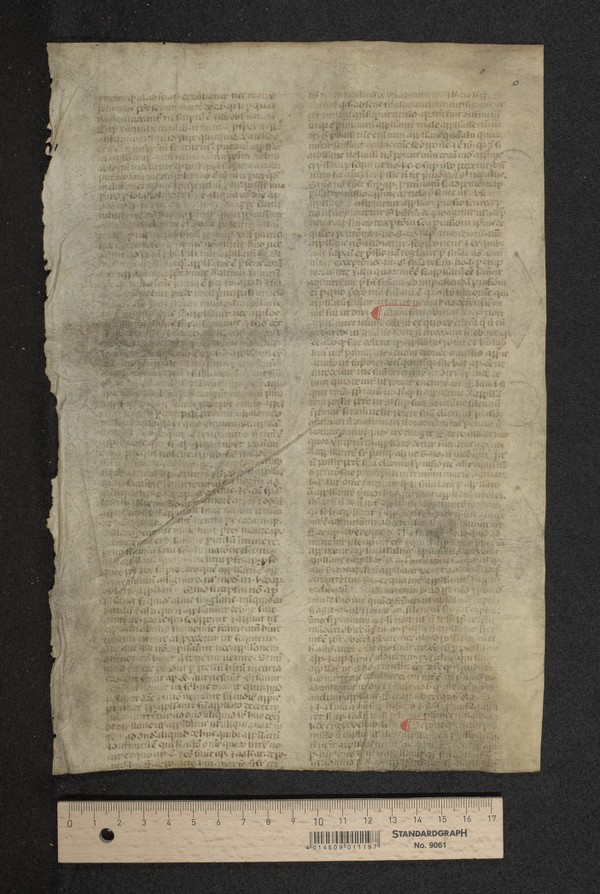
F-h8oz: Bernardus Compostellanus junior, Lectura super primo libro Decretalium, commentary on Innocent IV's constitution Statuimus (appeals against elections and provisions)
This parchment leaf in Oudenaarde carries part of the commentary of Bernardus Compostellanus junior (died 1267), papal chaplain, on the first book of the Decretals of Gregory IX. The passage on both sides comments Innocent IV's constitution Statuimus, which the commentary treats under the title De electione and which later stood in the Liber Sextus in the same title. The constitution regulates appeals to the pope against elections and provisions: the appellant must set out for the curia within a month and the party who arrives waits twenty days for the other, after which the case may proceed with the other party absent. The leaf discusses what each party must prove before the court proceeds in the other's absence, how the appeal is proved (instruments, witnesses, letters of executors, the procurator's letters), and why parties who did not appeal must still come to defend their rights.
The Fragmentarium record is Oudenaarde, Stadsarchief, Perkamenten nr. 56, catalogued as "Unidentified canon law text", 14th century, 292 x 199 mm, two columns.
- Identification: identified, high. Sustained agreement in wording and sequence across both sides with two manuscripts of the work, read on their page images, and with the printed text, Venice 1588, fols. 204v-205r, also read on page images. Witnesses: Arras, Médiathèque de l'Abbaye Saint-Vaast, Ms 590 (CGM 508), fol. 66v; Reims, Bibliothèque municipale (Carnegie), Ms 708, fols. 91r-v and 92v. The case of the auditor obtained "per principalem aut per procuratorem", with its model mandate to "magistro B. Hispano", is in both manuscripts and in the fragment but not in the 1588 print, which passes straight from "ff. de reg. iur. cum par." to "Si autem solus appellatus est presens". Durantis, Speculum iudiciale II.3, De appellationibus, n. 14, has the same case reworded with his own name in the mandate; n. 15 then continues differently, while the fragment continues with Bernardus. The Durantis passage is a parallel, not the fragment's text.
- Transcription: source-assisted, selected lines. A research reader (Claude) reread on the native images lines 1-16 and about 25 further lines of the column headed fol. [1]v a, the first six lines of [1]v b, and about 16 lines of [1]r b, with both manuscripts and the print available. The rest of each side, including all of [1]r a, was not transcribed. Several readings remain uncertain and are marked. Accuracy has not been measured. The preserved source-assisted record of September 2026 reads "an" at [1]v a line 3 and expands "ap." at line 12 as appellans; the image has "aut", and both manuscripts and the following sentence support ap(pellatus).
- Verification: a research reader (Claude) compared the fragment lines on the fragment's images with the Arras and Reims page images and with the 1588 print page images (Google Books, full view). The HTR of CoMMA was used only to locate the passages. Arras was checked on the image for the first passage only; its readings for the other passages come from CoMMA's machine text and are labelled.
Textual evidence
Fragment images (manifest canvas order): canvas 1, labelled fol. [1]r, 2810 x 4187 pixels; canvas 2, labelled fol. [1]v, 2842 x 4241 pixels. The text runs from the side labelled [1]v to the side labelled [1]r: [1]v carries the earlier part of the commentary and [1]r a later part. Whether the two sides are contiguous, or what is lost between them, was not checked.
Abbreviations are expanded in parentheses; square brackets mark uncertain or supplied readings. Lines count from the top of each column.
Fol. [1]v, column a, lines 1-16
Native crop box 400,420,1000,800 on canvas 2 (image).

| Fragment, fol. [1]v a | Arras 590, fol. 66v a-b (image) | Reims 708, fol. 91r a (image) | Print 1588, fol. 204v a (image) |
|---|---|---|---|
| 1: [et pars que non] uenit ad curiam expectet p(er) .xx. dies p(ar)tem adu(er)sam. | ⁊ p(ar)s q(ue) n(on) uenit ad curiam expectet p(er) .xx. dies p(ar)tem adu(er)sam. | et pars que non uenit ad curiam expectet partes aduersam | absent from this point |
| 2-3: S(ed) pone q(uod) apparet auditorem impetratu(m) e(ss)e s(ed) n(on) c(on)stat p(er) principale(m) aut p(er) p(ro)cur(atorem) fuit optentus | S(ed) pone q(uod) apparet auditore(m) i(m)petratu(m) e(ss)e s(ed) no(n) constat q(uo)d p(er) principale(m) aut p(er) p(ro)curatore(m) fuit obtentus | Sed pone quod apparet auditorem impetratum esse sed non constat quod per principalem aut per procuratorem fuit obtentus | absent |
| 4-9: nu(m)quid sufficiat ... S(ed) c(ontrarium) tenem(us) q(uia) c(um) auditor p(ro) litigatore impetrat(ur) et litigator h(oc) ratu(m) h(abe)t h(ec) ratih(abiti)o mandato c(om)paratur ff. de reg. iur. l. hoc iure. nec in c(om)missionib(us) quas p(a)p(a) facit in curia exprimitur ad cuius instancia(m) sit datus auditor. | same wording, apart from spelling and abbreviation | same wording, apart from spelling and abbreviation | absent |
| 9-11: ¶ Si simplic(ite)r [d(icitu)r] mandat d(omi)n(u)s p(a)p(a) mag(ist)ro b. [h]isp(a)no q(uod) ca(usam) que v(er)titur int(er) t(ales) sup(er) tali re audiat et diffiniat. | S(ed) simpl(icite)r d(icitu)r mandat d(omi)n(u)s p(a)p(a) magistro .b. hyspano q(uod) causam que v(er)titur int(er) tales sup(er) tali re audiat (et) diffiniat. | Sed simpliciter dicitur mandat dominus papa magistro b(er)nardo hyspano quod causam que vertitur inter tales super tali re audiat et diffiniat | absent |
| 11-14: ¶ Si aut(em) sol(us) ip(s)e ap(pellatus) e(st) p(re)sens si uult q(uod) p(ro)cedatur alt(er)a p(ar)te absente nec(ess)e h(abe)t ostendere de app(ellatione) et q(uod) t(em)p(or)a h(uius) c(on)stit(utionis) s(er)uauit. | Si aut(em) solus appellatus est p(re)sens si uult q(uod) p(ro)cedatur alt(er)a p(ar)te absente nec(ess)e h(abe)t ostend(er)e de appellatione (et) q(uod) tempora h(uius) constitutionis s(er)uauit. | si autem solus appellatus est presens ... seruauit | (fol. 204v a) Si autem solus appellatus est praesens, si vult quod procedatur altera parte absente, necesse habet ostendere de appellatione, & quod tempora huius constitutionis seruauit. |
| 14-16: [S(ed) ...] an appellatus qui uult q(uod) p(ro)cedatur absente p(ar)te altera p(ro)bare d(ebet) adu(er)sariu(m) ex ca(usa) l(egitti)ma et in scriptis et infra decendium appellasse | an aut(em) appellatus qui uult q(uod) p(ro)cedat(ur) absente p(ar)te alt(er)a p(ro)bare debeat adu(er)sariu(m) ex c(aus)a l(egitti)ma (et) in scriptis (et) i(nfr)a decendiu(m) appellasse | an autem appellatus qui uult quod procedatur absente parte altera probare debet aduersarium ex legittima in scriptis et infra decendium appellasse | an autem appellatus, qui vult vt procedatur altera parte absente, probare debeat aduersarium ex causa legitima, & in scriptis, & inf. decendium appellasse |
The fragment's "ipse" at line 12 is in neither manuscript nor the print. In line 10 the initial after "mag(ist)ro" is a clear "b." followed by "[h]isp(a)no"; Arras has ".b. hyspano", Reims "b(er)nardo hyspano". Innocent IV's registers name a papal chaplain "magistro Bernardo Hispano capellano suo, decano Ulixbonensi" (É. Berger, Les registres d'Innocent IV, Google Books snippet). Bernardus junior was a papal chaplain, so the model mandate probably names the author; that identification of the chaplain was not checked further. Durantis gives the same mandate to "Guilielmo Durandi". Whether Durantis took the case from Bernardus was not examined.
Fol. [1]v, columns a (lower part) and b
Column a, native box 400,2400,1000,1120 (image); column b, native box 1440,440,1000,330 (image).


| Fragment | Reims 708 (image) | Print 1588 (image) | Note |
|---|---|---|---|
| a: C. de temp. app. l. ii. § ult. P(ri)mu(m) dictu(m) magis placet. ¶ Item q(ueritur) de modo p(ro)bandi app(ellatione)m et alia q(ue) p(ar)s p(re)sens h(abe)t nec(ess)e p(ro)bare ut possit altera p(ar)te absente p(ro)cedi. R(espondeo) p(ro)babit h(oc) p(er) i(n)strum(en)ta u(e)l acta publica p(er) testes p(er) litt(er)as executor(um) quib(us) credim(us) ex quo sunt duo u(e)l plures. ar. i. de testi. cu(m) a nob(is) ... | fol. 91r b: ... primum dictum magis placet. Item queritur de modo probandi appellationem et alia que pars presens necesse habet probare ut possit altera parte absente procedi. Ro. probabit hoc per instrumenta uel acta publica per testes uel litteras executorum quibus credimus ex quo sunt duo uel plures ar. i. de testi. cum a nob. | fol. 204v a-b: prius dictum magis placet. Item quero de modo probandi appellationem & alia, quae pars praesens necessario habet probare ... per testes, per litteras executorum, quibus credimus, ex quo sunt duo vel plures | Fragment, Arras [HTR] and print have "per testes per litteras"; Reims "per testes uel litteras". |
| a: [...] approbati e(st) q(uod) in audie(n)cia p(ar)s absens antequa(m) in aliquo p(ro)cedatur citetur. ¶ It(em) q(ueritur) s(i) sufficiat si p(ar)s p(re)sens p(ro)bet app(ellatione)m p(er) unu(m) teste(m) et p(er) litt(er)am qua(m) p(ro)cur(ator) p(ar)tis absentis datus ad impetrand(um) et c(ontra)dicendu(m) impetrare intendit | moris tamen approbati est quod in audiencia pars absens antequam in aliquo procedatur citetur. Item queritur si pars presens probet appellationem per unum testem et per litteram ... | omits the moris sentence; Item quero, si pars praesens probet appellationem per vnum testem & per litteram ... | Arras [HTR]: "It(em) q(ueritur) si sufficiat si p(ar)s p(ro)bet", with the fragment. |
| b 1-5: [per confessionem ipsam et unum tes]tem dicim(us) app(ellatione)m p(ro)batam. ar. i. de suc. ab intesta. cu(m) dil(ectus). S(ed) sola p(re)d(ic)ta l(itte)ra que de app(ellatione) loq(ui)t(ur) n(on) p(ro)baret [app(ellatione)m] q(uia) l(ice)t q(ui)s c(ontra) c(on)fessio(nem) in uno iudicio facta(m) n(on) possit in alio iudicio uenire ut no. s. e. p(er) inquisitione(m) confessio t(ame)n p(ro)cur(atoris) n(on) obe(st) d(omi)no nisi in ca(usa) u(e)l negocio ad qua(m) u(e)l q(uod) [constituitur] | fol. 91v a: ... dicimus appellationem probatam. ar. i. de succes. ab intesta. cum dilectus. tucius tamen est hoc casu per dilationem iuramenti ... i. de iureiur. iuramentum. Sed sola predicta littera ... | fol. 204v b: dicimus appel. probatam, arg. inf. de success. ab intest. cu(m) dilectus. sed sola p(re)d(ic)ta l(itte)ra, que de appellatione loquitur, no(n) probaret appellatione(m) | The fragment and the print lack the sentence "tucius tamen ... iuramentum", which Reims (image) and Arras [HTR] have. |
Fol. [1]r, column b
Native box 1420,1440,1000,600 on canvas 1 (image). The side is badly abraded; this is the clearest stretch.

| Fragment, fol. [1]r b | Reims 708, fol. 92v b (image) | Print 1588, fol. 205r b (image) |
|---|---|---|
| [ad defensionem] iur(is) sui ut dixi. ¶ [Si autem?] tu [mihi?] obicias q(ua)re non appellantes uenire debent ex quo ex c(er)ta c(aus)a q(ue) n(on) tangebat eos u(e)l q(uam) ueram forte n(on) credeba(n)t sciebant ap(pellatum) e(ss)e. R(espondeo) q(uia) scire debebant q(uod) appellat(us) poterat ex b(e)n(e)fic(i)o hui(us) iur(is) principale i(n) iudic(ium) deducere omisso app(ellationis) articulo ut sup(ra) dixi. Unde q(ui)cu(m)q(ue) sciebat ap(pellatum) e(ss)e uenire debebat ius suu(m) defensurus [...] ff. loca(ti) l. si quis domu(m). P(apa) tame(n) no(tat) hic q(uod) l(ice)t [appellatus] c(ontra) appella(n)tem possit petere ut s(ibi) sup(er) sua c(on)dic(i)o(n)e silenciu(m) i(m)ponat(ur) si tamen uelit petere sua(m) elec(tione)m u(e)l p(ro)uisio(nem) confirmari n(on) d(ebet) admitti [...] | ad defensionem iuris sui ut dixi. Et si tu obicias quare appellantes uenire debeant ex quo ex certa causa que non tangebat uel quam ueram forte non credebant sciebant appellatum esse. Ro. quia scire debebant quod appellatus poterat hoc ex beneficio huius iuris principale in iudicium deducere omisso appellationis articulo ut s. dixi. unde quicumque sciebat appellatum esse uenire debebat ius suum defensurus ut dixi preiudicare debuit quod de iure potuit occurrere. ff. locati. si quis domum § huic. Papa tamen notat hic quod licet appellatus contra appellantem possit petere ut sibi super condicione sua silencium imponatur ... | ad defensionem iuris sui, vt dixi. Si autem tu mihi obiicias: quare non appellantes venire debent, ex quo ex certa causa, quae non tangebat eos, vel quam veram non credebant sciebat appellatum esse? R. quia scire debent quod appellatus poterat ex beneficio huius iuris principale in iudicium deducere omisso appellationis articulo, vt sup. dixi. vnde quicunque sciebat appellatum esse, venire debebat ius suum defensurus, vt dixi. Papa tamen notat hic, quod licet appellatus contra appellantem possit petere ... |
Arras [HTR] agrees with the fragment in "non appellantes" and "eos".
Witness pattern
The fragment sides with Arras in most variants checked ("per .xx. dies partem adversam", "ex causa legitima", "per testes per litteras", "si sufficiat"), with Arras and the print against Reims in "non appellantes", with both manuscripts against the print in carrying the auditor case and the moris sentence, and with the print alone against both manuscripts in lacking "tucius tamen ... iuramentum". It has an extra "ipse" at [1]v a line 12. On these few passages it belongs to none of the three witnesses exactly. No recension claim follows.
Sources
- Bernardus Compostellanus, Lectura aurea super primo libro Decretalium, in Perillustrium doctorum ... in libros Decretalium aurei commentarii, vol. I (Venice: Giunta, 1588), fols. 153-214; constitution Statuimus from fol. 204r b ("Sequens Decre. est Innocentii quarti, & habetur de elec. lib. 6"), passages at fols. 204v-205r. Google Books, fol. 204v, fol. 205r. The print's running head names "Bernardi Compostel. super I. Decret."
- Arras, Médiathèque de l'Abbaye Saint-Vaast, Ms 590 (CGM 508), 14th century, catalogued by the IRHT as "Bernardus Compostellanus, Apparatus novellarum Innocentii IV; etc." (Arca notice); fol. 66v (column b, foot of column a). CoMMA labels this manuscript "Ms. 508", its CGM number.
- Reims, Bibliothèque municipale, Ms 708 (G. 589), late 13th century, from Guillaume Fillastre's library (Arca notice). D. Marcotte (ed.), Humanisme et culture géographique à l'époque du Concile de Constance (2002), p. 260, describes fols. 1-97 as Bernardus Compostellanus iunior, Commentarius in librum I Decretalium, "éd. Venise, 1588, f. 153-206v". Passage on fol. 91r a (image), fol. 91r b, fol. 91v a (image) and fol. 92v b (image).
- Attribution: B. Tierney, Foundations of the Conciliar Theory, biographical appendix: Bernardus Compostellanus junior (d. 1267), chaplain to the pope, "author of a commentary on the first book of the Decretals, an apparatus of glosses on the Novellae of Innocent IV". The 1588 print and the Reims catalogue name the work; Arras is catalogued under the Novellae apparatus. The relationship between the Lectura and the Novellae apparatus in these witnesses was not examined.
- Parallel: Guillelmus Durantis, Speculum iudiciale II.3, De appellationibus, § Nunc breviter, nn. 14-15 (Lyon edition, scan n483).


Limits
- [1]r column a and most of both columns of [1]r and of [1]v b were not transcribed; [1]r is heavily abraded and its lower edge is torn.
- Arras was read on the image for the [1]v a lines only. Its readings for the other passages are machine HTR, marked [HTR].
- The comparison with the print used Google Books page images. The edition's treatment of the auditor case (absent) was checked on fol. 204v a; other omissions in the print were noticed only where they fell inside the compared lines.
- Kuttner's and Kessler's studies of the Novellae commentaries, Bertram's manuscript lists, and the CGM entries for Arras 590 and Reims 708 were not read; the attribution rests on the print, the Reims catalogue description and Tierney.
- The catalogue's 14th-century date was not examined.
Preserved readings
Initial isolated image-only response · CATMuS output · Source-assisted revision, September 2026 · Additional short-crop isolated response · Source-assisted reading, October 2026
None of these is a verified transcription. The lines above are from the October 2026 source-assisted reading, made with the two manuscripts and the print available.