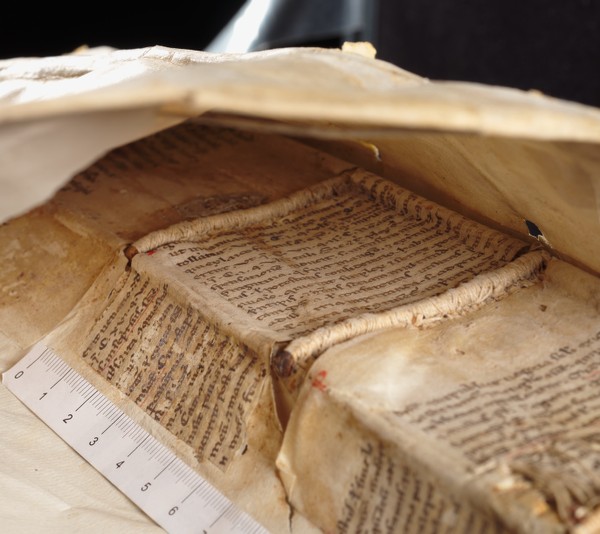
F-ja1n: Johannes Faventinus, Summa super Decretum Gratiani, pars I, D. 86
The four spine strips carry part of the commentary of Johannes Faventinus (John of Faenza, about 1171) on distinction 86 of the first part of Gratian's Decretum, from the comment on chapter 8 (Qui venatoribus) to that on chapter 24 (Tanta nequitia). The work is a summa, that is a continuous commentary that quotes a few words of the law text (a lemma, here underlined in red) and then explains them. It is not the standard marginal gloss on the Decretum.
Catalogue record: Fragmentarium F-ja1n, Orselina-Locarno, Biblioteca Madonna del Sasso, MdS 16 Ga 8/F1-4; four parchment spine strips, 70 x 99 mm, Italy, dated 1301-1400, Gothic script, titled "Unidentified glosses on Decretum Gratiani", with no description. The catalogue had the subject right: this is commentary on the Decretum. It did not name the work, the author or the place in the Decretum. The script looks earlier than the fourteenth century to a non-specialist eye (a small rounded glossing hand of a kind usual around 1200); this is recorded as a tension with the catalogue date, and no new date is proposed.
- Identification: identified, confidence high. Four separate passages on the strips agree in wording and in order with the Summa as it stands in two manuscripts: Vatican City, Biblioteca Apostolica Vaticana, Borgh. lat. 71, f. 57ra-57va, and Reims, Bibliothèque municipale, Ms. 684, the openings the library labels f. 35v-36 and f. 36v-37. The Summa is unprinted. Johannes Faventinus compiled it largely from two earlier summae, by Rufinus and by Stephen of Tournai, and the fragment shows exactly that mixture in one running text:
- the passage on hunting in the arena is Stephen's (ed. Schulte, p. 107) and is not in Rufinus, whose treatment of hunting (ed. Singer, p. 176) is worded differently;
- the passage on the publicans, Misericordia plenitudo virtutum, Morte luitur and Insolentem infrenat iactantiam is Rufinus's (Singer, p. 177); Stephen (Schulte, p. 108) words the same lemmata differently ("Publicani dicuntur qui publico officio fruuntur ...", "plenitudo ..., i. e. sine misericordia non potest quis plenus esse virtutibus") and has no comment on Insolentem infrenat;
- the story of Elisha is in both sources but in neither edition: Singer prints "Tangit illam ystoriam, in qua legitur ....." with a note that Rufinus gives it after Paucapalea, and Schulte prints only "[historia secundum Paucapaleam et Rufinum]". It therefore does not separate the three works;
- the scheme of dispensation at Tanta nequitia is in neither source as printed at distinction 86. Singer's text and apparatus pass from chapter 22 to Gratian's dictum Similiter; Schulte's text passes from chapter 21 to the same dictum (Schulte abridges, so this is weaker for Stephen). Singer prints a related but differently worded scheme only in his apparatus at C. 1 q. 7, as an insertion in one Rufinus manuscript (Paris, BnF lat. 4378).
So the fragment has a Stephen passage and a Rufinus passage that Stephen words otherwise, joined in one text, followed by a passage neither edition has, all as in the two Faventinus manuscripts. One later work is a real rival for the last passage only: the Summa "Omnis qui iuste iudicat" (Summa Lipsiensis, ed. Weigand, Landau and Kozur, 2007, pp. 365-366) copies the dispensation scheme almost word for word; but its hunting and publican passages at distinction 86 are worded differently (search results inside the edition: "Hii omnes sunt infames, si ad id locant operas suas; secus, si uirtutis ostendende causa id fecerunt"; "Publicani dicebantur qui publica uectigalia exigebant"), and it has no hit for Morte luitur, infrenat, dentatis or locet. The Summa Parisiensis (ed. McLaughlin, pp. 67-68) and the Summa Coloniensis differ in the hunting and Elisha passages, on the evidence of search snippets. Not tested: Simon of Bisignano, Sicardus of Cremona, the Summa "Tractaturus magister" and Huguccio. The printed ordinary gloss (Rome 1582) gave no hit for the distinctive words in a search of its scanned text and was not read page by page.
Wording. Most places where the fragment differs from the Vatican copy are shared with the Reims copy and are therefore variants inside the tradition of the Summa: appellatur or appellantur (Vatican dicitur), et apparere, the clause "qui ex laico factus est episcopus" after the first reference to C. 1 q. 7, Sic et triplex est causa, scilicet, et extrinseca, "sociam multitudinem", and "[venation]em mortale pec[catum]" without non solum before it. Both copies and the fragment read potestatis. Left unmatched in either copy: the fragment's "negocia seculi exigunt ... sectantur" with autem in the publican passage (both copies have the one clause "negotia seculi sectantur"), and a verb after dispensationem that looks like movet or movent (both copies adducit).
- Transcription: the image-only first reading was made without knowledge of the work. The source-assisted reading was made by a research reader with Rufinus's edition and the two manuscripts open: the central panel and the lower-left strip of image 1, and the main panel and the folded strip of image 2, were reread on perspective-corrected crops. The upper lines of the lower-left strip rest on the first reading and are not used. Two further panels in image 1 are out of focus and unread. Accuracy has not been measured.
- Verification: a research reader compared the manuscript images with page images of Borgh. lat. 71 and of Reims 684 (the reader's own transcription of both), with page images of Singer's Rufinus (pp. 176-178) and Schulte's Stephen (pp. 107-108), and with search results inside the editions of the Summa Lipsiensis, Parisiensis and Coloniensis. The coordinating model read the main panel of image 2 (native box 2380,1550,5000,2750: "dicuntur qui publice negocia seculi exigunt ... Misericordia plenitudo ... Morte luitur ... Insolentem infrenat iactantiam eorum") on the manuscript image and the same passage on the page image of Borgh. lat. 71, f. 57r, right column, and found the wording as the research reader gives it. It also read the Tanta nequitia passage in the Reims manuscript on the page image ("tria dispensatione aguntur circa personas ... de maximo dicitur qui ex laico factus est episcopus ... Sic et triplex est causa ... scilicet intrinseca ... et extrinseca habitus vel potestatis consideratio"), the two occurrences of potestatis at the head of f. 57v of the Vatican manuscript, Singer's pages 176 to 178 for what Rufinus has at this distinction, and the opening of the Reims manuscript, which begins "Cum multa super concordia discordantium canonum" under a medieval heading naming Johannes Faventinus. Gaps: two witnesses of an unprinted work, the Reims one a black and white microfilm scan; the rival summae seen only through search results or not at all; line ends on two panels are out of view. No human review.
Textual evidence
Images: image 1 (canvas mds_16Ga08_a010_e002_s001) and image 2 (canvas mds_16Ga08_a013_e002_s001), both 5493 x 4890 pixels. The strips were photographed obliquely inside the binding, so the regions are four-cornered and are given as corner points (upper left, upper right, lower right, lower left) in native pixels:


- A, folded strip, image 2: 1500,1950 / 2250,1750 / 2500,3800 / 1800,4000
- B, lower-left strip, image 1: 700,3150 / 1420,2500 / 2450,4150 / 2000,4350
- C, main panel, image 2: box 2380,1550,5000,3500
- D, central panel, image 1: 1200,2230 / 3400,1560 / 4850,2300 / 2500,3080
Square brackets mark letters lost or out of view, a question mark an uncertain word. The manuscript texts are given with abbreviations expanded; V is the Vatican copy, R the Reims copy, and where only one text is given the two agree apart from spelling.
| Fragment | Johannes Faventinus (V, R) |
|---|---|
| A: [b]estiis vel sine lo[...] / [a]d peccatum non refer[t] / [quam]vis quantum ad i[...] / [...] est infamis. in s[...] / [...] in arena pas[...] / [...]em . mortale pec[...] | cum dentatis bestiis vel sine locatione operarum id facit. Nam quantum ad peccatum non refert utrum locet vel non locet in hoc operas suas, quamvis quantum ad infamiam referat. In primo namque casu est infamis. In secundo notam infamie evadit nisi in arena passus sit honorari. Hanc venationem non solum mortale peccatum est exercere (V) / hanc venationem mortale peccatum est non solum exercere (R) sed et aspicere |
| B: in xii iugis b[...] / Cumque ex? ma[...] / misit pall[...] / [cu]currit post hel[...] / meum et matrem | arabat Eliseus in xii iugis boum et ipse ex arantibus unus erat. Cumque ex mandato domini venisset ad eum Elias misit pallium super eum, qui statim relictis bobus cucurrit post Eliam et ait: Osculer oro te patrem meum et matrem meam |
| C: dicuntur qui publice negocia seculi exigunt . l[...]na sectantur. In evangelio autem qui publice p[...] publicani appellantur. Misericordia plenitudo v[...] .i. nullus potest et apparere perfectus in virt[...] nisi cum tempus habet misericordiam faciat. Morte luitur c[...] qui maledixerit patri vel matri morte mo[...] Insolentem infrenat iactantiam eorum | Hodie publicani dicuntur qui publica negotia seculi sectantur. In evangelio qui publice peccat publicanus dicitur (V) / appellatur (R). Misericordia plenitudo virtutum est .i. nullus potest (R adds et) apparere perfectus in virtutibus nisi cum tempus habet misericordiam faciat. Morte luitur. cum dicitur qui maledixerit patri vel matri morte moriatur. Insolentem infrenat iactantiam eorum scilicet qui obtentu religionis de parentibus non curant |
| D: personas. Aut enim pe[...] / ut in Ianuario sene hic dicitur. aut quod est us[...] / tollatur? ut infra C. i q. ult. de max[...] / qui ex laico factus est episcopus. vel quod inhibitum [...] / ertur. ut infra C. vii q. i c. non autem [...] / et infra C. i q. ult. tali. Sic et triplex est ca[...] / spensationem movet? scilicet intrinseca meritorum [...] / prerogativa que fuit in Augustino. et extrinseca [...] / tus vel potestatis consideratio. habitus [...] / nuario qui erat simplex et senex. potes[...] / principis et [...] sociam multitudinem [...] / [...] vel conferentis utilitas. P[...] / ad illa tria impetranda. scilicet ad penam | R: Tanta nequitia etc. Tria dispensatorie aguntur circa personas. Aut enim pena minuitur ut in Ianuario sene hic dicitur. Aut quod est usurpatum tolleratur ut infra C. i q. ult. de Maximo dicitur qui ex laico factus est episcopus et de [...] qui apud hereticos factus fuit episcopus. Vel quod inhibitum est confertur ut infra C. vii q. i c. non autem de Augustino dicitur et infra C. i q. ult. tali. Sic et triplex est causa que dispensationem adducit, scilicet intrinseca meritorum et scientie prerogativa que fuit in Augustino et extrinseca habitus vel potestatis consideratio. habitus ut in Ianuario qui erat simplex et senex. potestatis ut principis et [...] sociam multitudinem. V the same, except: tollitur ut C. i q. ult. Si quis episcopus (with a marginal addition); Sic triplex causa; no scilicet; sive prerogativa; Extrinseca without et; and, after principis, a different and partly unread phrase, then "vel conferentis utilitas. Primum valet ad illa tria impetranda" |
Against the sources. Stephen's printed text of passage A has "nisi in arena se passus sit honorari" and "sed etiam aspicere culpandum est"; the fragment has "in arena pas[...]" without se, with the two manuscripts. Rufinus's printed text of passage C has "publica seculi negotia vel lucra sectantur: in euangelio qui publice peccat publicanus appellatur" and "nullus potest etiam apparere ... misericordiam facit" (faciat in some of Singer's manuscripts); the fragment's faciat is that of both Faventinus copies.
Sources. Vatican City, BAV, Borgh. lat. 71: f. 57r, f. 57v, f. 1r. It opens "Cum multa super concordia discordantium canonum sint hactenus edita commenta prudentium", the prologue of Johannes Faventinus's Summa, and the Manuscripta juridica database lists it (ff. 1ra-157ra) under that author and title. Reims, Bibliothèque municipale, Ms. 684: openings labelled f. 35v-36 (passage A, right page, right column) and f. 36v-37 (passages B, C, D, left page, left column), a microfilm scan published by the IRHT; the library's record, as given in the Biblissima IIIF collections, attributes it to Johannes Faventinus, and its first page opens with the same prologue, "Cum multa super concordia discordantium canonum", under a medieval heading naming him. Rufinus: H. Singer, Die Summa decretorum des Magister Rufinus (Paderborn, 1902), p. 177, with pp. 176 and 178. Stephen of Tournai: J. F. von Schulte, Die Summa des Stephanus Tornacensis über das Decretum Gratiani (Giessen, 1891), pp. 107-108; that edition is abridged.


Order, other items, and limits
In both manuscripts the four passages follow one another as A, B, C, D within about one and a third columns, so the strips come from one leaf or one opening of the same book; their original arrangement on the leaf was not reconstructed. Image 1 also shows two further panels of the same lining, out of focus and unread. The third image is a colour chart.
Not claimed: a date or origin for the fragment; that its two unmatched readings represent a distinct version of the Summa; any closer relation to the Reims or the Vatican manuscript; that the fragment is a new or independent witness. A later summa that copies Johannes Faventinus through the whole of distinction 86 would be indistinguishable on this evidence; none was found among those tested.