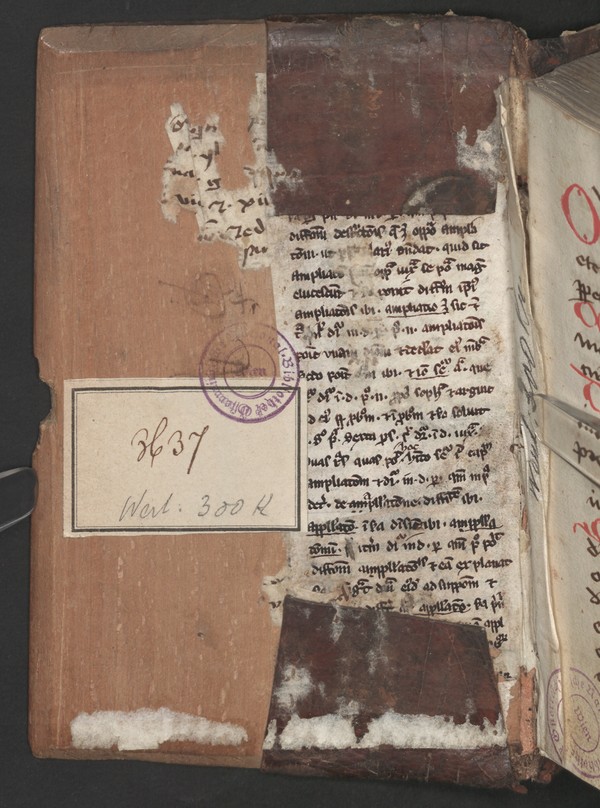
F-kcu7: Anonymous, Compilationes supra Summulas Petri Hispani ("Omnes homines") or a close derivative, on Tracts IX-XI
The two strips carry the anonymous Compilationes supra Summulas Petri Hispani, or a close derivative of it. This is a thirteenth-century gloss commentary on Peter of Spain's Tractatus (later called Summule logicales), the standard logic textbook, and it opens "Omnes homines natura scire desiderant". The strips carry its divisio textus, the outline in which a commentator divides the text into parts and cites each part by its opening words. That outline covers Tract IX (De ampliationibus), Tract X (De appellationibus) and Tract XI (De restrictionibus), numbered as in de Rijk's 1972 edition.
The identification is of the work. Only one other copy was compared: Nuremberg, Germanisches Nationalmuseum, Hs 27773, written about 1260. The fragment's wording is fuller than that copy:
- The front strip follows it clause by clause but adds phrases such as "quia opposita iuxta se posita magis elucescunt".
- It has "explanat" where Nuremberg has "exponit".
- The back strip agrees with Nuremberg only in structure and in the opening words it cites.
The fragment is therefore either an expanded or interpolated copy of the Compilationes or a close derivative of it. Comparison with Vienna, ÖNB, Cod. 2389, a copy that de Rijk reports as interpolated, could settle which.
The Fragmentarium record describes two parchment strips used as guards in Wien, Österreichische Nationalbibliothek, Cod. 3637, a Mondsee miscellany. The strips measure about 140 x 60 mm and are written in Northern Textualis. The record dates them 1251-1325 and places their origin in Germany or Austria. The record's title is "Commentarium super Petri Hispani summulas logicales". Ivana Dobcheva's description calls the text "Kommentar eines Textes wohl über Logik (unidentifiziert)". The reconstruction summary already located the base text and its cited opening words in de Rijk's edition, without naming the commentary. That location is correct, except that it assigns "Appellatio" (p. 197) to Tract IX, where de Rijk numbers it X. The description quotes "quae est oppositio ampliationis". The strip reads "que est opposita amplia-/tioni", "which is opposed to ampliation".
- Identification: identified, high confidence, as the Compilationes or a close derivative of it. The agreement with the one copy compared is strong, but the fragment's fuller wording does not rule out a reworking, so it is not claimed to be the Compilationes in the text that copy transmits.
- Diagnostic basis: the front strip agrees with the Nuremberg copy (fol. 128ra) clause by clause, in the same order of parts and opening words. Both have "diffinitionem restrictionis que est opposita ampliationi", the definition of ampliation "ibi Ampliatio est", "prima dividitur in duas, primo ponit ampliationis unam distinctionem et declarat ... membra", "proponit sophisma et arguit ... probando et improbando" and "ponit distinctionem appellationis et eam ...". The back strip has the same sequence as Nuremberg's outline of the restriction tract: a sophisma (a puzzle sentence) at "Secundum predicta queritur", then "Solet autem poni".
- Differences: the fragment's wording is fuller than this one copy. It adds "ut ... quid sit ampliatio, quia opposita iuxta se posita magis elucescunt" ("opposites placed side by side shine out more clearly"). It reads "explanat" against "exponit", and "ad suppositionem et ..." where Nuremberg has "ad significationem et suppositionem". The back strip is much longer than Nuremberg's outline and agrees with it only in structure and opening words.
- What follows: the fragment is an expanded or interpolated copy, or a close derivative. Only one witness was compared. De Rijk reports that the Vienna copy, ÖNB Cod. 2389, "contains a number of interpolations"; it was not consulted.
- Alternatives considered:
- Guillelmus Arnaldi's Lectura tractatuum: its printed openings for ampliation and appellation are worded differently.
- Simon of Faversham's commentary: it covers Tracts I-V only.
- Robertus Anglicus: no text for these tracts is printed, so his commentary was not tested on the text.
- The fifteenth-century commentaries of Versor, Lambertus de Monte, Gerardus de Harderwijck, and George of Brussels with Bricot were read in the Munich digital library's OCR (machine-read text). They comment on a different arrangement of the text in question-and-notabilia form and do not share the fragment's wording.
- Transcription: an image-only first reading and a source-assisted reading. A research reader reread both strips on the image at reading size: the front strip, canvas 0, about 1420,1100-2620,2900, and the back strip, canvas 1, rotated, about 260,1000-1480,3000. The abraded left half of the front strip and the struck-through lines on the back remain uncertain. Lines under the leather turn-ins are unread. Accuracy has not been measured.
- Verification: a research reader compared both strips with the page image of Nuremberg GNM Hs 27773, fol. 128ra-rb. The coordinator read the front strip, canvas 0, around native box 1420,1100-2620,2900 ("...ampliationis ibi Ampliatio est ... prima dividitur in duas, primo ponit ampliationis unam distinctionem et declarat ... membra, secundo ponit aliam ibi Non solum autem"), against Nuremberg GNM Hs 27773 fol. 128ra (dlib.gnm.de page image), and found clause-by-clause agreement. Gaps:
- Only one witness was compared. Vienna Cod. 2389 and Munich Clm 6905 were not collated, and no other copy was consulted.
- The back strip was matched only in structure and opening words.
- The covered lines are unread.
No human review.
Textual evidence
Manuscript images: Cod3637_VDS (canvas 0, inside front cover, front strip, text upright) and Cod3637_HDS (canvas 1, inside back cover, back strip, text upside down). Boxes are in native pixels. Expansions are in parentheses, supplied or lost text is in square brackets, uncertain readings carry "?", and opening words cited by the commentary are in italics.


| Fragment | Nuremberg, GNM Hs 27773, fol. 128ra-rb |
|---|---|
| canvas 0, box 1420,1100-1960: "diffinitione(m) restrictionis q(ue) e(st) opposita amplia-/tioni ut ... quid sit / ampliatio, q(uia) opposita iuxta se posita mag(is) / elucescunt. ... ponit diffinitione(m) ip(s)i(us) / ampliationis ibi Ampliatio est" | "[In prima ponit] diffinitionem restrictionis que est opposita ampliationi. In secunda ponit ampliationis diffinitionem ibi Ampliatio est." |
| canvas 0, box 1420,1700-2450: "... [prima] di(viditu)r in d(uas). p(rim)o p(onit)? ... ampliationis / ... (et) declarat ei(us) m(em)b(r)a / s(ecund)o ponit [aliam] ibi ... / ... di(viditu)r in d(uas). p(rim)o p(ro)p(onit)? sophisma (et) argu- / ... p(ro)bando (et) i(m)p(ro)bando (et) s(ecund)o? solvit" | "Prima in duas. Primo ponit ampliationis unam distinctionem et declarat membra eius. Secundo ponit aliam ibi Non solum autem ... dividitur in duas. Primo proponit sophisma et arguit probando et improbando. Secundo solvit ibi Solutio." |
| canvas 0, box 1520,2440-2900: "de a(m)pliatione [interlinear a, i.e. appellatione] diffinitione(m) ibi. / Appellatio. in s(ecund)a dividit ibi Appella-/tionum. item di(viditu)r in d(uas). p(rim)o ponit / distinctione(m) appellationis (et) ea(m) explanat / [s(ecund)o assi]gnat d(ifferentia)m eius ad supp(ositi)o(n)em (et)" | "In prima declarat de appellatione diffinitionem ibi Appellatio autem; in secunda dividit ibi Appellationum. Secunda adhuc in duas. Primo ponit distinctionem appellationis et eam exponit. Secundo assignat differentiam eiusdem ad significationem et suppositionem ibi Differt autem." |
| canvas 1 (rotated), box 260,1000-2350: "... [distinguendo] eius acceptiones (et) diffiniendo ip(su)m. S(ecund)o ad / ... declarationem p(ro)cedit? ip(s)i(us) / ... unum sophisma ... ibi S(ecundu)m / p(re)d(i)c(t)a q(ueritu)r" | "In prima declarat de restrictione diffinitionem et divisionem; in secunda ad dictorum intelligentiam? ... in tertia proponit sophisma et ipsum declarat ibi Secundum predicta." |
| canvas 1 (rotated), box 260,1000-1950: "... ex distinctione p(ro)cedit? ... / ... ibi Sol(et) aut(em) po(ni)" | "in quarta movet aliam questionem et solvit eam ibi Solet autem queri; in quinta modos restrictionis secundum usum ibi Solet autem poni." |
Differences
- On the front strip:
- The fragment adds the explanation "ut ... quid sit ampliatio, quia opposita iuxta se posita magis elucescunt", which Nuremberg lacks.
- It writes "ipsius" and "eius" where Nuremberg has none.
- It reads "explanat" for Nuremberg's "exponit", and "ad suppositionem et ..." where Nuremberg has "ad significationem et suppositionem". The line end is lost, so the order is not certain.
- It twice writes ampliation for appellation ("ampliationum", "ampliatione"); the second is corrected interlinearly.
- On the back strip, the wording is far fuller than Nuremberg's outline. It includes phrases absent from Nuremberg, such as "distinguendo ... eius acceptiones et diffiniendo ipsum", "et eam expl[anat]", "solvit dicendo" and "illa propositio ibi". Only the order of the sophisma and the opening words "Secundum predicta queritur" and "Solet autem poni" agree.
- No claim is made from these differences about the fragment's exact relation to the Nuremberg text.
Witness and basis of attribution
The witness compared is Nuremberg, Germanisches Nationalmuseum, Hs 27773, fol. 128ra-rb, read from the museum's page image. In that manuscript the work occupies ff. 100ra-129rb under the later heading "Compilationes supra Sumulas Magistri Petri Hispani".
The work's title, opening and anonymity rest on L. M. de Rijk, "On the Genuine Text of Peter of Spain's Summule logicales (Conclusion). V: Some Anonymous Commentaries on the Summule Dating from the Thirteenth Century", Vivarium 8 (1970), section 4, pp. 30-37 (Internet Archive):
- He lists eight manuscripts, including Nuremberg 27773 (p. 31) and Vienna ÖNB 2389 "with a number of interpolations" (p. 32).
- He prints the opening "Incipiunt compilationes supra Tractatus magistri Petri Yspany. Omnes homines natura scire desiderant" from Paris, BnF, nouv. acq. lat. 308 (p. 33).
- He states that he could find no clue to the school in which the glosses originated (p. 37). No author is named in any witness he reports.
The tract numbering and pages follow L. M. de Rijk (ed.), Peter of Spain, Tractatus, called afterwards Summule logicales (Assen 1972): IX De ampliationibus (p. 194), X De appellationibus (p. 197), XI De restrictionibus (§14 p. 204, §18 p. 207). The same twelve-tract order, with ampliation ninth, appellation tenth and restriction eleventh, is announced in the Compilationes prologue (de Rijk 1970, p. 36).
Layout and limits
The front strip carries the end of the outline of Tract IX and the start of Tract X. The back strip carries part of the outline of Tract XI. Whether the strips come from one leaf or from consecutive leaves was not established. Neither was which side of the leaf each strip shows. Neither strip shows a column edge that would give the page layout.
Other items in the images:
- Torn scraps pasted at the upper left of the front board carry only isolated letters and were not identified.
- The host volume's first leaf, with red initials, is not part of this record.
No claim is made about date or origin beyond the catalogue, about which redaction the fragment represents, or about its relation to Vienna Cod. 2389 or other copies.