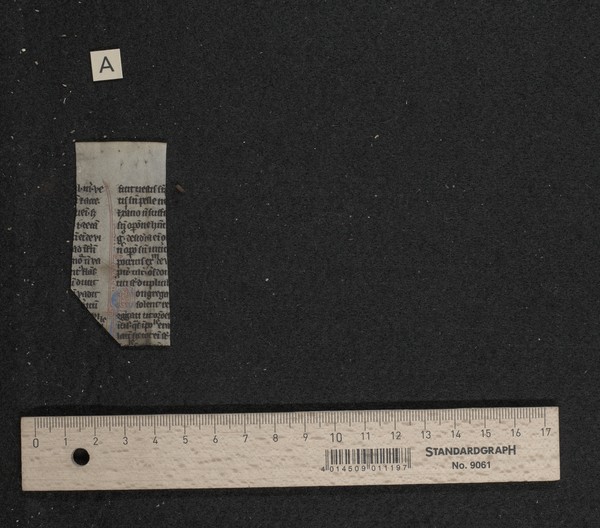
F-ln58: Nicolaus de Byard, All Saints sermon Congregate illi sanctos eius, opening and two later passages (piece A)
The larger of the two strips in Antwerp, Fragm. 297 a-b (piece A), comes from a two-column copy of a sermon for All Saints on the theme (opening Bible verse) Congregate illi sanctos eius (Ps. 49:5). On one face it keeps the blue initial and the opening of the sermon; on the other it keeps two later stretches of it, the first on the saints being gathered for the feast (with Sophonias 3:20) and the second on Esther sending Mordecai to gather the people (Esther 4:16). These agree in wording and order with the sermon in Paris, Bibliothèque nationale de France, lat. 15951, ff. 336rb-336va. J. B. Schneyer's Repertorium der lateinischen Sermones des Mittelalters, the standard listing of medieval Latin sermons by their opening words, gives the sermon as no. 194 of the Sermones de sanctis (sermons for saints' days) of Nicolaus de Byard and also lists it under Robert of Sorbon; lat. 15951 has the note "fr. N. de biart." in the lower margin of f. 336r, below the column in which the sermon begins. The text that precedes the sermon on the strip is not the end of the sermon that precedes it in lat. 15951. The smaller strip (piece B) has not been placed.
The Fragmentarium record is Antwerpen, Erfgoedbibliotheek Hendrik Conscience, Fragm. 297 a-b: 68 x 32 mm, dated 1301-1400, titled "Unidentified text", with four images labelled fol. [1]r (a), fol. [1]r. (b), fol. [1]v (a) and fol. [1]v (b). The description fits the images: two small strips, each photographed on both sides with a ruler, each with a blank upper margin and cut through the text at the foot. The record does not name the text. The text runs from the face labelled fol. [1]r (a) to the face labelled fol. [1]v (a), so the catalogue's recto and verso labels for piece A agree with the order of the text.
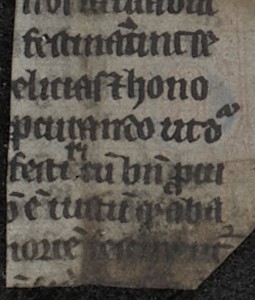
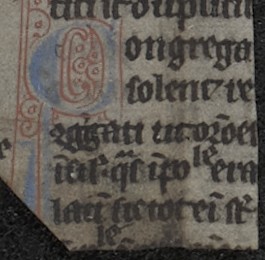
- Identification: identified, high confidence, for piece A. Three separated places on the strip agree with lat. 15951 in wording and order: the opening after the initial on the recto ("Solent re[ligiosi] ... congregati ut orationes ... quasi impossibile erat ... [sigil]latim. Sic enim s[unt]"), fourteen line-ends of the first column of the verso ("quanto plures ... tanto melius est ... tempore quo congregabo ... in omnibus populis ... nos laudabunt ... delicias et hono[res] ... expectando ut dicitur ... bien procu[rat] ... non est iustum quod p[ost] ... [m]orte"), and eleven line-beginnings of its second column ("[man]davit ... et congrega ... [rep]eris in S[usis] ... pro me ... [con]gregan[di] ... ibi illi ... fid[eles]"). The agreement is in the sermon's own argument, examples and transitions: religious meet in chapter so that the prayers of all are asked together, because asking one by one would be nearly impossible; the saints are gathered for one feast; the French proverb "bien festivatur qui bien procurat"; Esther's message glossed "in Susis, i. in paradiso"; "Sed qua intentione congregandi sunt". It does not rest on the three biblical verses the sermon cites. The strip's copy differs from lat. 15951 at several points: the theme is written in short form, on a single line; "congregati" for "congregari"; no "quia difficile vel" before "quasi impossibile"; an extra clause "sed vellera ovium" (the fleeces of sheep) between the two "quanto plures" sentences; "omnibus populis" (the Vulgate's wording) for "cunctis populis"; "ut" for "sicut"; a verb form in the proverb line that may differ ("[fe]stiva^ri^(?)" for "festivatur"); "ab[" after "quod p(ost)", unexplained; and two line-beginnings in the Esther passage that do not match ("tiōes e[" where lat. 15951 has "Hest. iiii. Hester volens rogare", and "inc^a^ ei[" where it has "i. in paradiso"). These show that the two copies differ; they do not show how they are related. The attribution to Nicolaus de Byard rests on Schneyer's listing and on the marginal note in lat. 15951. That note stands below the only sermon that begins in its column, so it is reasonably taken as that sermon's ascription, but it does not name the sermon. A Fragmentarium editor reviewed the identification in November 2026 and judged the attribution to Nicolaus de Byard correct, and Schneyer's second listing, under Robert of Sorbon, one of the over-ascriptions for which Schneyer is known. The strip itself names no author. Whether the strips come from Nicolaus de Byard's Sermones de sanctis as a collection, or from another compilation that included this sermon, is not established.
- Transcription: the image-only first reading covers all four faces; the source-assisted reading covers piece A. A research reader who knew the sermon's opening words from Schneyer reread on the native images recto column b, lines 10-15, verso column a, lines 1-13, and verso column b, lines 1-11, before opening lat. 15951, and reread a few of them afterwards (recto column b, line 14). An independent checker then read recto column b, lines 12-15, verso column a, lines 9-14, and verso column b, lines 1-11, on the native images before opening lat. 15951 at those places, and supplied verso column a, line 14 and the readings "orationes" (recto b, line 12) and "[fe]stiva^ri^ cu bien procu[rat]" (verso a, line 12). Recto column a, recto column b above the initial (lines 1-9) and both faces of piece B were read by the research reader only for a few words and otherwise rest on the first reading; none of them was matched. Each line of piece A keeps only four to twenty letters, and minims (u, n, m, i) are often ambiguous, so "festina-" and "festiva-" cannot be told apart on the strip. Accuracy has not been measured.
- Verification: a research reader compared the three passages of piece A with page images of lat. 15951, ff. 336rb and 336va, on Gallica. An independent checker, who had read the research reader's account and transcriptions before choosing its lines, took the lines that account had read worst or left out: verso column a, lines 9-14 (canvas 2, native box 215,1100,255,300), verso column b, lines 1-11 (canvas 2, 470,740,150,520) and recto column b, lines 12-15 (canvas 0, 400,1090,265,260). It read them on the native images, then compared them with page images of lat. 15951, f. 336rb and f. 336va. Of these 21 lines, 17 agree with lat. 15951 in the same order, including the proverb line. Two (verso b, lines 3 and 7), single lines inside the Esther passage between lines that agree, do not match. The checker corrected several readings of lat. 15951 given here ("orationes", "festivaverunt", "festivatur"), read the marginal note on f. 336r itself, and confirmed that the end of the preceding sermon in lat. 15951 shares no wording with recto column b, lines 1-9. Its readings of lines the research reader had already transcribed are not blind; its new evidence is mainly verso column a, lines 12-14. Gaps: Schneyer's pages were not rechecked for this report; no other witness of the sermon was compared; the hand and date of the marginal note were not assessed; recto column a, recto column b above the initial and piece B were not matched. Both comparisons are model readings of page images. A Fragmentarium editor has reviewed the identification and attribution, not the transcription.



Textual evidence
Images: four canvases from https://fragmentarium.ms/loris/F-ln58/. Piece A is canvas 0, fol. [1]r (a), fol_1r_a.jp2, 2321 x 2046 native pixels, and canvas 2, fol. [1]v (a), fol_1v_a_.jp2, 2340 x 2060. Piece B is canvas 1, fol. [1]r. (b), and canvas 3, fol. [1]v (b). Regions are given as x,y,width,height in native pixels. Abbreviations are expanded in parentheses, square brackets mark letters lost at the cut or supplied, and (?) marks an uncertain reading.


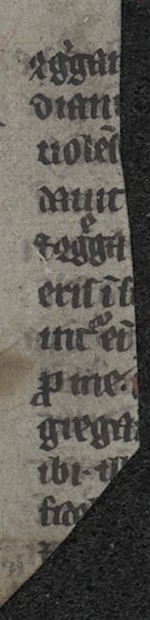
Piece A is a strip about 3 cm wide with a blank upper margin and about 14 lines on each face. Each face keeps the line-ends of one column, the space between the columns, and the line-beginnings of the next. The recto has a two-line blue initial C with red penwork at line 10 of its second column. The passages are:
- recto column b, lines 10-15 (theme and opening): canvas 0, 400,1090,265,260
- verso column a, line-ends 1-14: canvas 2, 215,720,255,680
- verso column b, line-beginnings 1-11: canvas 2, 470,720,150,620
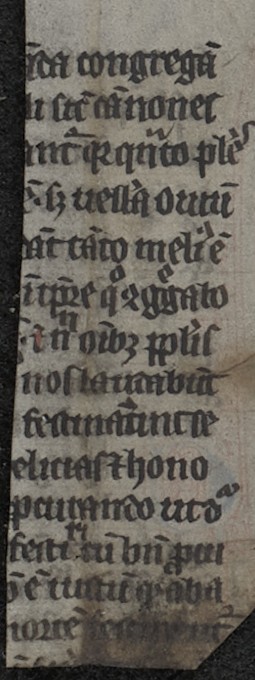
Paris, BnF, lat. 15951, Gallica btv1b90672729, view 360 (ff. 335v-336r) and view 361 (ff. 336v-337r). The lat. 15951 column gives its text as read on the page images, lightly normalised; lines of f. 336va are counted from the top of the column.
| Fragment | lat. 15951 |
|---|---|
| Recto b, line-beginnings: 10 [C]ongrega[ / 11 Solent re[ / 12 ꝯggati ut orōes[ (congregati ut orationes) / 13 [.]sil'. q̄si ip̄o^le^ erat[ ([in]simul(?). quasi impossibile erat) / 14 latī sic enī s[ ([sigil]latim. Sic enim s[unt]) / 15 ^le^ only | f. 336rb: Congregate illi sanctos eius qui ordinant testamentum eius super sacrificia. Ps. / Solent religiosi in capitulo congregari ut orationes omnium petantur(?) simul quia difficile vel quasi impo^le^ erat petere sigillatim. Sic enim sunt sancti in patria quod quasi impo^le^ est orationes petere singulorum ... |
| Verso a, line-ends: 1 [...]ndā(?) congregā[ndi] / 2 (not resolved) / 3 [..]ūt q̃ q̃nto pl'es (quanto plures) / 4 [..]e. sed vell'a ouiū (sed vellera ovium) / 5 [..]āt tanto meli' ē (tanto melius est) / 6 [ii]i. tp̄e q^o^ ꝯgg^e^[ab]o ([Soph. ii]i. tempore quo congregabo) / 7 [..]. in oībȝ ꝓpl'is (in omnibus populis) / 8 nos laudabūt / 9 festiva..(u)nt se(?) / 10 [d]elicias ⁊ hono[- / 11 [ex]pectando ut d^r^ (dicitur) / 12 [fe]stiva^ri^(?) cu(?) bn̄ ꝓcu[rat] (bien procurat) / 13 n̄ ē iustū(?) q̄ p̄(?) ab[ (non est iustum quod p(ost)) / 14 [m]orte [...] | f. 336va, lines 4-15: Sancti ergo ad festivandum congregandi sunt, non mali, quia quanto tales plures sunt peius est. Sancti vero quanto plures tanto melius. Unde Soph. iii. in tempore quo congregabo vos dabo vos in laude et in nomen cunctis populis, hoc est in festo in quo nos laudabunt peccatores. Nam hic festivaverunt sibi divicias delicias et honores illicite expectando sicut dicitur vulg(ariter) bien festivatur qui bien procurat. Et ideo non est iustum quod post mortem in aliis festivent. |
| Verso b, line-beginnings: 1 ꝯgga[n] (congregan[di]) / 2 dia[t] ([exau]diat[ur]) / 3 tiōes e[ / 4 dauit ([man]davit) / 5 ⁊ ꝯgga (et congrega) / 6 eris ī s ([rep]eris in S[usis]) / 7 inc^a^ ei[ / 8 ꝑ me. or ꝓ me. (pro me.) / 9 gregā ([con]gregan[di]) / 10 ibi. il[ (ibi illi) / 11 fid[ (fid[eles](?)) | f. 336va, lines 30-36: exaudiatur. Sic sancti congregandi sunt ut facilius a domino quis exaudiatur. Hest. iiii. Hester volens rogare Assuerum regem mandavit Mardocheo: et vade et congrega omnes quos reperis in Susis, i. in paradiso, et ora pro me. ¶ Sed qua intentione congregandi sunt dicit ibi illi, i. ad honorem. Fideles enim ... |


The differences are listed under Identification above. Along the fourteen line-ends of verso column a the strip and lat. 15951 run in the same order from "quanto plures" to "[m]orte", with the fleece clause as the one addition; in verso column b the order "[man]davit ... et congrega ... [rep]eris ... pro me ... [con]gregandi ... ibi illi ... fideles" is the same, and lines 5-6 divide "rep-eris" where the wording requires. Verso b, line 7 may carry a different gloss on "Susis" ("in c(uri)a ei(us)" has been suggested); that is a conjecture. These differences show that the strip's text is not identical with that of lat. 15951; whether either depends on the other is not established.
Witness compared: Paris, BnF, lat. 15951, ff. 336rb-336va, page images on Gallica (views 360-361). The sermon begins on f. 336rb after "... et facit omnia mala excusari", in a run of All Saints material (the margin of f. 334v reads "qr celebrat festu omn scor", and f. 337r has the running title "De omnibus sanctis"). The lower margin of f. 336r, below column b, reads "fr. N. de biart."; its hand and date were not assessed. Attribution: J. B. Schneyer, Repertorium der lateinischen Sermones des Mittelalters, vol. 4, p. 244, Nicolaus de Byard, Sermones de sanctis no. 194; vol. 5, no. 2016, under Robert of Sorbon.
Leaf order, other items, and what is not claimed
Leaf order, from the text: on piece A the second column of the recto backs the first column of the verso. The sermon opens in recto column b and runs on in verso column a, from about f. 336va, line 4 of lat. 15951, and then in verso column b, from about line 30. In verso column a a line of the strip carries about as much text as a line of lat. 15951. On that basis the column lengths implied by the text (about 24-25 lines for recto column b, about 28 for verso column a) are only roughly consistent, three or four lines apart; variant text such as the fleece clause could account for the difference, but the estimate is not evidence for the identification, and the full height of the column does not survive.
Before the initial, recto column b, lines 1-9 ("sicut vestis s[ / tis sine pelle n[ / et panno non suffi[ / sed opinione hn̄t[ ... / n(on) opus sine ini[ ... / ꝑcutis(?) ex^m^ de v[ ... / titi s; dupliciter"), and the line-ends of recto column a, are the end of a preceding text that is not identified. It shares no wording with the end of the sermon that precedes Congregate in lat. 15951 ("Certe ista bestia terribilis ... Hec est amor sui ... et facit omnia mala excusari"). So at this point the strip's book does not have the order of lat. 15951; the rest of lat. 15951 was not searched for this text.
Piece B is the outer edge of one column, with a wide margin carrying a paraph-like sign and blue and red penwork from an initial that is not on the strip. The first reading saw the same hand and size of script as on piece A, but nothing on the images proves a join. Its lines do not continue piece A's lines at the same height, and its words ("de ip̄o uō ... / [.]p̄m de celo" on one side, "ut ip̄m cō ... / filios eiu[s] ... / q̃nto ei" on the other) were not found on ff. 336r-336v of lat. 15951. It is unplaced, and the identification is claimed for piece A only.
Not claimed: the date and origin of the copy (the catalogue gives 1301-1400; the script was not dated here, and lat. 15951 was not dated); which collection the strips' book contained, and its order of sermons beyond the one place noted; the strip's relation to lat. 15951 or to any other copy; authorship beyond the listings and the marginal note described above; the identity of the text before the sermon and of piece B.