F-mgx2: Gilbert the Universal, Glossa ordinaria in Lamentationes, book I, on Lamentations 1:16-17
Two inscribed spine tabs in Gubbio are identified with high confidence as pieces of a manuscript of the Glossa ordinaria on Lamentations. This is the standard medieval commentary written in the margins and between the lines of the Bible text; the Lamentations part is attributed to Gilbert the Universal (d. 1134). One tab has three line ends from the gloss on Lamentations 1:16, "Quisquis ergo doctorum ecclesiam sibi commissam minus converti viderit, de fonte amoris hauriat, unde lacrimas producat". The other has four line ends from the allegorical gloss on Lamentations 1:17, "nec est ei ulla vox oris digna, qua possit hostium dogmata vincere et sua defendere. Unde sepe fit polluta feditate carnalium ...".
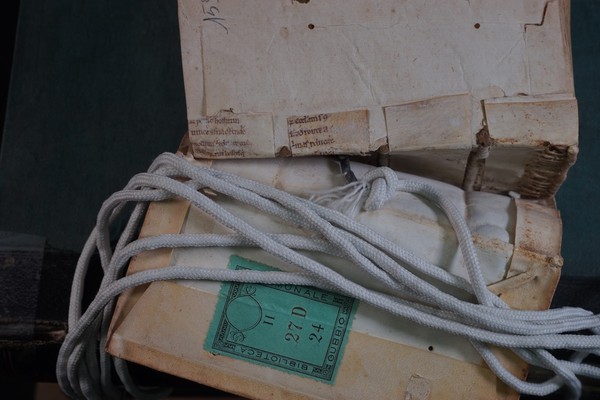
The Fragmentarium record describes four parchment tabs (60 x 29, 59 x 28, 63 x 29 and 60 x 34 mm) reused as spine linings, still in situ, in Gubbio, Biblioteca comunale Sperelliana, II 27 D 24. The host book is Luis de Granada, Scorta del peccatore (Venice: Gabriel Giolito de' Ferrari, 1576). The record dates the tabs to the twelfth century, in a small transitional Caroline minuscule by one hand, and titles them "Unidentified fragments in Latin". Its transcription of a few words ("hostium / suadenter / fede[...]te cal" and "(rum) eccl(esi)am s(ed) / d[...] fonte a / cimas reducat") fits the text identified here, with the corrections given below. The record names no work. The Gubbio record F-dkld, a Vulgate fragment, belongs to a different volume (II 24 D 13) and has no bearing on this one.
- Identification: identified, high. Each tab gives a short run of words, and both match the Glossa in wording and order. Tab B has "-rum ecclesiam s(ibi) c-", "fonte a-" and "-crimas p(ro)ducat". Tab A has "-ua p(ossi)t hostium", "uince(re) & sua defende(re)", "polluta fed[i]t[at]e car-" and "hostes q(uibus)". Three other texts were considered:
- Paschasius Radbertus's commentary on Lamentations, the source the Glossa draws on here, words the 1:17 sentence differently: "quae possit hostes revincere, suaque defendere dogmata". The fragment follows the Glossa's wording.
- Martin of León (d. 1203) copies the 1:16 sentence into a sermon. Full-text searches of his printed works, in the Munich Digitisation Centre's OCR and the Patrologia Latina text, did not find the 1:17 passage. This weakens Martin as an alternative but does not conclusively exclude him.
- Alvarus Pelagius quotes both sentences in De planctu ecclesiae, but he wrote in the fourteenth century, later than the fragment's script. The manuscript reads lacrimas and feditate with the modern edition, where the 1545 print has lachrymas and foeditate.
- Transcription: image-only first reading and source-assisted reading. A research reader reread every visible line of both inscribed tabs on the first photograph, at native size and enlarged. The rereading corrected the first reading's "ostende" to "defende(re)", "cꝯsua" to "& sua", "cal" to "car", and "reducat" to "producat". The opening words of tab A line 4 and of tab B line 2 remain uncertain. Accuracy has not been measured.
- Verification: a research reader compared all seven visible lines with page images of the Lyon 1545 Glossa (scans 392 and 393) and with search snippets of Andrée's edition, pp. 256 and 260. COORDINATOR CHECK: The coordinator read tab A lines 1-2 on canvas 0 (native box 1870,1100,2760,1600) against the Lyon 1545 Glossa page image (MDZ bsb10141269, scan 393). The photographs are oblique and in situ; the left part of every line is cut away, and more lines than are visible are probably hidden under the sewing. Andrée's critical apparatus was not seen. The search for the 1:17 passage in Martin of León rests on OCR and the Patrologia Latina text, not on a reading of his whole work. No human review.
Textual evidence
Manuscript image: canvas 0, "binding strips" (6000 x 4000). Canvas 1 shows the same tabs from another angle. Tab A is the left inscribed tab, at native-pixel box 1870,1100,2760,1600. Tab B is the middle one, at box 2860,1130,3420,1580. Abbreviations are expanded in parentheses. Square brackets in the left column mark text lost at the cut, supplied from the source.

| Fragment | Glossa ordinaria, Lyon 1545 (and Andrée 2005) |
|---|---|
| Tab B l. 1: [docto]rum ecclesiam s(ibi) c[ommissam] | Quisquis ergo doctorum ecclesiam sibi commissam |
| Tab B l. 2: [... vi]d[erit] d[e] fonte a[moris] | minus converti viderit, de fonte amoris |
| Tab B l. 3: [... la]crimas p(ro)ducat | hauriat, unde lachrymas (Andrée: lacrimas) producat |
| Tab A l. 1: [... q]ua p(ossi)t hostium | nec est ei ulla vox oris digna, qua possit hostium |
| Tab A l. 2: [dogmata] uince(re) & sua defende(re) | dogmata vincere, et sua defendere. |
| Tab A l. 3: [unde sepe fit] polluta fed[i]t[at]e car[nalium] | Unde sepe fit polluta foeditate (Andrée: feditate) carnalium |
| Tab A l. 4: [...] ?[desider]iorum ?int(er) hostes q(uibus) | operum et sanguine carnalium desideriorum inter hostes, quibus |
The readable words agree with the Glossa except for spelling. The manuscript's lacrimas and feditate agree with Andrée against the 1545 print's lachrymas and foeditate. Several words are damaged: the second word of tab A line 1, the opening of tab A line 4, and the opening of tab B line 2. The surviving line ends are ragged. This is compatible with a marginal gloss fitted around a Bible text, but the tabs do not establish the original page layout; the missing text lengths cannot be checked securely.
The printed texts compared are:
- Biblia sacra cum Glossa ordinaria, vol. 4 (Lyon, 1545), Threni chapter 1: scan 392, right marginal column, for tab B, and scan 393, left marginal column under "Expandit Sion. Allegori.", for tab A. Both were read from the page images. The running head reads "Glos. ordi. Thren. Cap. I".
- Alexander Andrée, ed., Gilbertus Universalis, Glossa ordinaria in Lamentationes Ieremie prophete. Prothemata et Liber I (Stockholm, 2005), pp. 256 and 260. This was seen as Google Books search snippets only.
The attribution of this gloss to Gilbert the Universal rests on Andrée's edition.
Other observations and limits
The two tabs have the same hand, ink, letter size and line spacing. The Lamentations 1:16 passage comes shortly before the 1:17 passage in the gloss, so the tabs probably come from one leaf or from neighbouring leaves; that is not proved. The two other tabs show no writing on their visible faces. The record counts seven and six lines on the inscribed tabs, while the photographs show four and three. No claim is made about the manuscript's date beyond the catalogue's, its origin, its place in the textual tradition of the Glossa, or whether it is a previously unknown witness.