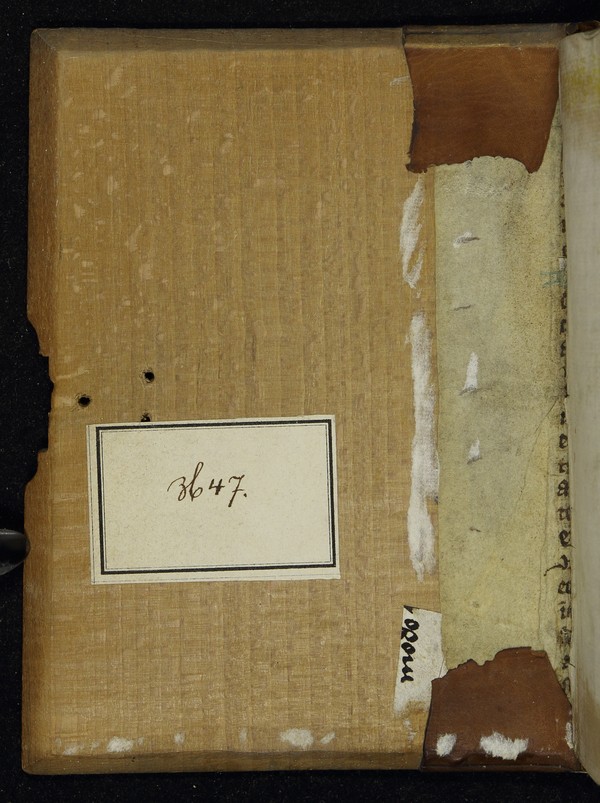
F-n5r2: Canticle of Moses (Audite caeli), Deuteronomy 32:1-27
The guard strip bound into Vienna, ÖNB, Cod. 3647 is a narrow vertical slice of one parchment leaf carrying the Canticle of Moses, Audite caeli quae loquor (Deuteronomy 32), in the wording of the Latin Vulgate. One face runs from verse 1 to verse 14, the other continues from verse 14 or 15 to verse 26 or 27. Only four to six letters of each line survive. The kind of book the leaf came from (a psalter with canticles, a breviary or a Bible) is not established.
The catalogue record describes Wien, Österreichische Nationalbibliothek, Cod. 3647, a guard (a strip of reused parchment sewn into the fold of a quire as reinforcement), 143 x 35 mm, Latin, Northern Textualis, Germany or Austria, dated 1276-1500 with century fields for the thirteenth and fourteenth, title "Unidentified", no description. Nothing in the description conflicts with the text found; the record did not name it. The host volume is listed by manuscripta.at as "Sermones et themata sermonum", with no account of its binding waste.
- Identification: identified, high confidence, as a biblical text; book type open. The letter groups of about 40 of the 56 lines can be placed in Deuteronomy 32:1-27 in unbroken order, at a steady interval of about 50 characters of text from one line to the next, which is what a vertical cut through a regular single column produces. The four coloured initials on the strip (red Q, blue D, blue C, red D) fall on the openings of verses 8, 12, 23 and 26. A psalm was considered because of the alternating initials and set aside: atque twice at the right distances, funic[ulus], [c]ome[deret] and [comp]lebo in this order fit no psalm. The strip is too narrow to show which form of the Vulgate text it has. At the one point checked for this, verse 17, the surviving letters are read is e, the stroke before the s dropping below the line like a long i; that fits daemoniis et and not daemonibus et, which would leave us e. One reading of three letters at low resolution does not place the manuscript's text. Continuous copying with a coloured initial for each verse and a mid-verse point is the usual dress of the canticles appended to a liturgical psalter, where this one is sung at Lauds on Saturday, but the same text stands in breviaries and Bibles and the strip does not decide between them.
- Transcription: source-assisted, both faces. The image-only first reading gives the letter groups without a text. The source-assisted reading was made by a research reader who reread all 28 lines of each face on enlarged crops of the native images and revised some groups with the Vulgate text in hand. About fifteen lines remain uncertain, among them the first two lines of each face and the last of each; they are marked in the reading. Minim strokes (the short verticals of i, n, m, u) cannot be divided securely at this resolution. Accuracy has not been measured.
- Verification: manuscript images against a printed Vulgate text, in part on page images. A research reader compared every line of both faces with a transcription of the Vulgate, and compared the lines falling in verses 7-11, 16-18 and 22-25 with page images of the Vulgate text printed in Dereser's 1788 edition of the canticle. The coordinator read on the images the letter groups mea / s hb / i inu / a su / elis / a atq / ipie / et fec and filios / funic / a: In / it eu / ullos on canvas 2 (Cod3647_Falz2_3_v) and assa / ctor on canvas 1, and compared them with the research reader's table of the Vulgate text, not with a page image. Gaps: verses 1-6, 12-15, 19-21 and 26-27 were compared with the transcription only; no medieval manuscript of the canticle was compared; the other eleven images of the record (covers, pastedowns, spine, edges, flyleaves) were not studied. No human review.
Textual evidence
The strip is shown on two images of the record: canvas 2, labelled Cod3647_Falz2_3_v (image, 648 x 3222 pixels, strip at about x 110-320), and canvas 1, labelled Cod3647_Falz2_3_r (image, strip at about x 310-500). Lines are about 108 pixels apart, the first near y 190. On canvas 1 a host leaf with cursive writing overlaps the right edge of the strip.


Passages collated, with the lost letters of each word supplied in brackets from the Vulgate. Expansions of abbreviations are in parentheses.
Canvas 2, lines 3-11 and 13-15 (native box 110,380,320,1800) and lines 17-19, 21 (110,1870,320,2400):
| Line | Manuscript | Vulgate, Deuteronomy 32 |
|---|---|---|
| 3 | mea | v.2 doctrina mea |
| 4 | s hb (stroke) | v.2 super h(er)b(am) |
| 5 | i i(n)u | v.3 Domini invocabo |
| 6 | a su | v.4 perfecta sunt |
| 7 | elis | v.4 fidelis |
| 8 | ?ecau | v.5 peccaverunt |
| 9 | a atq | v.5 prava atque |
| 10 | ipie | v.6 insipiens |
| 11 | (et) fec | v.6 et fecit |
| 13 | n tu | v.7 patrem tuum |
| 14 | t ti. [red Q] | v.7-8 dicent tibi. Quando |
| 15 | filios | v.8 separabat filios Adam |
| 17 | funic | v.9 Jacob funiculus |
| 18 | a: In | v.10 deserta, in loco |
| 19 | it eu | v.10 circumduxit eum |
| 21 | ullos | v.11 pullos |
Canvas 1, lines 3-7 (native box 310,380,500,930) and lines 14-22 (310,1540,500,2520):
| Line | Manuscript | Vulgate, Deuteronomy 32 |
|---|---|---|
| 3 | assa | v.15 incrassatus |
| 4 | ctor | v.15 factorem |
| 5 | eu(m) i(n) | v.16 eum in diis |
| 6 | ira | v.16 ad iracundiam |
| 7 | is e | v.17 daemoniis et |
| 14 | s fili | v.20 infideles filii |
| 15 | rita | v.21 irritaverunt |
| 16 | s i(n) e | v.21 eos in eo |
| 17 | bo ill | v.21 irritabo illos |
| 18 | debi | v.22 ardebit |
| 19 | ra(m) cu(m) | v.22 terram cum germine |
| 20 | t. [blue C] | v.22-23 comburet. Congregabo |
| 21 | lebo | v.23 complebo |
| 22 | s: au | v.24 eos aves |
The remaining lines, read with less certainty, fall in sequence between and after these: on canvas 2, alie (v.12 alienus), ome (v.13 comederet), a blue D at v.12 Dominus, and bus (v.14 ovibus); on canvas 1, atus (v.19 concitatus), t ab (v.20 ait: abscondam), : iu (v.25 pavor, iuvenem), e. with a red D (v.25-26 sene. Dixi) and minims with b (v.26 hominibus). The first line of canvas 2 stands above the opening of the canticle and may end the preceding text; it is not read securely, and neither is the second line, which should fall in verse 1.
No difference of wording from the Vulgate is visible, and with so few letters a line none could be expected to show. The modern critical text prints daemonibus, inritabo and in pluvia where the Clementine Vulgate (the Roman revision of 1592) prints daemoniis, irritabo and ut pluvia. The strip does not preserve the letters that would separate the second and third pairs; for the first, is e as read agrees with daemoniis. The punctuation mark the strip has after deserta and after eos is a point with a tick above it, marking a pause inside the verse.
Sources used. The whole text was compared with the transcription at vulgate.org, Deuteronomy 32, which gives the critical text (daemonibus). Page images were read in Thaddaeus Dereser, Das Lehrgedicht des Moyses an die Israeliten (Bonn: Abshoven, 1788), which prints the Clementine Vulgate of Deuteronomy 32 with verse numbers beside a German version: p. 8 (verses 7-8), p. 9 (verses 9-11), p. 12 (verses 16-18, Immolaverunt daemoniis, et non Deo), p. 14 (verse 22) and p. 15 (verses 23-25). The text is biblical and needs no attribution beyond chapter and verse.
Leaf order and limits
The face that the catalogue labels verso (canvas 2) carries the earlier text and is the recto of the original leaf; the face labelled recto (canvas 1) follows it directly. Since the second face takes up within a line or two of where the first stops, the strip keeps nearly the full height of a single column of about 28 lines.
The cursive writing beside the strip belongs to the host manuscript and is not part of this result. The covers, pastedowns, spine, edges and flyleaves shown in the other images of the record were not studied.
Not claimed: the kind of book, its date or origin beyond the catalogue's, the form of the Vulgate text, the identity of the text above the canticle's opening, or that the identification is new.