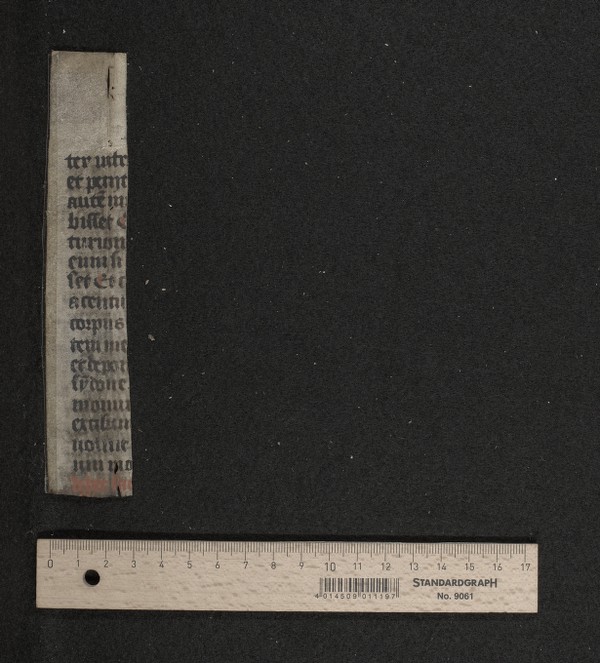
F-ne56: Missal, Holy Week (Tuesday: end of the Passion according to Mark; Wednesday: lesson Isaiah 63 and gradual Ne avertas)
The strip preserves readings and a chant for Holy Week, strongly supporting its identification as part of a missal. Whether the complete book was a plenary missal, containing the prayers as well as the readings and chants, cannot be established from this strip. One face has the end of the Passion according to Mark read on Tuesday of Holy Week (Mark 15:43-46, down to its last words "ad ostium monumenti"), followed by a red rubric. The other face has the end of the first lesson of Wednesday of Holy Week (Isaiah 63:5 and 7, passing from "auxiliata est michi" straight to "Miserationum" without verse 6) and the gradual, the chant sung after that lesson, Ne avertas faciem tuam with its verse Salvum me fac Deus (Psalm 68:18 and 2, Vulgate numbering). The catalogue already named Mark 15:43-46 and Psalm 68. This is a substantial catalogue refinement: it adds the missal identification, the two days, the Isaiah lesson and the precise gradual. The use of the missal (Roman, of a diocese, or of an order) is not determined.
The Fragmentarium record describes Antwerpen, Erfgoedbibliotheek Hendrik Conscience, Fragm. 127: one parchment strip of 161 x 31 mm, Latin, Northern Textualis with red decoration, dated 1451-1500, with the title "Unidentified liturgical manuscript" and the subtitle "Mark 15:43-46 ; Psalm 68". That description fits, and the catalogue already named Mark 15:43-46 and Psalm 68. It does not say what kind of liturgical book this is, to which days the texts belong, that a lesson from Isaiah 63 stands above the psalm text, or that the psalm text is the gradual Ne avertas; those four points are what is new here. The record has no linked description.
- Identification: identified, high, for the Holy Week texts and their liturgical placement. The combination strongly supports a missal; the complete book's plenary format and its use are not established. On fol. [1]r 16 line beginnings fall in order on Mark 15:43-46, and on fol. [1]v 16 line ends fall in order on Isaiah 63:5 and 7 and the gradual. Three features support the missal identification. The Isaiah text passes from "]liata" (line 6) to "]a(ti)onum" (line 7) with room between them only for "est michi. Miser-", so verse 6 is absent, which is the form of the lesson in the missals compared and not the continuous Bible text. The psalm text follows the lesson at once. It runs verse 18 and then verse 2, the order of the gradual and not of the psalm. A Bible or a gospel lectionary is excluded by the abridged lesson followed by a chant; a gradual (chant book) or a psalter is excluded for the verso by the prose lesson above the chant in the same script. In wording the manuscript has "]s que", that is "omnibus que", where the Arbuthnott missal prints "super omnia quae"; a Lateran missal edition seen in a snippet has "super omnibus que". On the recto "intr[" fits "introiuit" or "introiit" equally.
- Transcription: image-only first reading of both faces, and a source-assisted reading in which a research reader reread every line of both faces on enlargements of the native images. The assisted reading differs from the first in recto lines 2 and 6 and verso lines 2, 3, 4, 6, 7, 15 and 16; no line rests on the first reading alone. Verso lines 2, 3, 6 and 7 are rubbed, and the red rubric in recto line 17 has lost its lower half and is not securely read. Accuracy has not been measured.
- Verification: a research reader compared both faces with the text of the Arbuthnott missal in the 1864 edition, pp. 133-134, read as the edition's OCR text and not on the page image, and compared verso lines 6-13 with a Google Books snippet of an edition of a Lateran missal, p. 167. The coordinator read all sixteen line ends of the verso ("non erat", "-esiui et", "-diuuaret", "-chi bra-", "-digna-", "-liata", "-a(ti)onum", "laudem", "-s que", "d(omi)n(u)s deus", "-rtas fa-", "-ro tuo", "uelocit(er)", "-aluum me", "intraue-", "ad a(n)i(m)am") on an enlargement of canvas 1, native box 208,530,601,2000, against the page image of p. 134 of the edition, where the lesson passes from "auxiliata est mihi" to "Miserationum" and the gradual follows; the recto was not checked in this way. No manuscript missal was collated, and no page image of a printed missal was read by the research reader. Only about a quarter to a third of each line survives, so the comparison rests on line beginnings and line ends, not on whole lines. No human review.
Textual evidence
Manuscript images: [fol. [1]r](https://fragmentarium.ms/loris/F-ne56/ehc_20220622b_0071_fragm_127.jp2/full/2458,/0/default.jpg) (canvas 0, 2458 x 2720 pixels), text in the native-pixel box 172,540,565,2070; [fol. [1]v](https://fragmentarium.ms/loris/F-ne56/ehc_20220622b_0072_fragm_127.jp2/full/2314,/0/default.jpg) (canvas 1, 2314 x 2554 pixels), text in the box 208,530,601,2000. The boxes are approximate. The recto keeps the left edge of a column, so each line gives its beginning; the verso keeps the right edge of a column, so each line gives its end. Letters outside square brackets are on the strip; the text inside is supplied from the edition in a medieval spelling. Abbreviations are resolved in parentheses and a question mark marks a doubtful reading.
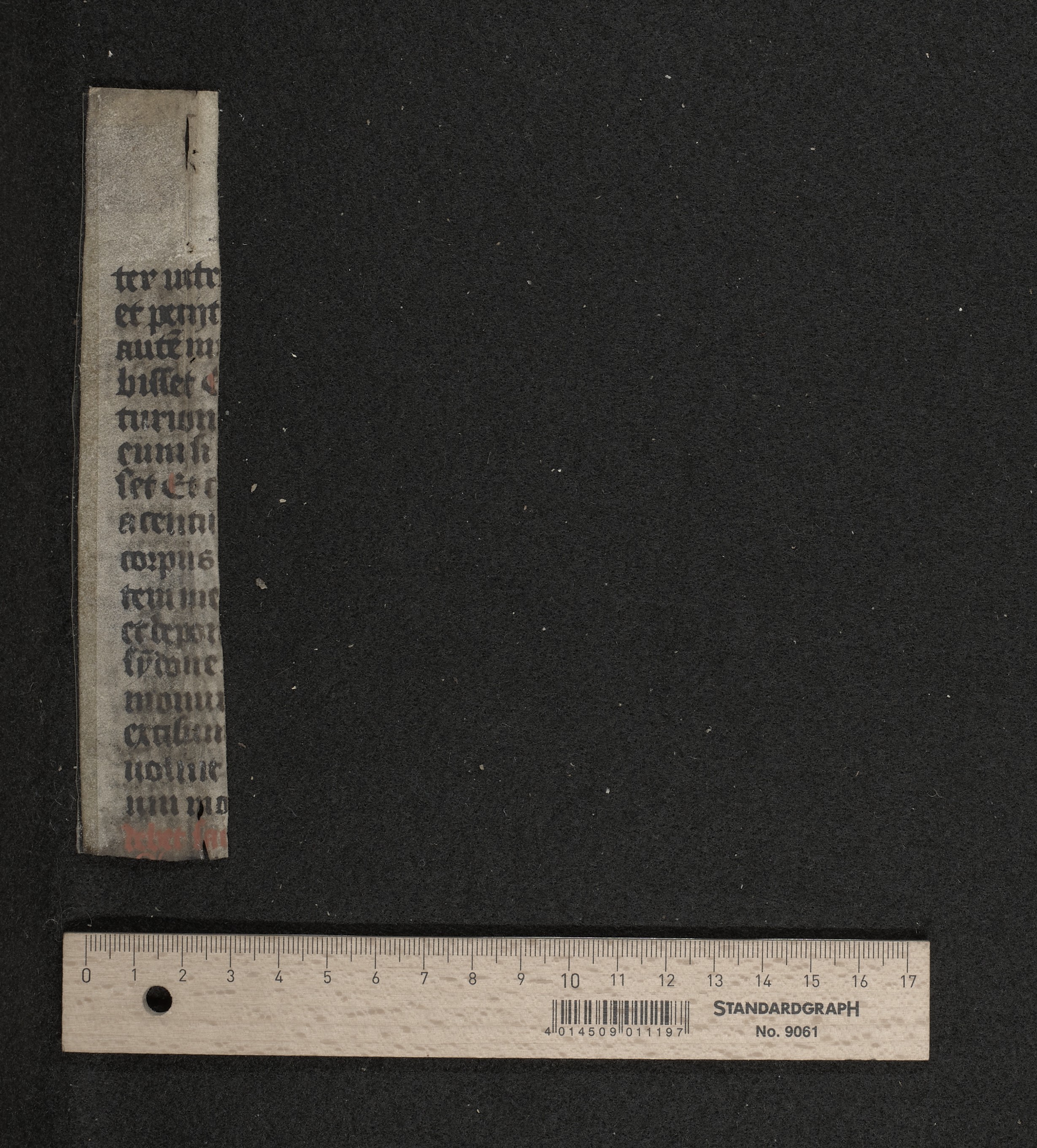

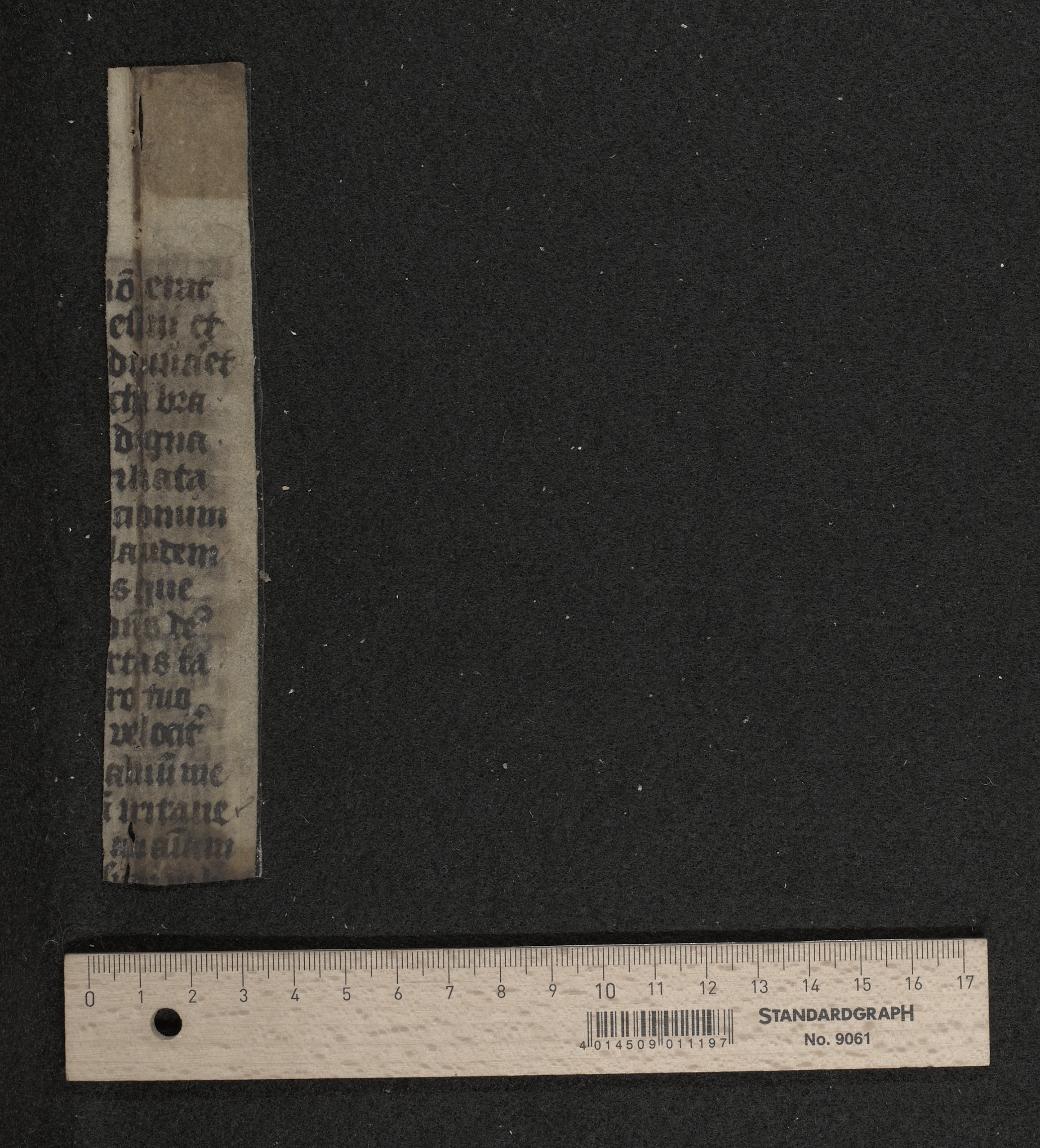

| Line | On the strip | Arbuthnott missal, pp. 133-134 |
|---|---|---|
| r1 | ter intr[ | [audac]ter intr[oiuit ad Pilatum] |
| r2 | et petijt [ | et petiit [corpus Ihesu. Pilatus] |
| r3 | aute(m) m[ | autem m[irabatur si iam o-] |
| r4 | bisset. E[ | -bisset. E[t accersito cen-] |
| r5 | turion[ | -turion[e interrogauit] |
| r6 | eum si [ | eum si [iam mortuus es-] |
| r7 | set. Et c[ | -set. Et c[um cognouisset] |
| r8 | a centu[ | a centu[rione donauit] |
| r9 | corpus [ | corpus [Ioseph. Ioseph au-] |
| r10 | tem m[ | -tem m[ercatus syndonem] |
| r11 | et depo[ | et depo[nens eum inuoluit] |
| r12 | syndone [ | syndone [et posuit eum in] |
| r13 | monum[ | monum[ento quod erat] |
| r14 | excisum [ | excisum [de petra et ad-] |
| r15 | uoluit [ | -uoluit [lapidem ad ost-] |
| r16 | ium mo[ | -ium mo[numenti] |
| r17 | (red) debet sa[ ? | edition: rubric "Offertorium" |
| v1 | ]no(n) erat | [Circumspexi et] non erat |
| v2 | ]esiui et | [auxiliator, qu]esiui et |
| v3 | ]diuuaret | [non erat qui a]diuuaret |
| v4 | ]chi bra | [et saluauit mi]chi bra- |
| v5 | ]digna | [-chium meum et in]digna- |
| v6 | ]liata | [-tio mea auxi]liata |
| v7 | ]a(ti)onum | [est michi. Miser]ationum |
| v8 | ]laudem | [Domini recordabor.] Laudem |
| v9 | ]s que | edition: [Domini annuntiabo super omnia] quae |
| v10 | ]d(omi)n(u)s de(us) | [reddidit nobis] Dominus Deus |
| v11 | ]rtas fa | [noster. Gradale. Ne aue]rtas fa- |
| v12 | ]ro tuo | [-ciem tuam a pue]ro tuo |
| v13 | ]uelocit(er) | [quoniam tribulor] uelociter |
| v14 | ]aluu(m) me | [exaudi me. V. S]aluum me |
| v15 | ](m) intraue | [fac Deus quonia]m intraue- |
| v16 | ]ad a(n)i(m)am | [-runt aque usque] ad animam |
On the recto all 16 line beginnings fall on the edition's text of Mark 15:43-46 in order, at intervals of 18 to 22 letters. The first line has "intr[", which fits the Vulgate's "introiuit" as well as the edition's "introiit". After "monumenti" the edition has the rubric "Offertorium"; the manuscript has a red line there too, but what survives of it looks like "debet sa" and is not that word. On the verso the 16 line ends fit in order. Line 9 ends "]s que", so the manuscript had "omnibus que" where Arbuthnott prints "super omnia quae"; the Lateran missal edition, as far as its snippet shows, reads "laudem Domini super omnibus que reddidit nobis", which agrees with the strip at that point. Whether the manuscript had "Laudem Domini annuntiabo" with Arbuthnott or lacked "annuntiabo" with the Lateran text falls in the lost part of line 9, and in line 3 "non erat" or "non fuit" is likewise lost. Verse 6 of Isaiah 63 ("Et conculcavi populos ...") is absent from the strip, from Arbuthnott and from the Lateran snippet. Lines 2, 3, 6 and 7 of the verso are rubbed and the letters nearest the cut are the least sure. A 17th line on the verso shows only the tops of letters.
Sources: Liber ecclesie beati Terrenani de Arbuthnott, the missal of Arbuthnott in Scotland, of Sarum use (the use of Salisbury), edited by A. P. Forbes and G. H. Forbes (Burntisland 1864), p. 133 for the end of the Tuesday Passion and p. 134 for the Wednesday lesson and gradual, used in the OCR text of the scan. Vetus missale Romanum monasticum Lateranense, edited by Shin-Ho Chang (2002), p. 167, seen only as a Google Books snippet. These are anonymous liturgical texts and no author is in question. The Arbuthnott missal is used as a witness of the common medieval mass formulary for these two days, not as the use of this fragment, and its wording differs from the strip at "omnibus que".
The leaf and what is not claimed
The upper margin is preserved on both faces and the strip is cut at the foot, so each face begins with the first line of its column. Between the last line of the recto and the first of the verso the missal would have had the rest of the Tuesday mass, the Wednesday introit and collect and Isaiah 62:11-63:5, roughly 1,700 to 1,800 letters. That would suit a leaf of two columns of some 35 lines, with the recto strip from the first column and the verso strip from the last; this is an estimate from the length of the text, not something the strip shows.
Not claimed: the plenary format of the complete book; the use of the missal, which is not determined; the date and script, which are the catalogue's; the origin; the reading of the red rubric after the Passion; any relation to other strips in the same collection. A secure reading of that rubric, or the wording lost in verso lines 3 and 9, might narrow the use.