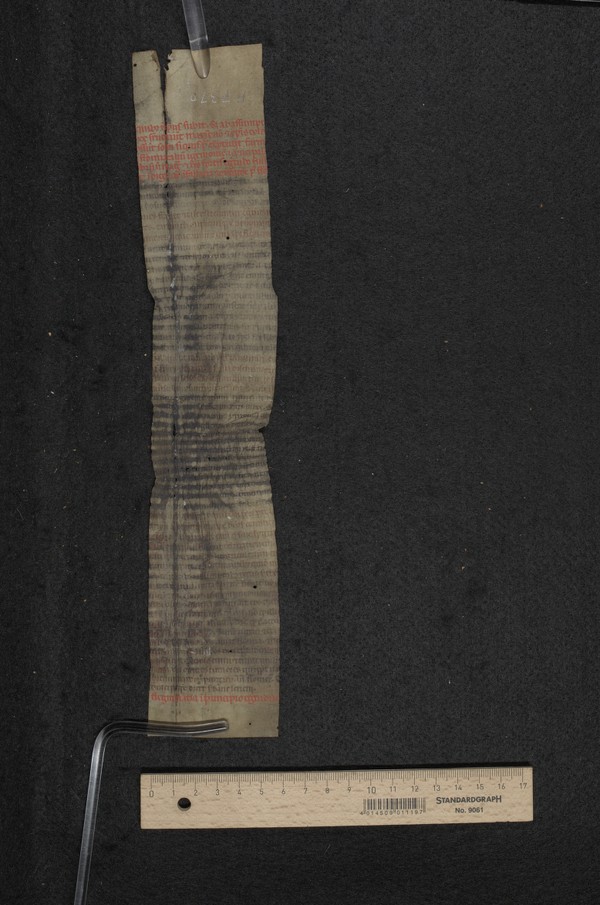
F-nfu2: Hippocrates, Regimen acutorum, book IV with Galen's commentary, Textus XIX-XX and XXIV-XXVII
The strip comes from a fifteenth-century copy of the fourth book of the Hippocratic Regimen acutorum (On regimen in acute diseases) with Galen's commentary, in a Latin translation. The identification is high-confidence. The Hippocratic text is written entirely in red and Galen's commentary in black. The faces carry sections XIX-XX and XXIV-XXVII, numbered as in the Venice 1527 Giunta edition. Both were compared with the page images of that edition.
The Fragmentarium record describes Antwerpen, Erfgoedbibliotheek Hendrik Conscience, Fragm. 308. It is a parchment strip of 317 x 59 mm, written in southern textualis, dated 1401-1500, with 61 lines to the page and red rubrication. It was recovered from the binding of E. van Meteren, Historien der Nederlanden (Amsterdam 1652), K 7370. The record's title is "Medical treatise", and its description calls the text unidentified. The genre is right. The red text is not a series of rubrics, though. It is the Hippocratic text being commented on.
- Identification: identified, high. On face B, about twenty red lines follow Textus XXVII in order, from "[Synanchus] autem fit ex capite reuma mult[um]" to "cum crisis in fallacia iam fuerit". The black line above Textus XXV ends Galen's commentary on XXIV ("parapligiam .i. apoplexiam"). On face A, six red lines give the end of Textus XIX, a black line ends Galen's commentary on it ("ipse dicat secundum hanc seriem"), and the first red line of Textus XX follows ("[phleg]minantia in principio egritudin[um]"). The translation's distinctive vocabulary also agrees: Greek words glossed with ".i." (hygenionicum .i. principale, parapligiam .i. apoplexiam, epispason .i. evellentem) and the closing formula "in fallacia". The reading of the red lines as a liturgical book mentioning Mary and the Assumption was considered and rejected. The words are "sed ab assumpt[ione]" in Textus XIX, and the supposed "Marie" is "maxime vero". One difference of wording is clear: in XIX the manuscript has "sed ab assumpt[ione]", where the 1527 edition reads "sed ad defectionem spirituum". The 1522 Giunta Galen Opera also reads "ad defectione[m]", but that was seen only as an OCR snippet. The translator was not checked, and no claim is made about which Latin version or print tradition the manuscript follows.
- Transcription: an image-only first reading and a source-assisted reading. A research reader reread these on enhanced crops: the red lines at the top and the last two lines of face A, the black block at the top of face B, and the red blocks of Textus XXV, XXVI and XXVII on face B. The darkened, abraded black commentary in the middle of both faces was not reread and rests on the first reading, which is largely illegible there. Every line is cut at both ends. Accuracy has not been measured.
- Verification: a research reader compared the manuscript lines above with page images of the 1527 edition (Bayerische Staatsbibliothek copy, MDZ bsb10139648, scans 709-712). The coordinator read canvas 1 (face B), native box 600,2780-1480,3500, Textus XXVII ('[coagul]atur. lingua liui[da] / -ta et recuruatur propter uenas que sub lingu[a] / ... existentes ad linguam firmant[ur] / [sp]ongiosam propter siccitatem'), against the 1527 Giunta page image, MDZ bsb10139648 scan 712 ('coagulatur: lingua liuida effecta et rotundata: et recurvata propter venas que sub lingua sunt ... existentes he ad linguam firmantur ... spongiosam propter siccitatem'), and found line-by-line agreement. Gaps: the black commentary in mid-face was not compared, Textus XXVI was matched only by its position and its closing word "pugillis", and no Articella incunable or manuscript witness was consulted. No human review.
Textual evidence
Manuscript images: [fol. [1]r](https://fragmentarium.ms/loris/F-nfu2/fol_1r.jp2/full/full/0/default.jpg) (canvas 0, face A) and [fol. [1]v](https://fragmentarium.ms/loris/F-nfu2/fol_1v.jp2/full/full/0/default.jpg) (canvas 1, face B). Boxes are in native pixels. Proposed expansions are in parentheses, text lost at the cut edges is in square brackets, and uncertain readings carry "?".


| Fragment | Regimen acutorum IV, Venice: Giunta 1527 |
|---|---|
| canvas 0, box 660,600-1460,900, red (Textus XIX): "-quib(us) n(on) pus subit. S(ed) ab assumpt- / -[superueni]u(n)t. maxi(m)e u(er)o (et) ep(at)is dolo- / -ssu(n)t solui si quis p(ri)us te(m)ptau(er)it farm- / ... ige(m)monicu(m) .i. p(ri)ncipale / ... magna (et) n(on)? fortis eg(ri)tudo fu- / -[indige]t a(u)t i(n) fallacia (et) moderatio(n)e p(ost) flo-" | scan 709, p. 333, right column: "quibus non pus subit: sed ad defectionem spirituum passiones he superveniunt: maxime vero et epatis dolores: et conversiones egritudinum non possunt solvi: si quis prius tentaverit pharmacare .i. pharmacum dare: sed phlobothomia talium hygenionicum .i. principale est: deinde vero in clysteribus nisi magna et fortis egritudo fuerit: si vero non et postea pharmacia indiget: aut in fallacia. Et moderatione post phlobothomiam: pharmacia." |
| canvas 0, box 660,3550-1460,3830: black "... ip(s)e dicat s(ecundu)m ha(n)c seriem." then red "[phleg]minantia i(n) p(ri)ncipio eg(ri)tudin(um)" | scan 710, left column: "et nimis hic mentem deinceps ipse dicit secundum hanc seriem. Textus XX. Quicumque vero phlegminantia in principio egritudinum mox conantur solvere pharmacia" |
| canvas 1, box 600,1150-1450,1500, red (Textus XXV): "... i(n) p(ri)ncipio / ... omnib(us) c(ir)cu(m)sta(n)tib(us)? / -ib(us) facile e(nim) auxiliabiliora su[nt]" | scan 711, p. 334, right column: "Et oportet hos tales prefomentantes phlobothomare in principio confestis sublimibus existentibus omnibus circumstantibus spiritibus et reumatibus: facile enim auxiliabiliora sunt." |
| canvas 1, boxes 640,2800-1460,4100, red (Textus XXVII): "-s a(u)t fit ex capite reuma mult[um] / ... [v]ernali. ad sa[gittidas]? / -[super]fluat (et) ip(s)am amplior(em) p(ro)p(ter) latitu[dinem] / ... coagulat? eas q(ue) p(ro)p(ri)e sangui[nis] / ... coagulatur. ling(ua) liui[da] / -ta (et) recuruatur p(ro)p(ter) uenas q(ue) sub lingu[a] / ... ad lingua(m) firmant[ur] / [sp]ongiosam p(ro)p(ter) siccitatem / ... ex uenis suscipiens ex lata quide(m) rotu(n)[da] / ... ex molli dura. ex bene i(n)cur[uabili] / ... caput radens (et) cerotu(m) ... / ... fomentare (et) bibere aquam (et) melli[cratum] / ... c(um) crisis in fallacia iam fuerit." | scans 711-712: "Synanchus autem fit cum ex capite reuma multum et conglutinosum hora hyemali vel vernali ad sagittidas .i. occiduas venas superfluat et ipsam ampliorem propter latitudinem epispason evellet ... coagulat eas que proprie sanguinis ... coagulatur: lingua livida effecta et rotundata: et recurvata propter venas que sub lingua sunt ... existentes he ad linguas firmantur ... spongiosam propter siccitatem ... humidum quod ex venis suscipiens ex lata quidem rotunda fit: ex bene colorata vero livida: ex molli vero dura: ex bene vero curvabili incurvabilis ... et caput radens et cerotum collo ... et bibere aquam et mellicratum non frigida da: succum autem offerre cum crisis in fallacia iam fuerit." |
Differences: in XIX the manuscript reads "sed ab assumpt[ione]" where the edition has "sed ad defectionem". The reading is clear on the image, and "spirituum assumptio" is the expression the same lemma uses a line earlier. The manuscript appears to lack "vero" in "ex molli [vero] dura" and "ex bene [vero] incurvabili", which is uncertain at the cut edge. It reads "dicat" for "dicit" at the end of the commentary on XIX. Spellings differ: farm- for pharm-, flobotomia, temptauerit, igemmonicum. No claim is made from these differences about the manuscript's relation to the printed text.
The edition used is Thaddaei Florentini Expositiones in arduum aphorismorum Ipocratis volumen ... In praeclarum regiminis acutorum ... (Venice: Giunta, 1527). Its fourth book of Regimen acutorum is printed as alternating "Textus" (Hippocrates) and "Commentum Galeni", under the heading "Claudii Galeni Pergameni ... Hippocratis liber quartus ... incipit". It was read from the Bayerische Staatsbibliothek copy, MDZ bsb10139648. The attribution to Hippocrates and Galen is the edition's own. The fourth book is the one Galen's commentary already treats as spurious.
Layout and limits
Face A carries text from Textus XIX-XX and face B text from Textus XXIV-XXVII. The text between them is about two columns of the edition's length. That fits a two-column page, with the strip preserving one column on each side, but the layout was not observed directly. Which face is the recto was not established. No claim is made about the manuscript's date or origin beyond the catalogue, about the Latin version or translator, or about the fragment's relation to other copies.