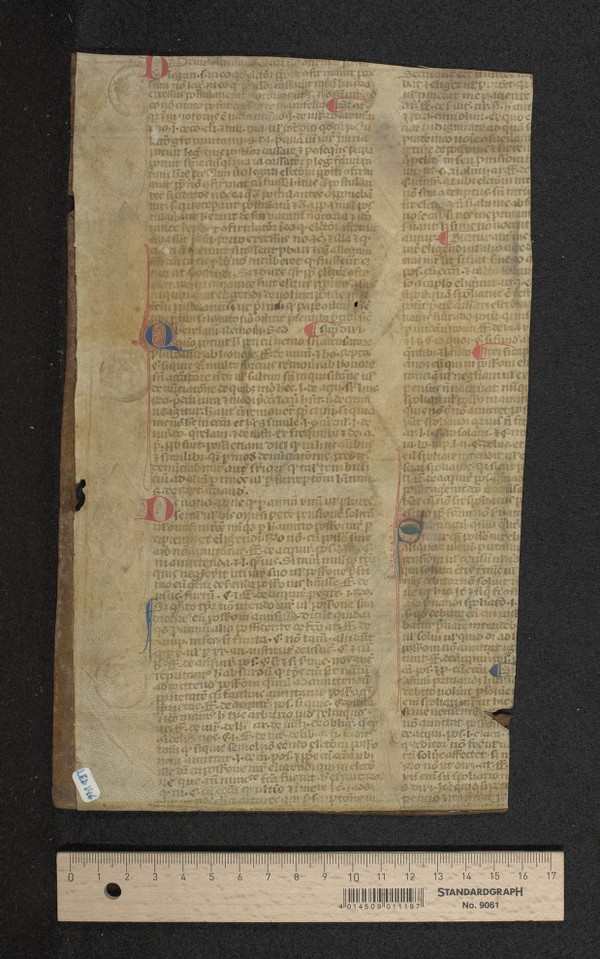
F-o1p7 — Oudenaarde, Stadsarchief, Boekbanden, BB 0027
- Identification: Identified; high identification confidence. The fragment transmits the text printed as Bernardus Compostellanus's Lectura aurea in primum librum Decretalium, on X 1.6.23 Bonae memoriae and X 1.6.24 Querelam. Sustained commentary prose agrees with Paris 1516, fols. 55v–56v, including the opening question about confirmation of the legate's proceedings and the distinctive De novo question about pension and election rights. The attribution is to the text of that edition, conventionally assigned to Bernardus Compostellanus iunior; historical authorship and textual dependence were not separately established.
- Transcription: The preserved image-only reading covers only a short crop and is highly incomplete, with several wrong tentative readings. The source-assisted record preserves corrections and additional scoped readings separately. Neither is a certified full-leaf transcription. Identification confidence does not measure transcription accuracy.
- Verification: A Codex reviewer inspected manuscript crops and actual 1516 print images at fols. 55v, 56r, and 56v. Detailed comparison covers the opening argument, the Querelam / Removeri passage, and De novo. The right-column transition was inspected but its manuscript lemma remains unresolved. These comparisons are source-assisted. No human palaeographic review was performed.
Catalogue details carried from the Fragmentarium record: “Unidentified Roman law text”, 14th century, one trimmed leaf, 266 × 158 mm, one image. The full image shows two columns with red/blue decoration; the right edge cuts through the second column. The identification supports describing the text as a canon-law commentary, with Roman-law citations inside its argument. The date and binding provenance are catalogue information, not findings independently established by these comparisons. The imaged side's recto/verso designation is not settled here.
Sources and scope
The manuscript source is Fragmentarium canvas 0. The following native IIIF regions were inspected from cached images requested at twice native size:
| Region | Scope |
|---|---|
560,220,1020,560 | Column A opening argument, approximately A1–11 |
560,1260,1020,560 | Querelam and beginning of its gloss, approximately A23–33 |
560,1780,1020,560 | End of preceding gloss and De novo, approximately A35–45 |
1620,1780,600,560 and 1620,2300,600,560 | Trimmed column B transition and following discussion; no complete transcription |
The frozen crop image-001.png is the top 310 native pixels of region 560,1260,1020,560. Its text overlaps the larger crop and must not be counted twice. The full-leaf image was inspected for layout, not fully transcribed. No other side was available for these comparisons.
The edition is Bernardus Compostellanus, Lectura aurea in primum librum Decretalium, cum apostillis Anthonii de Crevant (Paris, Berthold Rembolt, 1516), Internet Archive scan. The IA metadata gives the title and imprint. Cached OCR (bern.txt, lines 17950–18350) was read first; downloaded DjVu XML located the scan pages. The OCR interleaves columns and is not a literal transcription of print. These print images were subsequently inspected:
- 55v, scan n125: right column from Duximus confirmandam.
- 56r, scan n126: printed heading Fo. lvi; left column Querelam / Removeri and De novo.
- 56v, scan n127: left-column Substractum and opening Quesiui qualiter amittitur possessio iuris eligendi.


Cached Bibliotheca Augustana, X 1.6 excerpts were also consulted for the underlying Bonae memoriae and Querelam decretals. Their common lemmata do not establish the commentary's attribution.
Selected manuscript reading and comparison
The following is source-assisted. Row numbers count physical rows from the top of each named crop, including partially clipped rows; full-column numbers are approximate cross-references. Parentheses propose abbreviation expansions, ? marks doubt, and [illegible] preserves unresolved text. ul' is retained without silently replacing it with vel. See the assisted record for the complete scoped response and exposure inventory.
From F-o1p7_c0_560_1260_1020x560.jpg:
 3  [Q]uerelam. Remou[illegible]. sed
 3-right  ¶ [illegible]
 4  quo? potuit h(oc) peti cu(m) nemo sin(e) accusatore
 5  p(ro)hibeatur? ab honore. ff. de mun'. et ho. Rescripto.
 6  §. si quis. e(rgo) multo forcius remoueri ab honore
 7  sin(e) accusatore nō d(ebet)? ul' saltim sin(e) inquisitio(n)e ul'
 8  denu(n)ciatione de q(ui)b(us) mo(dis) h(ab)es. s. de accu. sup(er) hiis.
 9  R(espo)n. p(re)dicta iura et modi p(re)dicti locu(m) h(ab)ent ubi de cri-
10  mine agitur. hic aut(em) nō remouet(ur) p(ro)pter crim(en) s(ed) quia
11  ius nō h(ab)et in eccl(es)ia et h(ab)es simile [illegible]
From F-o1p7_c0_560_1780_1020x560.jpg:
 6  [D]e nouo. pone q(uod) p(er) annu(m) unu(m) ul' plures
 7  semel ul' bis omisi pete(re) pensione(m) solita(m)
 8  ul' omisi int(er)esse electio(n)i nu(m)q(ui)d p(ro)pter h(oc) amitto possessio(n)e(m) iur(is) p(er)-
 9  cipiendi et eligendi. R(espo)n. nō cu(m) possessio sine
10  a(n)i(m)o nō amittat(ur). ff. de acquir. pos. [illegible]
| Scoped check | Agreement and limits |
|---|---|
| Column A opening versus 55v, lower right | The question about confirming the legate's proceedings is followed by electionem prepositi, postulationem cassauit, the notorious excess of the postulants, and the need for citation even in notorious cases. This extended sequence supplies an additional check beyond De novo. The faded opening lemma and every abbreviation were not resolved into a new full transcript. |
| Querelam, rows 3–11, versus 56r, left | The print visibly gives the heading Querelam and lemma Removeri, then the question about removal without an accuser, the Digest allegation, inquiry/denunciation, and the distinction between crime and lack of right in a church. These linked arguments agree. The manuscript's lemma and row-3-right word remain unresolved. |
| De novo, rows 6–10, versus 56r, lower left | The distinctive sequence of one or more years, one or two omissions, a customary pension, participation in an election, and possession of the rights of receipt/election appears in both. The print begins, in expanded normalization, “Pone quod unum annum vel plures semel vel bis omisi petere pensionem solitam vel omisi interesse electioni”; the manuscript appears to have per annum unum. Its answer likewise states that possession is not lost without intention. This commentary prose, rather than the shared lemma alone, supports identification. |
| Column B transition versus 56v, left | Print visibly reads Substractum and then Quesiui qualiter amittitur possessio iuris eligendi. The manuscript lemma is unresolved because the image is faint and trimmed; no lemma difference is established. This check does not supply a full collation of column B. |
Significant differences and unresolved readings are not silently harmonized. At the first ab honore occurrence, the tentative manuscript reading p(ro)hibeatur? is supported by the print's prohibeat(ur). Later, the manuscript appears to have remoueri ... sine accusatore and an abbreviated negative expression, whereas the print gives ut removeatur ... sine accusatione. The exact manuscript expression still needs palaeographic review.
The large Q belongs to Querelam on crop row 3, not the first word of row 4. The red row-3-right mark is pilcrow-like, but its following word remains unread. No correction, deletion, or marginal addition is securely identified in this span.
Result and remaining limits
The sequence and extended distinctive prose identify the text in the 1516 edition. No competing compilation with this complete sequence was established; wholesale borrowing is not excluded merely by identifying the printed text. The shared canonical lemmata and Roman-law allegations alone would not settle the attribution. Phrase-search failures against other canonists are not treated as exclusions.
Much of the leaf, exact legal-reference abbreviations, the foot of column A, and most of column B remain uncollated. The number of missing connecting lines, the presence or absence of a Hostiensis citation, manuscript rarity, and witness novelty are not established by these checks.
The useful next work is a palaeographic check of the unresolved Querelam wording and column B lemma, or a complete manuscript-to-print collation if full transcription is wanted.