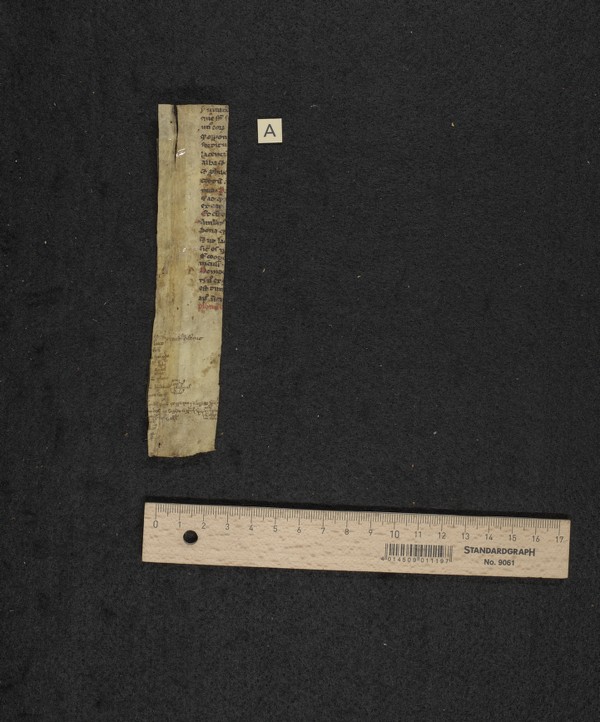

F-qycu: Avicenna, Canon medicinae (Latin of Gerard of Cremona), III, fen 3, tract. 1, ch. 1-2
Strip A of this fragment is identified with high confidence as the outer edge of a leaf of Avicenna's Canon of Medicine in Latin, from Book III, fen 3 (a fen is one of the sections into which each book of the Canon is divided; this one is on the eye), tractatus 1. It holds the second half of chapter 1, on the anatomy of the eye, down to its last words, followed by the red heading of chapter 2, on knowing the conditions and complexions of the eye. Strip B carries no main text, only a marginal scheme.
The Fragmentarium record describes two parchment strips, Antwerpen, Erfgoedbibliotheek Hendrik Conscience, Fragm. 418 a-b, 146 x 29 mm and 148 x 29 mm, taken from the binding of Lucian, Dialogi aliquot (Basel, Froben, 1534), dated to the second half of the thirteenth century and titled "Unidentified Latin text with glosses", with the content note "Probably a treatise on optics". The guess was close in subject, since the text concerns the eye, but it is medical anatomy and not optics. The description of the hands and of the glosses fits. The catalogue date has not been reassessed; the record's century field (15th) disagrees with its own date range.
- Identification: identified, high. Each side of strip A preserves only the first or last two to nine letters of the bottom 24 lines of one column, so the placement rests on the order and spacing of short line ends and line beginnings, not on any long phrase. On the side that holds the earlier text, 22 of 24 line ends were placed; on the other, all 24 line beginnings, the last being the rubric "[com]plexionum e[ius]". They occur in the printed text in the same order at a steady interval of about 45 to 60 letters, and the gap between the two sides (about 1,500 letters) equals the lost upper half of the second column. The fragment has the Canon's running text and the next chapter's heading in the Canon's own order, with glosses in another hand in the margin, so it is the Canon itself and not a commentary or an excerpt in another work. Other texts on the eye were tested by the same word-sequence method and do not fit: Alcoati and the other treatises in Pansier's Collectio ophtalmologica, Petrus Hispanus De oculo, Benvenutus Grapheus, Albertus Magnus De animalibus, the 1572 Opticae thesaurus of Alhazen and Witelo, Roger Bacon's Perspectiva, Bartholomaeus Anglicus, and the 1515 volume of Isaac and Constantine the African. Only one print of the Canon was compared (Padua 1479); no difference of wording can be established from so little text, apart from the two doubtful places noted below. The attribution of the translation to Gerard of Cremona is the conventional one and was not checked.
- Transcription: image-only first reading by an isolated reader, covering every line of strip A and the traces on strip B, and a source-assisted reading. A research reader reread all 48 lines of strip A on enlarged crops, first without and then with the source; about fifteen first readings were corrected once the source was known (for example "partis se[cundine]" for "patris sed", "vero ex" for "visu ex"). The strip is about 190 pixels wide in the published image, so single letters are often ambiguous. Accuracy has not been measured.
- Verification: a research reader compared the strip with the Padua 1479 print. Lines 4-24 of the earlier side and lines 1-12 and 17-24 of the later side were compared with the print's page images; lines 13-16 of the later side were first compared with the print's machine-read text (OCR) and then read on the page images by the coordinator ("et cum eis" at the foot of leaf 73, column b; "quoddam simile panniculo", "sit bona" and "et ut lacertus" at the head of leaf 74). Lines 1-2 of the earlier side were not placed. The coordinator read the first eleven line beginnings of canvas 0 (native box 940,490,1110,1010: "s' virtutem / que sunt / unus eorum / que oppon- / fortitu- / lacertu- / alba et / et prohib- / coniun- / mia. P / quod ad o-") on the manuscript image and the same passage, with the rubric of chapter 2, on the page images of the 1479 print. No critical edition and no second print or manuscript of the Canon was consulted. No human review.
Textual evidence
Manuscript images: [fol. [1]r](https://fragmentarium.ms:443/loris/F-qycu/fol_1_r.jp2/full/2881,/0/default.jpg) (canvas 0) and [fol. [1]v](https://fragmentarium.ms:443/loris/F-qycu/fol_1v.jp2/full/2663,/0/default.jpg) (canvas 1). The text runs from the side labelled v to the side labelled r, so the labelled verso is the earlier page. Line ends are in native-pixel box 500,575,680,1600 of canvas 1; line beginnings in box 940,490,1110,1520 of canvas 0, the rubric in box 930,1380,1120,1530. In the right-hand column the fragment's letters are in square brackets; print abbreviations are resolved.


Side labelled v (earlier text), line ends:
| Fragment | Padua 1479, leaf image 73, column b |
|---|---|
| 4 ...opposit(a) | superfluitatis [opposita] est parti nutrimenti |
| 5 ...grade- | et causa completiva est ut [gra]detur delatio luminis super glaciale |
| 6 Ampli- | et sit ei sicut clipeus. [Ampli]us extremitas nervi |
| 7 et glaciale | comprehendit vitreum [et glaciale] |
| 8 ...ugineum | usque ad terminum qui est inter glaciale et [albugineum] |
| 9 est apud | et terminus apud quem pervenit vitreus [est apud] coronam |
| 10 ...nationem | sicut rete comprehendit [venationem] |
| 11 ex ipsius | quapropter nominatur retina et nascitur [ex ipsius] extremitate |
| 12 ...ratur tu- | tela aranea ex qua [generatur tu]nica subtilis |
| 13 partis se- | cum qua penetrant ... [partis se]cundine quam nominabimus |
| 14 ...guitur in- | et illa quidem tunica [distinguitur in]ter secundinam et inter albugineum |
| 15 ...le et spis- | ut inter [subtile et spis]sum sit separatorium aliquod |
| 16 ...ei nutrim- | et ut adveniat [ei nutrim]entum ab anteriore parte ipsius |
| 17 ipsum a | penetrans ad [ipsum a] retina |
| 18 sicut | et secundina subtilis non fuit [sicut] tela aranee |
| 19 erecta | nisi quia si esset spissa [erecta] in facie glacialis |
| 20 quin | non elongaretur [quin] accideret ex ea |
| 21 ...elaret | propter suam spissitudinem vel alterationem eius quod [velaret] lumen a glaciali |
| 22 ...mitas | ex via albuginei. [Extremitas] autem panniculi subtilis |
| 23 ...venis | impletur et texitur [ex venis] sicut secundina |
| 24 ...mentum | Quoniam ipsa facit penetrare [nutrimentum] |
Side labelled r (later text), line beginnings:
| Fragment | Padua 1479, leaf image 73, column b (lines 1-12), leaf image 74, column a (lines 13-24) |
|---|---|
| 1 s' virtut- | et est [secundum virtutem] sicut composita ex tunicis subtilibus quattuor |
| 2 que sunt | [que sunt] sicut cortices suppositi ut si excorticetur |
| 3 unus eor- | [unus eorum] non fiat commune nocumentum et de ea est |
| 4 que oppon- | [que opponitur] foramini quoniam ille locus est magis indigens |
| 5 fortitu- | [fortitudine] et tutela. Tertius vero comprehendit |
| 6 lacertu- | [lacertum] motus pupille et impletur totus carne |
| 7 alba et | [alba et] pingui ut leniat oculum et palpebram |
| 8 et prohib- | [et prohibeat] eos exiccari et vocatur totum |
| 9 coniun- | [coniunctiva]. Lacertum autem moventem oculum iam diximus in anato- |
| 10 mia. P- (P touched red) | [mia. Palpebre] vero create fuerunt ut expellant |
| 11 quod ad o- | [quod ad oculum] volat et descendit ad ipsum de capite |
| 12 et ut eq-? | [et ut equent] lumen sua nigredine |
| 13 Et cum e- | [et cum eis] quidem ponitur |
| 14 simil- | quoddam [simile] panniculo quod similatur cartilagini |
| 15 bona | ut eorum statio super ipsum sit [bona] et non cadant propter debilitatem eius |
| 16 et ut lac- | [et ut lacertus] aperiens oculum habeat sustentaculum |
| 17 sicut os | [sicut os] ut bona fiat eius motio. Partes autem palpebre |
| 18 sunt coope- | [sunt coopertorium]. Deinde una duarum tunicarum |
| 19 pannicu-? | [panniculi]: deinde eius adeps postea lacertus eius |
| 20 Deinde (D touched red) | [deinde] tunica postrema et est hec superior. Inferiori |
| 21 vero ex | [vero ex] partibus deest lacertus et locus quidem in cuius scissione |
| 22 est tim- | [est timor] est ex eo quod sequitur anteriorem partem eius |
| 23 apud ini- | [apud initium] lacerti. (rubric:) de cognitione dispositionum oculi et com- |
| 24 (red) plexionum e- | [complexionum eius] et sermone universali de egritudinibus eius |
Differences: in line 14 of the later side the fragment seems to have "similiter" with an abbreviation stroke where the print has "simile"; this cannot be decided at this resolution. Line 16, "et ut lac-", agrees with the print, which reads "et ut lacertus aperiens" on the page (the OCR drops the "et"). The fragment's lines are a little shorter on the later side than on the earlier one. Nothing else that survives differs from the print. Lines 1-2 of the earlier side ("...iuven?", "...appr?") were not matched to the words that precede line 3.
The print compared is Canon medicinae, books III and V, Padua, [Johannes Herbort], 1479, in the copy of the Yale medical library digitised at archive.org; page images 73 and 74. The page carries the headings "Fen tertia de dispositionibus oculorum" and "Capitulum i. de anatomia oculi". The work and date of the print are taken from the library's record. The Latin Canon of the early prints is by convention the twelfth-century translation of Gerard of Cremona; that was not verified here.

Leaf order and other items
Both sides of strip A show the bottom 24 lines of a column with the lower margin beneath, and the outer margin beside it; the column had about 48 lines. In the lower margin of the side labelled r a second, smaller hand has written a bracketed list in which "sicco", "frigido", "humido" and "pleno" can be read; these are terms of chapter 2, which begins at the rubric, so the note is probably a scheme of that chapter. The longer marginal notes are unread.
Strip B has no main text. One side is blank apart from a word caught in the fold; the other has seven or eight short pale lines in a hand like that of the glosses, joined by pen strokes, which look like a marginal scheme. Nothing on it was read securely, and it is not shown that it comes from the same leaf as strip A.
Not claimed: the date and origin of the manuscript, which are the catalogue's; the identity of the gloss; any relation to a particular manuscript or recension of the Canon; and that the identification is new to scholarship.