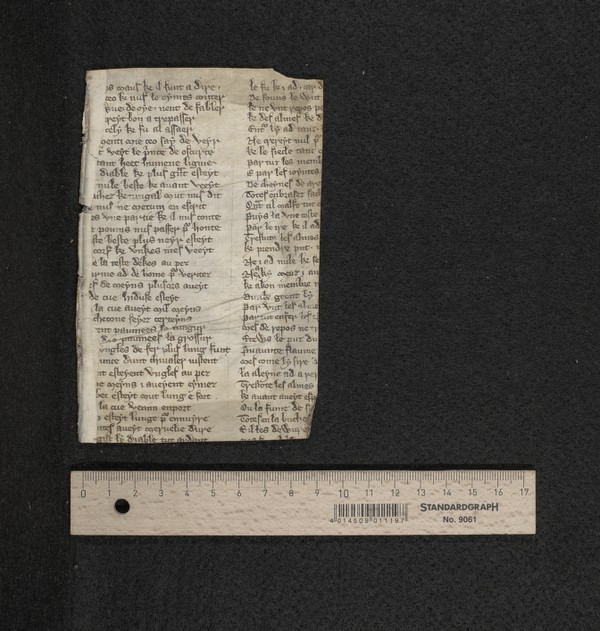
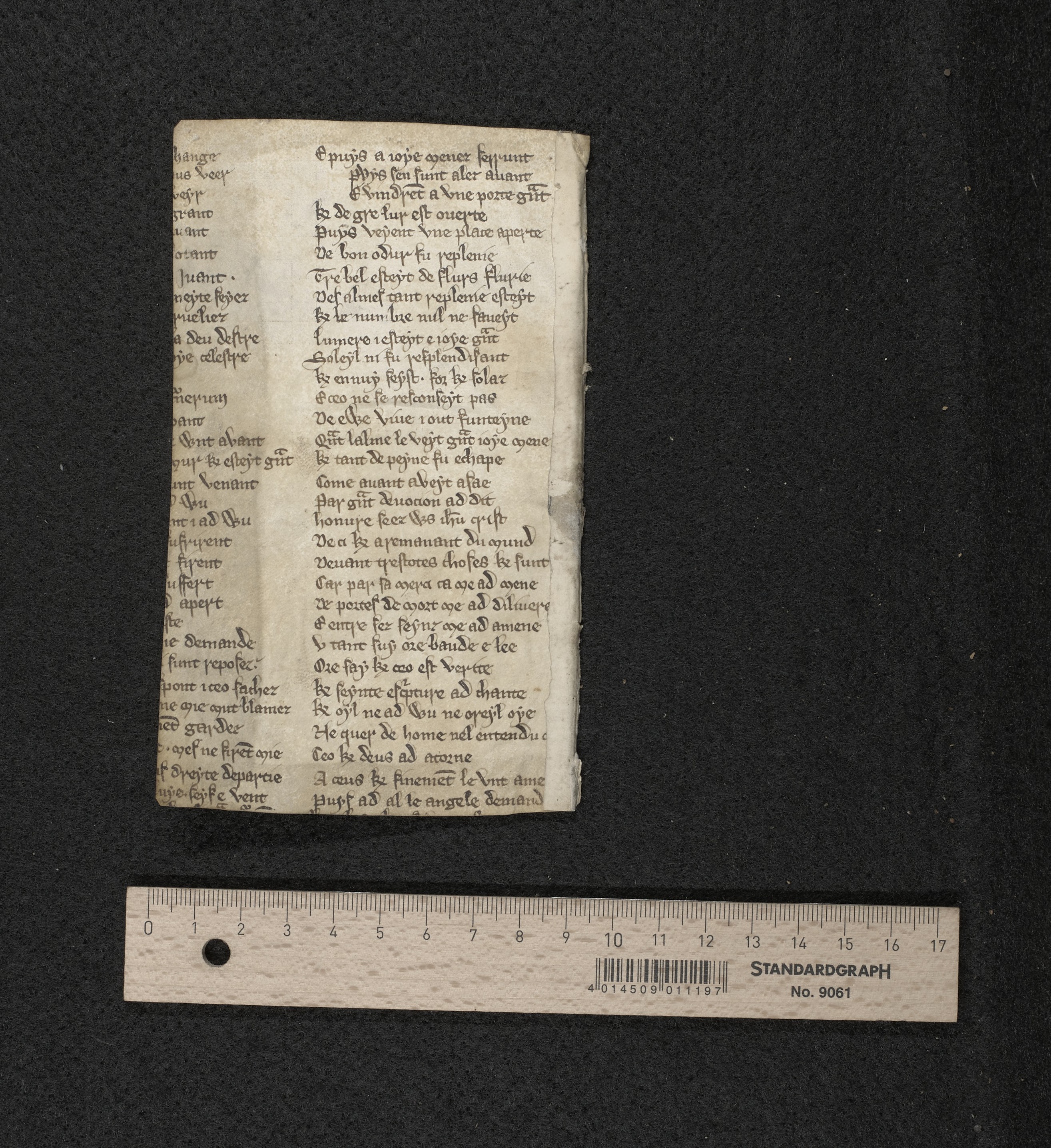
F-rjkx: Marcus, Visio Tnugdali (Vision of Tundale), Anglo-Norman verse translation, Wagner 1882 pp. 36-41
These two leaves carry part of an Anglo-Norman French verse translation of the Visio Tnugdali, the Latin Vision of Tundale written by the Irish monk Marcus in 1149. The identification is high-confidence. It identifies the work being translated and the passage. The leaves follow the Latin in order, from the description of Lucifer in the depths of hell to the gate and the field of joy with the fount of life, corresponding to Wagner's edition of the Latin, pp. 36-41. The translation is in octosyllabic couplets (rhyming pairs of eight-syllable lines). The manuscript was compared with the Latin because no edition of this French text was found.
The Fragmentarium record describes Antwerpen, Universiteitsbibliotheek Antwerpen, Bijzondere Collecties, MAG-P 64.74: two partial parchment leaves, 150 x 94 mm, from England, dated 1301-1325, in northern textualis with a red initial. The previous owner was Marcus de Schepper. The title is "Unidentified religious treatise in Anglo-Norman verse", and there is no further description. The record's language, verse form and religious subject fit. The text is a translated otherworld vision, not a treatise.
- Identification: identified, high. The work translated is the Visio Tnugdali. Manuscript and Latin agree phrase by phrase, in the same order, across all four faces. The Lucifer passage has his claws "of iron, longer than the lance knights use" ("ungles de fer plus lung sunt / [ke la la]unce dunt chivaler usent" = "ungulas lanceis militum longiores, et ipsas ferreas"). The angel's dialogue explains why God does not always give power to the good to correct their subjects, and why Lucifer is called prince of darkness when he cannot even free himself. Then come a red rubric for the souls "not very wicked" and the gate that opens of itself onto the fragrant field. The translation is free and amplifying: the passage on prelates who seek office "pur beiuere e pur manger" has no counterpart in the Latin. The soul's "Sit nomen domini benedictum" becomes an address to Jesus Christ. The one edited Anglo-Norman verse Tundale, Dublin, Trinity College 312 (C.4.2), ff. 140r-143v, ed. Friedel and Meyer 1907, is a different poem in monorhymed alexandrine laisses (stanzas of twelve-syllable lines on a single rhyme). It is therefore not this text.
- Transcription: an image-only first reading and a source-assisted reading. A research reader reread four columns on the image: fol. [2]v column b, fol. [2]r column a and fol. [1]v column b in full, and the lower half of fol. [1]r column a. The cut columns, fol. [1]r col b, fol. [1]v col a, fol. [2]r col b and fol. [2]v col a, rest on the first reading. The same is true of the upper half of fol. [1]r col a and of the stained bottom lines of fol. [1]v and fol. [2]r. Accuracy has not been measured.
- Verification: a research reader compared the reread lines with Wagner's 1882 edition of the Latin. The text was first located in the OCR. The Lucifer, prelates and gate passages were then checked on the archive.org page images of pp. 36, 38 and 41. The coordinator read canvas 3 (fol. [2]v), column b, native box 760,340-1420,1200 ('E vindret a une porte grant / Ke de gre lur est overte / Puis veyent une place aperte / De bon odur fu replenie ... Des almes tant repleine esteyt / Ke le numbre nul ne saveyt ... De ewe vive i out funteyne'), against Wagner 1882 p. 41, lines 2-8, on the archive.org page image ('venerunt ad portam, que ultro aperta est eis ... campum ... odoriferum, floribus insitum ... multitudo animarum, quam dinumerare nemo poterat ... fons aque vive'), and found phrase-by-phrase correspondence in sequence. Gaps: the comparison is with the Latin source, not with any French witness, since none was found. The cut columns were matched in sequence only from the first reading. The Middle English Vision of Tundale, said to derive from an Anglo-Norman text, could not be consulted. No human review.
Textual evidence
Manuscript images: [fol. [1]r](https://fragmentarium.ms/loris/F-rjkx/fol_1r.jp2/full/full/0/default.jpg) (canvas 0), [fol. [1]v](https://fragmentarium.ms/loris/F-rjkx/fol_1v.jp2/full/full/0/default.jpg) (canvas 1), [fol. [2]r](https://fragmentarium.ms/loris/F-rjkx/fol_2r.jp2/full/full/0/default.jpg) (canvas 2) and [fol. [2]v](https://fragmentarium.ms/loris/F-rjkx/fol_2v.jp2/full/full/0/default.jpg) (canvas 3). Boxes are in native pixels. Proposed expansions are in parentheses, letters lost at the cut edge are in square brackets, and uncertain readings carry "?".


| Fragment | Visio Tnugdali, ed. Wagner 1882 |
|---|---|
| canvas 0, col a, box 350,1150-1100,2010: "[C]ent paumees de lungure / [D]es paumees la grossur / [L]ungles de fer plus lung sunt / [Ke la la]unce dunt chiualer usent ... [Le] bec esteyt mut lung e fort / [E] la cue venim enport ... ]gist li diable tut ardant" | p. 36, lines 10-16: "qui digiti habent in longitudine centenas palmas et in grossitudine denas, ungulas lanceis militum longiores, et ipsas ferreas ... rostrum autem habet nimis longum et grossum, caudam etiam asperrimam et longam et ad nocendum animabus ... Iacet itaque ... super cratem ferream suppositis ardentibus prunis" |
| canvas 1, col b, box 730,260-1470,1930: "Come homicide . advltrie / Larcin . orgoyl . e trecherie ... E les prelaz ke entre sunt / Ke p(ur) mestre desirez unt / Prelacie . nent p(ur) valer ... Come seynt escripture dit aliors / Les mals puyssaunz puyssante[ment]" | p. 38, lines 6-15: "adulteri, homicide, fures, latrones, superbientes ... Hic quoque prelati et potentes seculi, qui desiderant preesse, non ut prosint, set ut presint ... Quapropter scriptura clamat: Potentes potenter tormenta patiuntur." |
| canvas 2, col a, box 340,250-1030,1940: "[M]es malement usent li home ... Pur quey ne ad n(ost)re sire done / [P]oer al bons de amender / [L]ur subiecs ke veyent errer ... [Al] bons est poer tolu / [P]ur peche de autre gent ... [Ke] est de tenebres p(ri)nce apelle / [Pur] quey ceo est car nul defendre / [N]e put ... / [N]e seymemes deliuerer ne put" | pp. 38-39, 38,17-39,3: "set malum est, male uti ea. Et anima: Quare omnipotens dominus non semper potentiam bonis tribuit, ut subditos suos emendarent ... Aliquando bonis potestas tollitur, subditorum culpis exigentibus ... quam ob causam illud monstrum princeps vocatur tenebrarum, cum neminem possit defendere nec semet ipsum valeat liberare?" |
| canvas 3, col b, box 760,340-1420,2010: "E vindret a une porte g(ra)nt / Ke de gre lur est ouerte / Puys veyent une place aperte / De bon odur fu replenie / Tre bel esteyt de flurs flurie / Des almes tant replenie esteyt / Ke le numbre nul ne saueyt ... De ewe viue i out funteyne ... Par g(ra)nt deuocion ad dit / Honure seez vus ih(es)u crist / De ci ke a remenant du mund ... De portes de mort me ad diliuere / E entre ses seynz me ad amene ... Ke oyl ne ad vu ne oreyl oye / Ne quer de home nel entendu[t] / Ceo ke deus ad atorne / A ceus ke finement le unt ame" | p. 41, lines 2-17: "venerunt ad portam, que ultro aperta est eis. Quam cum intrassent, viderunt campum pulchrum, odoriferum, floribus insitum ... multitudo animarum, quam dinumerare nemo poterat ... et est ibi fons aque vive ... cum magna devotione: Sit nomen domini benedictum ex hoc nunc et usque in seculum, qui de portis inferi liberavit me ... et introduxit me in partem sortis sanctorum ... Quod oculus non vidit nec auris audivit nec in cor hominis ascendit, que preparavit deus diligentibus se." |
Differences: these are a translator's departures, not variants of the Latin. The prelates passage on fol. [1]v is much longer than the Latin. It adds prelates who seek office for drink, food and fine horses, who will not support the good, who flatter the wicked, who act "come mercenarie", and who fail through "charnalite" or favour. The doxology is recast as praise of Jesus Christ "de ci ke a remenant du mund". "De portes de mort" agrees with the variant mortis of Wagner's manuscripts B and M against inferi. That is a single agreement with a biblical phrase and is not used to place the translator's Latin model. On fol. [2]r, "[P]ur ceo est prince apellez / [Ke p]rimerement prent le delices?" does not plainly render "propter primatum, quem tenet in tenebris", and the reading is uncertain.
The edition used is Albrecht Wagner, Visio Tnugdali. Lateinisch und altdeutsch (Erlangen: Deichert, 1882), a critical edition of the Latin with apparatus, read from the page images at archive.org, VisioTnugdaliWagner. The attribution of the Latin to Marcus rests on the work's own prologue and dedication, as accepted by the edition. Helinand of Froidmont's Chronicon, which copies the Vision, independently has the lance comparison ("ungues lanceis militum grossiores et longiores, et ipsos ferreos").
Leaf order and limits
Each leaf keeps one full column and part of the other. The text runs in this order: fol. [1]r, fol. [1]v, fol. [2]r, fol. [2]v. Fol. [1]v column b reaches "Les mals puyssaunz puyssante[ment]", the Latin "Potentes potenter tormenta patiuntur" (Wagner p. 38). At least three faint lines follow under a stain and the foot of the column is trimmed; they seem to begin the soul's question about power that God gives. Fol. [2]r column a opens "... ke deu done / Mes malement usent li home", the angel's answer "Potentia, que a deo est, non est mala, set malum est, male uti ea". No sentence of the Latin is skipped between the two leaves, so they are consecutive in the text, but how many French lines are lost at the foot of fol. [1]v cannot be determined from the images. Whether they form a bifolium was not established. Fol. [2]r column b has a red rubric, "De la peyne de ce[us ...]", corresponding to the Latin chapter "De moderata pena non valde malorum" (Wagner p. 39), and a red initial L.
This French verse version was not found recorded in the sources checked. ARLIMA lists the French and Anglo-Norman versions of the Vision de Tondale, and its only Anglo-Norman verse version is the Dublin alexandrine fragment. R. Easting, Visions of the Other World in Middle English (1997), p. 74, cites one Anglo-Norman translation (Friedel and Meyer). E. Gardiner, Medieval Visions in Western Culture (1993) and J.-M. Picard, The Vision of Tnugdal (1989) name only the Dublin fragment. A web search for an Antwerp Tundale fragment found nothing. Four sources could not be consulted: Dean and Boulton, Anglo-Norman Literature: A Guide to Texts and Manuscripts (1999), pp. 307-308; N. F. Palmer, Visio Tnugdali: The German and Dutch Translations (1982); M. Cavagna, La Vision de Tondale et ses versions françaises (2017); and the Jonas repertory. No claim is made that the version is new, or about its relation to the Middle English Vision of Tundale, its date of composition, or the manuscript's date and origin beyond the catalogue.