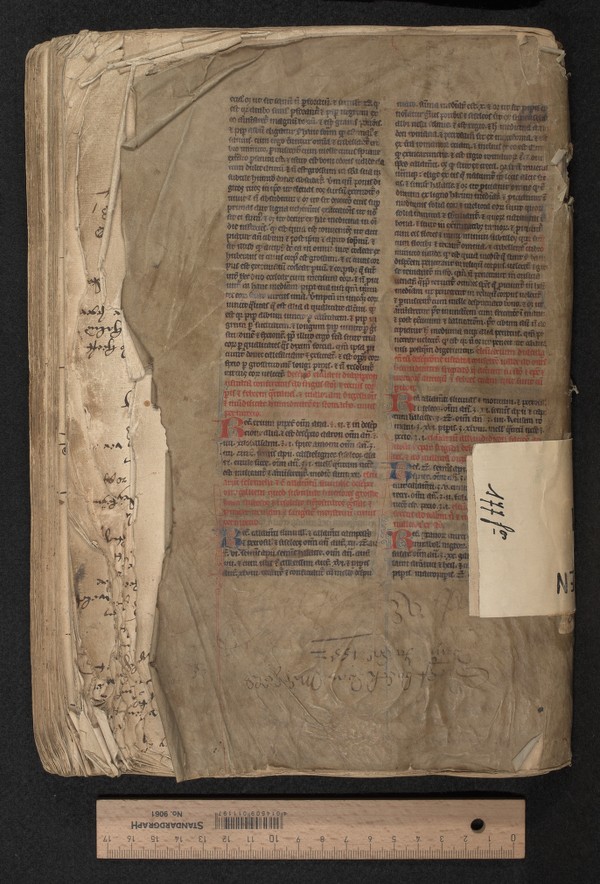
F-rl44 — Johannes Serapion, Breviarium medicinae
The upper-cover leaf is identified at high confidence as Johannes Serapion the Elder's Breviarium medicinae (also printed as Practica Io. Serapionis dicta breviarium), tract VII, chapter XX, on electuaries. The distinctive discussion of cumin and three kinds of pepper, its patient anecdote, and the surrounding recipe sequence agree with the Venice 1497 edition, fols. 71v–72r. Avicenna's Canon contains a substantial parallel, but does not preserve the same surrounding sequence.
The preserved image-only reading is unverified machine text. The selected readings below are preserved source-assisted corrections, made by a Codex reader through direct manuscript and edition image inspection. A second Codex coordinator inspected the inside manuscript image against edition fol. 71v and confirmed the sequence. Neither check constitutes expert palaeographic review or certification of a full transcription. The lower-cover leaf has not been compared.
Manuscript and edition
Fragmentarium F-rl44: Hasselt, Rijksarchief te Hasselt, Archief Schepenbank Mechelen aan de Maas, nr. 2. The catalogue describes two parchment leaves, 290 × 180 mm, in Northern Textualis, dated 1301–1400. The inspected upper-cover leaf has two columns with red rubrics and alternating decorated red and blue initials. A modern slip obscures part of its outside face.
The comparison edition is Practica Io. Serapionis dicta breviarium, Venice, Bonetus Locatellus for Octavianus Scotus, 16 December 1497, BSB 2 Inc.c.a. 3538. Its title page names the Practica and several other works in the volume. The BSB bibliographic metadata attributes the Breviarium to Serapio Senior. This distinguishes the matched work from the younger Serapion's De simplici medicina, also named on that title page. No claim about a particular translator or manuscript recension is made here.
Diagnostic comparison
| Manuscript passage | Edition and agreement |
|---|---|
| Upper cover, inside, left column, upper recipes | Fol. 71v, scan 146, left column: the preparations for women and pregnancy, followed by the preparation for vomiting blood, lead into chapter XX and Diaciminum Galieni. Their order and ingredients provide a check outside the passage that first suggested a candidate. |
| Inside, left column middle through right column upper portion | Fol. 71v, left column bottom continuing into right column: selection of cumin, white pepper and substitutes, preparation and administration, then an anecdote about a practitioner who ground the medicine excessively finely. The sustained connecting prose identifies more than a circulating recipe. |
| Inside, right column middle and lower portion | Fol. 71v, right column: Electuarium diacimini secundum descriptionem cognitam, then Electuarium diapipereon secundum descriptionem Galieni, followed by its extended discussion of pepper. |
| Upper cover, outside, left column lower portion | Fol. 72r, scan 147, left column top: Descriptio electuarii diapipereon usitata, then the Galenic calamentum preparation and its commentary. This additional passage preserves the same sequence across the two inspected faces. |
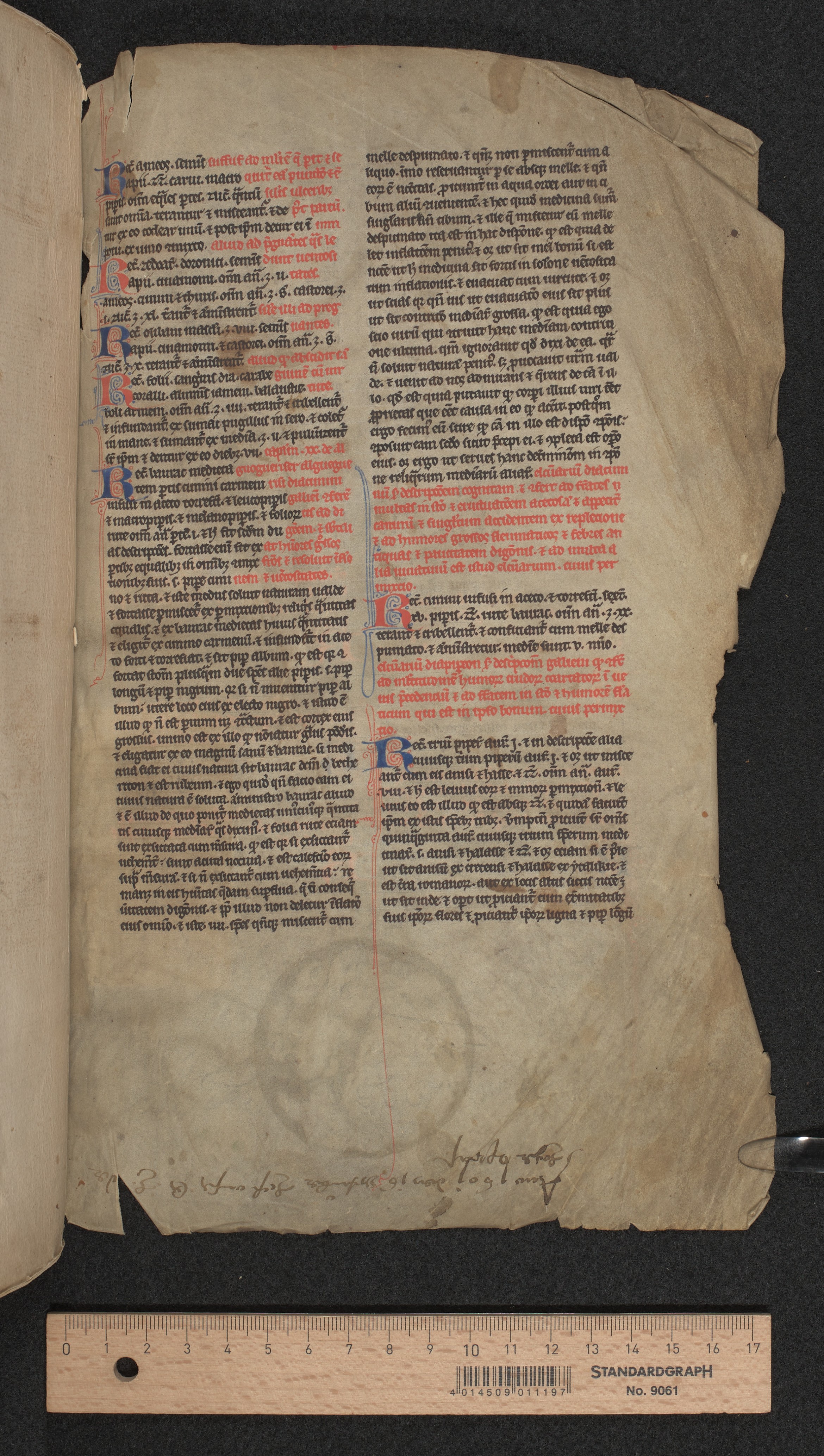
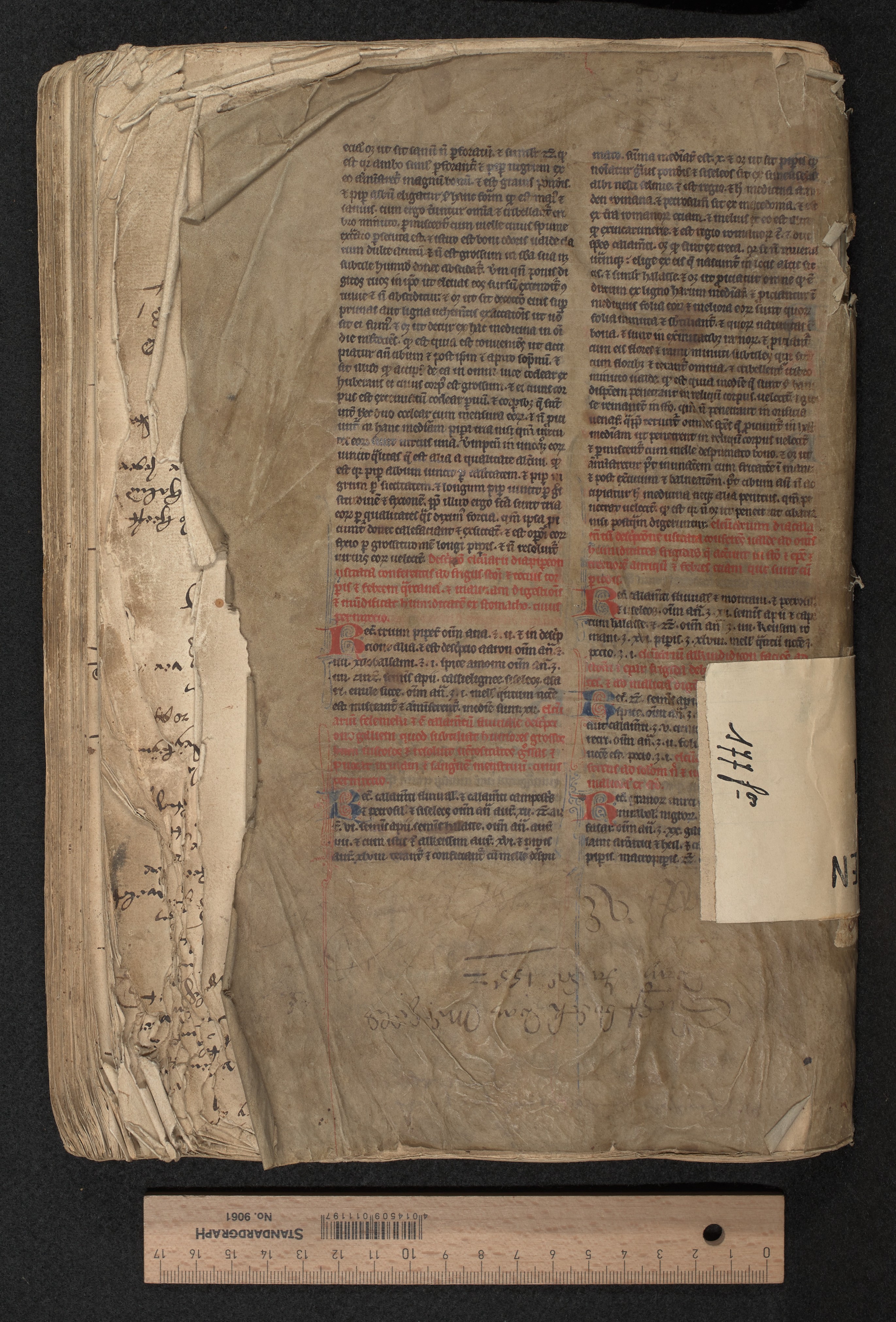
The manuscript incorporates therapeutic indications into long red rubrics where the print uses running text. Wording and spelling vary: for example, the manuscript's de electo nigro corresponds to print ex electo bono nigro. Recipe weights and every ingredient have not been verified.
The following short source-assisted spans retain physical line breaks. Proposed abbreviation expansions are in parentheses. A refers to the preserved reading's inside-left crop, original image rectangle (257,1302,1029,2108), whose line count includes the partial first line. B refers to an outside-left crop, original rectangle (1000,1660,1770,2690), also counting the partial first line.
A13 et eligito ex cimino carmeni et infundat(ur) in ace-
A14 to forti et torreat(ur)?. et sit pip(er) album. q(uod) est q(uod) con-
A15 fortat sto(machum) plusq(uam) due sp(ecies) alie pip(er)is. s(cilicet) pip(er)
A16 longu(m) et pip(er) nigrum. Q(uod) si n(on) inveniatur pip(er) al-
A17 bum utere loco eius de electo nigro. et istud e(st)

B2 [preceding black text] Descriptio elect(uarii) diapipereon
B3 usitata conferentis ad frigus sto(machi) et maciem cor-
B4 p(or)is et febrem q(ua)rtanam et malitiam digestionis
B5 et mundificat humiditatem ex stomacho. cuius
B6 preparatio.
These readings correct, rather than silently replace, the tentative pepper and electuary readings in the preserved response. Other uncertain words in that response remain unverified.
Alternative and scope
The cumin commentary also appears in Avicenna, Canon, book V, summa I, tract III: Lyon 1522, printed fol. 410r, scan 302. That edition and Milan 1473, scan 453 were inspected as images. Their surrounding recipe sequence differs from the manuscript. Serapion agrees both before and after the shared prose, including the intervening Galenic diapipereon discussion and the following diapipereon usitata preparation. This establishes the containing text of the inspected leaf; it does not determine the direction of literary borrowing or exclude local variants and abridgements.