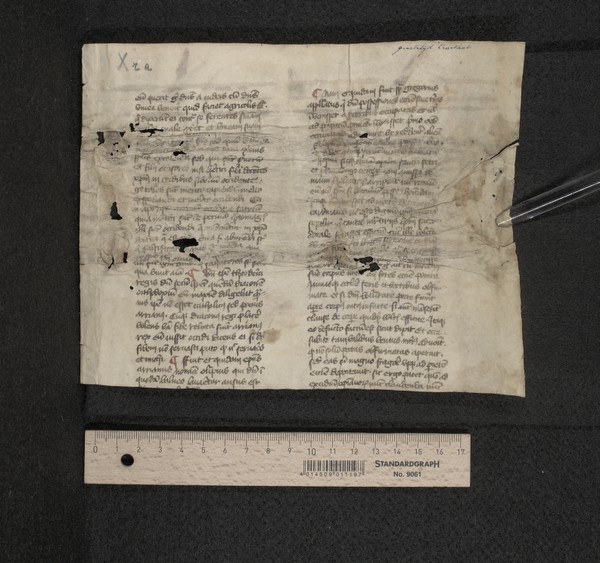
F-szlk: Servasanctus de Faventia, Antidotarius animae
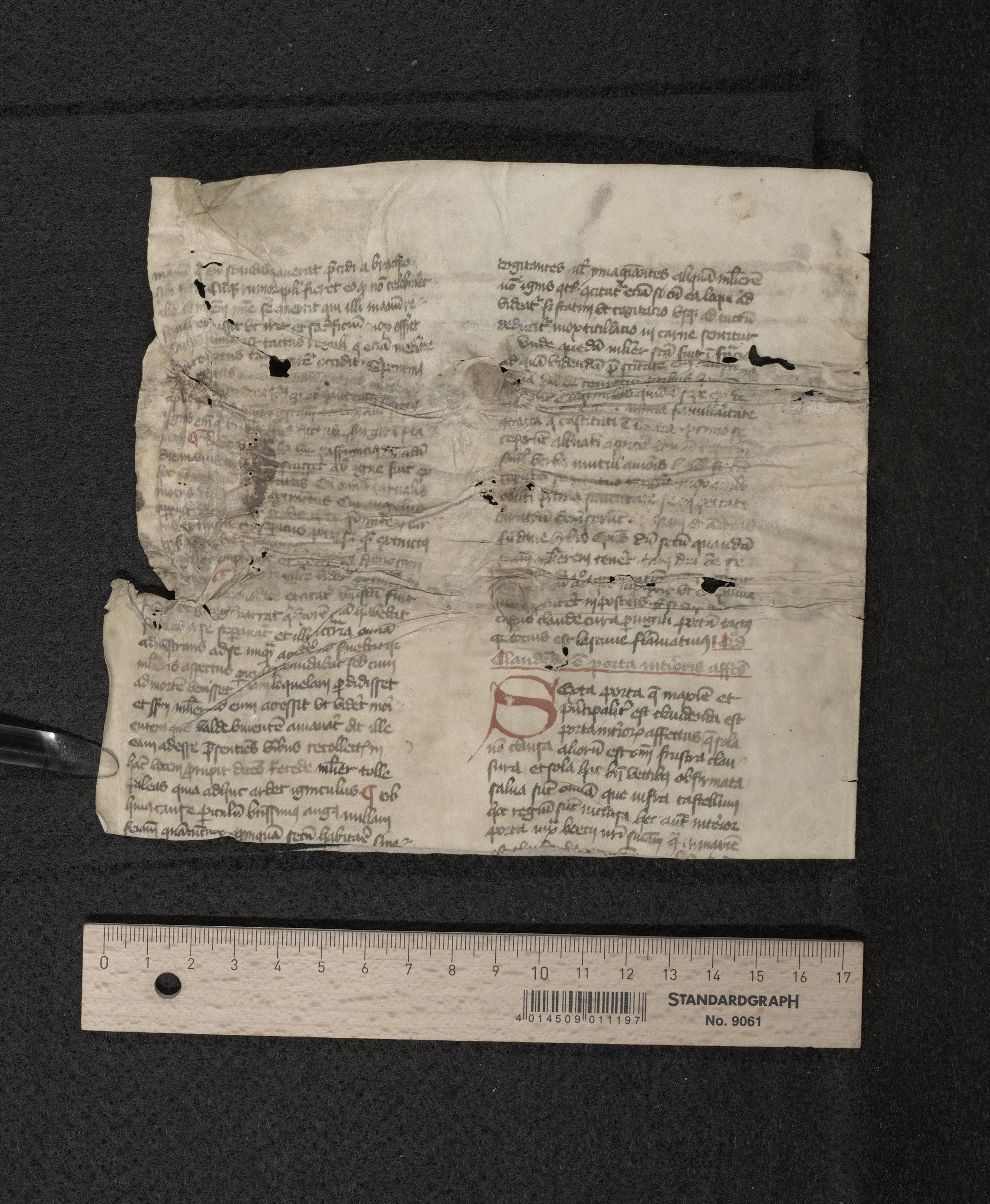
The bifolium is identified with high confidence as part of the Antidotarius animae of the Franciscan Servasanctus de Faventia (Servasanto da Faenza, d. about 1300), from the tractate that describes the soul as a royal castle whose gates must be shut. Its two leaves are consecutive and carry the end of a chapter on lawful killing under the gate of touch, the chapter on keeping feast days, the chapter on restraining touch, and the opening of the chapter on the sixth gate, the inner affection. The text agrees with the first printed edition in order across all eight columns.
The Fragmentarium record describes a parchment bifolium, Antwerpen, Ruusbroecgenootschap, Lat. 13, 166 × 206 mm, dated 1401–1425, catalogued as an unidentified spiritual treatise. The catalogue date has not been reassessed.
- Identification: identified, high. Three stretches of ten to twenty lines and several chapter rubrics correspond to the print, including the author's own matter: a miracle located at Faenza in the church of St Peter, the allegory's chapter headings, and the transitions between exempla. The exempla themselves (Theoderic's deacon, the Arian bishop Olimpius, Pope Gregory's body at the church doors) are borrowed from chronicles and would not identify the work alone. Decalogue treatises were tested first and excluded (Herolt, Geilhoven's Gnotosolitos, on page images).
- Transcription: image-only first reading of leaf X by an isolated reader, and a source-assisted selected reading. Leaf Z was not in the first reader's packet. Crumpled bands and most of one column of leaf X are unread. Accuracy has not been measured.
- Verification: a research reader compared three stretches with page images of the Wolfenbüttel copy of the print; the coordinator compared the foot of the last column (the end of the chapter on touch and the opening of the sixth gate) with the print's page image. The print's page images are small. No human review.
Textual evidence
Manuscript images: fol. Xr, fol. Xv, fol. Zr, fol. Zv. The text runs Xr, Xv, Zr, Zv, two columns each, with no gap between the leaves. Abbreviations are resolved silently; square brackets mark text lost or not read.


| Fragment | Print (Louvain: Johannes de Westfalia), Wolfenbüttel copy |
|---|---|
| Zv, right column, foot, compared by the coordinator: "... claude cura pervigili portam tactus quia totus est lascivie inflammativus. [rubric] Claudenda est porta interioris affectus. [red initial] Sexta porta que maxime et principaliter est claudenda est porta interioris affectus, qua sola non clausa aliarum est omnium frustra clausura, et sola hac bene vectibus obfirmata salva sunt omnia que infra castellum hoc regium sunt inclusa. Hec autem interior porta ..." | fol. xlvii verso: "... claude cura pervigili portam tactus, quia potius est lascivie inflammativus. Quod claudenda est porta interioris affectus. Capitulum vicesimumprimum. Sexta porta que maxime et principaliter est claudenda est porta interioris affectus, qua sola non clausa aliarum omnium est frustra clausura, et sola hac bene vectibus obfirmata salva sunt omnia que intra castellum hoc regium sunt inclusa. Hec autem interior porta iuxta ..." |
| Xr, left column, about twenty-two lines (research reader): "... heretici falsi doctores Christum in cordibus simplicium occidentes. Ergo tales sunt merito capiendi [...] et merito occidendi ... qui falsificant ... monetam ... Unde tempore Theodorici regis ... si deo fidem non servasti puto quod nec servares et michi. Fuit et quidam episcopus arrianus nomine Olimpius ..." | fol. xlv verso, right column: "heretici et falsa docentes Christum in cordibus fidelium occidentes. Ergo tales sunt merito capiendi, expoliandi et occidendi ... Si comburendi sunt qui falsificant aliquid de moneta ... Unde tempore Theodorici regis ... Si deo non servasti fidem, probabile est quod nec servares mihi. Fuit et quidam episcopus arrianus nomine Olimpius qui dum in quodam balneo lavaretur ..." |
| Xr, right column, foot, and Xv, left column (research reader): "... ante fores ecclesie ... usque ad parietem ecclesie deportavit. Sic ergo patet quomodo ad [...] claudenda ..." then the chapter on feasts: the man gathering wood on the sabbath stoned, a sickle that could not be pulled from the hand, the carter on the feast of Mary Magdalene | fol. xlvi recto: "ante fores ecclesie seris et vectibus obfirmate ... cum magno fragore usque ad parietem ecclesie deportavit. Sic igitur patet quomodo ad subsidium proximorum nunc claudenda est nunc aperienda est porta tactus", then cap. XIX "Quod custodienda sunt festa sanctorum": "qui ligna colligebat in sabbato iussus est lapidari. Nam et Faventie in ecclesia sancti Petri ... Quidam alius fuit qui in festo venerabilis Marie Magdalene boves coniunxit ad currum" |
| Zr and the head of Zv (research reader): "Ergo si tu mulier occasiones mortis ... prestas ..."; rubric on restraining touch; Pope Leo's hand; then on Zv "Recede mulier, tolle paleas quia adhuc ardet igniculus. Ob huius cause periculum beatissimus Augustinus nullam feminam quantumcumque propinquam secum habitare sinebat" | fol. xlvi verso to xlvii verso: "Ergo si tu mulier occasiones mortis ... prestas"; cap. XX "Quod cohibendus est tactus ne impudica contingat"; "Recede mulier, tolle paleas, quia adhuc vivit igniculus. Ob huius cause periculum beatissimus Augustinus nullam feminam quantumcunque propinquam secum habitare sinebat" |
Variants seen: totus for potius, infra for intra, ardet for vivit, falsi doctores ... simplicium for falsa docentes ... fidelium, puto quod nec servares et michi for probabile est quod nec servares mihi; the manuscript's rubrics lack the print's chapter numbers. The record's stray mention of Boethius is explained by the print's next words after the fragment ends, "iuxta Boecii nostri ...".
Edition and attribution
The edition is Servasanctus de Faventia, Antidotarius animae, Louvain: Johannes de Westfalia, about 1486 (GW M41855, ISTC is00476000), read in the Wolfenbüttel, Herzog August Bibliothek copy, images 97–102 (fols. xlv–xlvii). The attribution is that of the incunable catalogues; the mention of Faenza in the text fits it, and the question of authorship was not examined further.
No claim is made about the fragment's date or origin, or about its place among the manuscripts of the work.