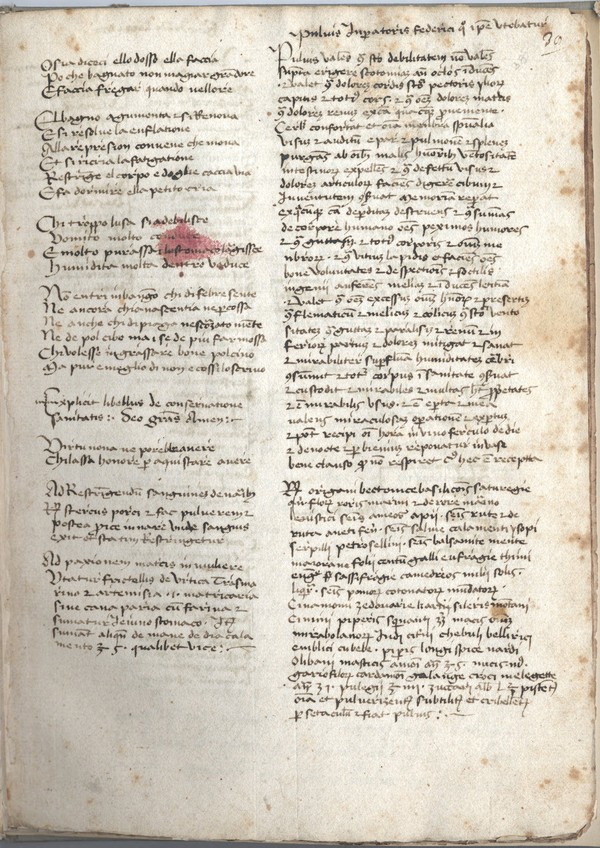

F-x61h: Cibaldone ("Libro terzo dello Almansore"), end of the chapter on bathing
The Italian verses at the head of the recto are the close of the Cibaldone, an anonymous verse regimen of health in the vernacular that was printed from about 1475 as the "third book of Almansor", identified here with high confidence. The leaf has its last three and a half stanzas, on bathing, and then the scribe's "Explicit libellus de conservatione sanitatis". The poem is one item on a leaf of mixed contents; the other items are described at the end.
The Fragmentarium record describes a paper leaf, Victoria, B.C., University of Victoria Libraries, Ms.Brown.It.1, fol. 38, 290 x 200 mm, dated 1415-1500, Italy (Bologna?), under the title "Medical recipes and poems" with the subtitle "includes poetic list of women's faults". Its summary calls the verses "the end of an Italian poem in the tradition of the Regimen sanitatis Salernitanum" and the list "an unidentified Latin poetic list of women's faults". The description of the poem's genre fits; the work is now named. The list is a catalogue of short phrases, not verse.
- Identification: identified, high. Nineteen manuscript lines agree with the closing lines of the first edition in content, order and stanza form (six-line stanzas rhymed ababcc), and both end the work at the same point. The wording is not that of the print: the manuscript is in a more central Italian spelling against the print's northern forms, it lacks one printed couplet, and in two places it keeps a rhyme where the print has none. These differences do not settle where the scribe's text came from: someone copying a printed edition could respell it, drop a couplet and mend a rhyme. Whether the leaf descends from a print or from a manuscript of the poem is not determined, and which recension, that is, which distinct version of the text, it represents has not been studied. Other vernacular verse regimens were not compared once this text matched.
- Transcription: source-assisted selected reading of recto column a; image-only first reading of both faces. A research reader reread recto column a lines 1-15 on the image; lines 16-19 were corrected from the print without a fresh reading at high magnification ("po'l cibo", "lo scrivo"). The rest of the leaf rests on the first reading, apart from the opening of recto column b and the upper half of the list on the verso, which the research reader also reread. Accuracy has not been measured.
- Verification: a research reader compared the manuscript lines with page images of the last two printed pages of the Florence copy. The coordinator read the closing lines of the poem on the manuscript image ("Chi troppo lusa ...", "Humidita molta dentro ...", "Non entri in bangno chi di febre sente / Ne ancora chi a nascentia ne percossa ... e cossi lo scrivo") and compared them with the image of the print's last page ("Chi tropo luxa si se indebilisse ... Non intri in bagno chi de febra sente / Anchora chi a mal nascente ni percosa ... cosi lo scrivo. FINIS"): the same lines in the same order, in a different regional spelling. No edition or study of the poem's manuscripts was consulted. No human review.
Textual evidence
Manuscript: fol. 38r, left column, native-pixel box about 150,100,1200,1700. A question mark marks an uncertain reading.

| Fol. 38r, column a | Print, [Vicenza, about 1475], last two pages |
|---|---|
| O sia di ceci? e llo dosso e lla faccia | On sia de cecer el dosso e la faza |
| Po che bagnato non magiar e grand'ore? | Poi che bagnato non manzi de granda hora |
| E facciase? fregar quando ne ll'ore | E faciasse fregar quando vien l'hora |
| El bagno agiumenta e si fenova | El bagno el corpo humecta e si renova |
| E si resolve la enflatione | E si resolve da esso la inflatione |
| Alla repression convene che mova | E le repletione conven ch'el mova |
| Et si ricria? la fatigatione | E si recrea la faticatione |
| Restringe el corpo e doglie caccia via | Restringe el corpo e dolie cazza via |
| E fa dormire e ll'apetito cria | E fa dormire e lo appetito aguza |
| Chi troppo l'usa si adebilisce | Chi tropo l'uxa si se indebilisse |
| Vomito molto conduce | Vomito fa el sincopo conduce |
| E molto pur assai lo stomaco languisce? | E molti humori al stomaco largisse |
| Humidita molta dentro v'aduce | Humidita assai entro induce |
| (not in the manuscript) | Com ordine e con modo se lo farai / Quando bisogna non te ne biasmarai |
| Non entri in bangno chi di febre sente | Non intri in bagno chi de febra sente |
| Ne ancora chi a nascentia ne percossa | Anchora chi a mal nascente ni percosa |
| Ne anche chi a piaga? ne scorzato niente | Ne chi a piaga ne scorzato niente |
| Ne de po'l cibo mai se de' piu far mossa | Ne dapo el cibo mai ge intri |
| Chi volesse ingrassare bene po'l cibo? | Chi volse ingrassare ben dapo el cibo |
| Ma pur e meglio di non e cossi lo scrivo? | Ma pur e melior non intrarli cosi lo scrivo |
| Explicit libellus de conservatione sanitatis. Deo gratias Amen. | FINIS |
The stanzas and their order are the same. The manuscript rhymes "via / cria" and "percossa / mossa" where the print has "via / aguza" and "percosa / intri"; it reads "agiumenta" for "el corpo humecta", "Alla repression" for "E le repletione", "Vomito molto conduce" for "Vomito fa el sincopo conduce", and it has no counterpart to the couplet "Com ordine e con modo se lo farai / Quando bisogna non te ne biasmarai". Some of these are corruptions on one side or the other (the manuscript's "si fenova" is a slip for "si renova"); which side is original was not determined.
The print compared is the copy Florence, Biblioteca Nazionale Centrale, Magl. M.6.13, digitised at archive.org, described there as "Libro terzo d'Almansore, Cibaldone", [Vicenza: Leonardus Achates?, before 1475/76], with the references ISTC R 0172, IGI 2789 and BMC VII 1034; its text opens "Opera del excellentissimo physico magistro Cibaldone electa fuori de libri autentici di medicina". The poem is anonymous; "Cibaldone" is the name under which the prints transmit it, and its claim to derive from the third book of Rhazes' Liber ad Almansorem was not tested. The scribe's own title, "libellus de conservatione sanitatis", is a description, not the printed title.
Other items on the leaf
Below the explicit the scribe added a moral couplet, "Virtu non a ne porrebbe? avere / Chi lassa honore per aquistare avere", which also occurs among Leonardo da Vinci's notes (seen only in quotations in modern books); its origin was not traced.
Recto column b has a recipe headed "Pulvis Inperatoris federici quo ipse utebatur", first a long list of virtues, then the ingredients. This is partly matched: a shorter recipe of the same name, "Pulvis domni Frederici imperatoris valens contra humorum exceptionem et praecipue contra fleumaticum et melancolicum ...", was printed from a manuscript in the Biblioteca Laurenziana, Florence, by K. Sudhoff, "Ein diätetischer Brief an Kaiser Friedrich II. von seinem Hofphilosophen Magister Theodorus", Archiv für Geschichte der Medizin 9 (1915), p. 6 note 2 (archive.org, read in OCR text only). The two share phrases ("contra stomachi debilitatem", "scotomiam ante oculos inducens", "contra defectum visus", "contra flematicum et melancolicum", the restoring of lost memory) and most of Sudhoff's ingredients (caraway, parsley, siler montanum, betony, cumin, calamint, hyssop, spikenard, pepper, rue, clary, eyebright, frankincense, mastic, saffron, all the myrobalans, cinnamon, squinanthum, marjoram, costmary, cardamom, galingale, liquorice), but the Victoria text is about three times as long and adds some twenty ingredients. The attribution to the emperor is the recipe's own; Sudhoff calls it alleged.
Verso column b has a list of about 66 two-word epithets of woman under the heading "Sanctus Johannes boccha doro" (John Chrysostom). It is partly matched: its core repeats three sayings that circulated widely. "Mulier est caput peccati", "Expulsio paradisi", "Arma diaboli" and "Transgressio legis" correspond to "mulier caput peccati, arma diaboli, expulsio paradisi, doli mater, corruptio legis antiquae" in the homily De muliere Chananaea printed under Laurentius of Novara and also transmitted under Chrysostom's name. "Naturalis temptatio", "Manifestum malum", "Desiderata miseria" and "Amicabile periculum" correspond to "ineffugabilis poena, necessarium malum, naturalis tentatio, desiderabilis calamitas, domesticum periculum" from the Opus imperfectum in Matthaeum, which the thirteenth-century chronicler Salimbene quotes under the name "Iohannes Os aurei", the same form as the leaf's heading. "Confusio hominis", "Insatiabilis bestia" and "Cotidiana sollicitudo" correspond to the answer of Secundus the philosopher, "Quid est mulier? hominis confusio, insaturabilis bestia, continua solicitudo, indesinens pugna ..." (as quoted by Vincent of Beauvais, Speculum doctrinale). These parallels were taken from the Corpus Corporum text collection, not from editions. The remaining forty or so epithets ("Rosa fetida", "Porta inferni", "Scorpio venenosus", "latronum ospitium" and others) were not found together in any text, so the list as a whole is unidentified.
The six short recipes (for nosebleed, for the womb, an electuary and a collyrium for the eyes, pills to purge the head, an astringent water) were not investigated. No claim is made about the date or origin of the leaf, or about the relation of this copy of the poem to other manuscripts.