F-x6c5: Psalter text, Psalm 49:5-10 (with probable Psalm 49:15-20)
The strip shown in the two images labelled "ant" carries Psalm 49:5-10 (Vulgate numbering; Psalm 50 in the Hebrew numbering): seven consecutive line fragments fall on the psalm in order, one line of text apart, with coloured initials on the verse openings "Et adnuntiabunt", "Audi populus meus" and "Non accipiam". The second strip, shown in the two "post" images, is rubbed and is only probably from the same psalm, verses 15-20. The text is the plain psalm with one-line verse initials, not a commentary. The kind of book is open: a psalter, a breviary (the book of the daily office, which contains a psalter) or a Bible.
The Fragmentarium record describes Orselina-Locarno, Biblioteca Madonna del Sasso, MdS 58 Ba 6/F2-6: four parchment strips used as spine reinforcements in a copy of Pelbartus of Temesvár, Sermones Pomerii de tempore (Hagenau 1503), two of them covered by the spine lining and two visible, of 42 x 61 mm and 34 x 64 mm; Latin, textualis (the formal Gothic book hand), dated to the end of the thirteenth or the fourteenth century (1251-1400); title "Unidentified religious text (?)". The description fits what the images show, and it records the coloured initials: a red "U" in line 1 and a red and blue "N" in line 5 on one strip, a red "S" in line 5 on the other. It names no text. The initial it gives as "U" is read here as an uncial E, the E of "Et adnuntiabunt". The catalogue's numbering of the strips could not be matched with certainty to the image labels, so this report goes by the image labels.
- Identification: identified, high, for the "ant" strip as Psalm 49:5-10; probable only for the "post" strip as Psalm 49:15-20. On the "ant" strip seven line fragments ("]icia. Et a[", "]dex est [.]ud[", "] d[..]tuus", "]te holocau[", "]per. Non [", "]gibus tuis [", "]menta [") occur in the psalm in that order with 33 to 40 letters between one and the next, which is one line each time, and the three coloured initials stand on verse openings. Other psalm passages with "holoca-" were considered (Psalms 50:18-21, 39:7, 65:13-15 and 19:4); none has "semper. Non", "gregibus tuis" and "iumenta" in the three lines that follow. On wording, "iumenta" and "holocau[sta]" exclude Jerome's version from the Hebrew, which has "pecudes" and "holocaustomata". The surviving letters do not separate the Gallican psalter (Jerome's revision from the Greek, the psalter of the medieval Latin Bible and of most of the liturgy) from the Roman psalter (the older Latin version long used at Rome), so the version is left as Gallican or Roman. For the "post" strip Psalms 44:3-8 and 50:4-5 were tried and fit less well; the strip is too rubbed to exclude another psalm absolutely.
- Transcription: image-only first reading and a source-assisted reading. A research reader reread every line of both strips on enlargements of the native images. The assisted reading keeps "holoca[" and "]ment[" from the first reading and replaces its other letter groups. On the "ant" strip the first group of line 3 is uncertain, "tuus" in line 3 and "tuis" in line 6 are read from minims (the short upright strokes of i, u, n and m) and are probable, and line 8 is unread. On the "post" strip only lines 4 and 5 give letters that can be placed, and those are probable, not secure. Accuracy has not been measured.
- Verification: a research reader compared the seven lines of the "ant" strip, and lines 2, 4, 5 and 7 of the "post" strip, with Psalm 49 in an online transcription of the Stuttgart Vulgate, which gives the Gallican version beside Jerome's version from the Hebrew. The source was a transcription, not a page image of an edition or of a medieval psalter. For a text as fixed as the psalter that is enough to identify the passage; it shows nothing about which psalter this was. The coordinator read "-icia. Et a-", "-dex e(st)", "holoca-", "-p(er). Non", "-gib(us)" and "-menta" on an enlargement of the "ant" strip (canvas 0, native box 4760,2500,5300,3750) against the same transcription of Psalm 49:5-10; line 3 and the second strip were not checked, and no page image of an edition was used. The hidden sides of the two visible strips and the two covered strips were not seen. No human review.
Textual evidence
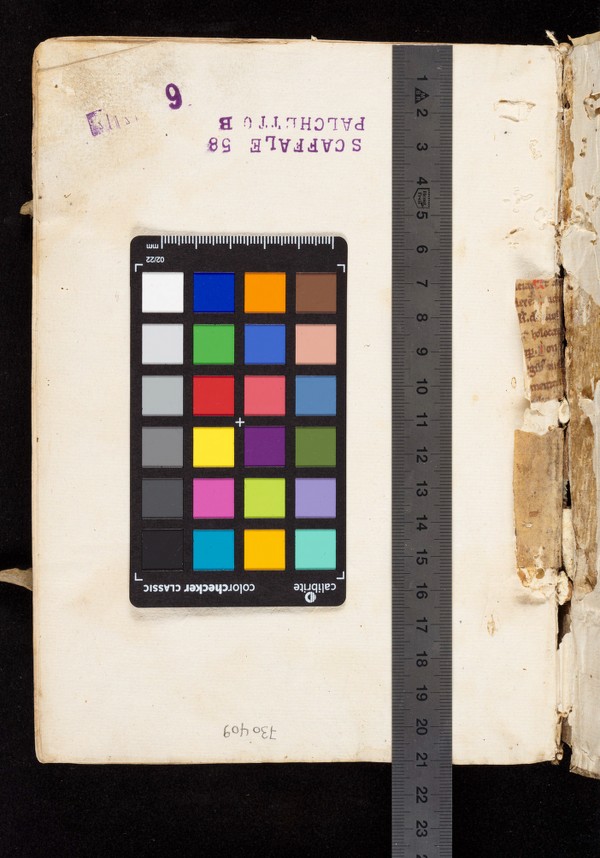
Each strip appears in two images of the same face. The "ant" strip: canvas 0, mds_58Ba06_rinforzi_ant_cont, native-pixel box 4760,2500,5300,3750, and canvas 1, mds_58Ba06_rinforzi_ant_phy, box 224,4252,813,5375, where the strip is upside down. The "post" strip: canvas 3, mds_58Ba06_rinforzi_post_phy, box 4930,2100,5290,3350, and canvas 2, mds_58Ba06_rinforzi_post_cont, box 308,4492,785,5896, upside down. All four images are 5610 x 8023 pixels and the boxes are approximate. Each strip is a narrow vertical slice of a leaf with 6 to 10 letters of each line, cut at both ends. Abbreviations are resolved in parentheses; square brackets mark what is lost or unread; a question mark marks a doubtful reading; bold in the right-hand column marks the letters that survive.




The "ant" strip, Psalm 49:5-10:
| Line | On the strip | Psalm 49, Gallican text |
|---|---|---|
| 1 | ]icia. [red E]t a[ | (5) ... super sacrificia. (6) Et adnuntiabunt caeli iustitiam eius quoniam Deus iu- |
| 2 | ]dex e(st) [hole, red descender] ud[ | -dex est. (7) Audi populus meus et loquar tibi Israhel et testificabor |
| 3 | ]t(ibi)? . d[hole]tuus | tibi. Deus Deus tuus ego sum. (8) Non in sacrificiis tuis arguam |
| 4 | ]te holocau[ | te, holocausta autem tua in conspectu meo sunt |
| 5 | ]p(er). [red and blue N]on [ | semper. (9) Non accipiam de domo tua vitulos neque de |
| 6 | ]gib(us) tuis [ | gregibus tuis hircos. (10) Quoniam meae sunt omnes ferae silvarum |
| 7 | ]menta [ | iumenta in montibus et boves |
| 8 | tops of letters only |
Between successive groups the unabbreviated psalm has 33, 33 to 40, 33, 33, 35 and 38 letters, so each step is one line in a book of about 40 letters to the line. Nothing in the surviving letters differs from the psalm text; the abbreviations (est, tibi, semper, -bus) are ordinary. In line 2 a hole has taken the A of "Audi" except the red descender of its initial. In line 3 the first group is short, abbreviated and uncertain, and "tuus" is read as minims and s. Whether the manuscript had "loquar tibi" in verse 7, and whether it carried the "diapsalma" note of some psalters, cannot be seen.
The "post" strip, probably Psalm 49:15-20:
| Line | On the strip | Psalm 49, Gallican text |
|---|---|---|
| 2 | unresolved letters; red upright with a foot at the cut edge | (16) Peccatori autem dixit Deus |
| 4 | ]ero od[ | (17) Tu vero odisti disciplinam et proiecisti sermones meos |
| 5 | ]um [red S] | retrorsum. (18) Si videbas furem |
| 7 | ]tuu[ ? | (19) Os tuum abundavit malitia |
Lines 4 and 5 are one line of text apart in the psalm (44 letters), as on the strip, and the red stroke two lines above line 4 stands where the P of "Peccatori" would be. Lines 1, 3 and 6 to 9 were not read well enough to confirm or contradict the placing, and line 7 is weak. The placing therefore rests on two lines and one initial and is probable, not established.
Source: Psalm 49 of the Vulgate, in the text of the Stuttgart edition (Biblia sacra iuxta vulgatam versionem), psalter iuxta Septuaginta (the Gallican version) with the psalter iuxta Hebraeos beside it, as transcribed at vulgate.org, Psalm 49. This is an online transcription, not a page image. The text is biblical and no question of authorship arises.
The strips and what is not claimed
If the placing of the "post" strip is right, the text is compatible with the two strips coming from one column: about six lines of text (verses 10-15, 243 letters) would fall between the last line of the "ant" strip and the first of the "post" strip. That reconstruction would require a column of at least 22 lines. The text sequence alone does not establish that the strips came from the same column; no physical join has been demonstrated. The parchment cover of the same host volume is a separate catalogue record and is not treated here.
Not claimed: the kind of book, which stays open between psalter, breviary and Bible, since the visible faces show no antiphon, rubric or psalm division, and Psalm 49 has no division initial of its own in the liturgical distribution; the version beyond Gallican or Roman; the date and script, which are the catalogue's; the origin; the use. The hidden sides and the two covered strips might settle the kind of book.