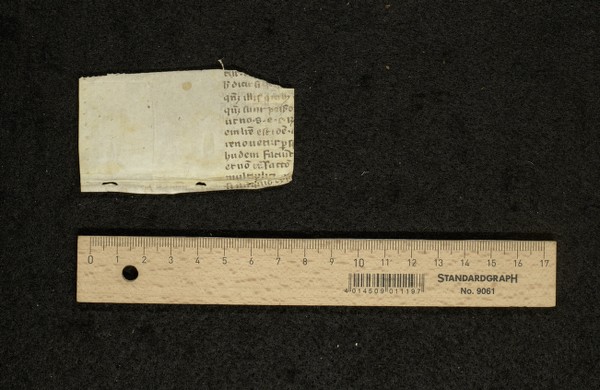
F-ypxa: Hostiensis (Henricus de Segusio), Lectura in Decretales Gregorii IX, on X 3.30.33-34 (De decimis)
This strip carries part of the commentary of Hostiensis (Henricus de Segusio, cardinal bishop of Ostia, died 1271) on the Decretals of Gregory IX, known as his Lectura or Apparatus. The two faces hold the end of his comments on chapter 33 of the title on tithes (X 3.30.33, Cum non sit in homine) and part of those on chapter 34 (Nuper abbates).
The catalogue record, F-ypxa, describes Antwerpen, Erfgoedbibliotheek Hendrik Conscience, Fragm. 315: a parchment strip of 45 x 80 mm, dated to the 14th century, titled "Unidentified canon law text", used as a quire guard in a Geneva print of 1577 (EHC C 1049). "Canon law text" fits. The record names no author, work or passage.
- Identification: identified, confidence high. Twenty of the 21 surviving line ends and line beginnings, on both faces, agree in wording and order with the printed Lectura, through nine successive lemmata (the words of the decretal that each comment starts from). Two alternatives were considered. The ordinary gloss on the Decretals has the same cross-reference to the chapter Pastoralis but none of the surrounding wording. Johannes Andreae's Novella, which reuses Hostiensis, was read on the page image of the Venice 1581 edition (vol. 3, leaves 146v-147r) and is not the text here. Where the fragment has "[eccle]siasticam. ergo morta[le] / [ec]clesiis subaudi. et / hic nichil iu[ngit] / ...tantum que ex lege / in fi. sed et subau[diri]", the Novella has "[Per cen. ec.] ergo mortale peccatum est ... [Quibus] quod non aliis ... [De iure] dicit Inn. quod de consuetudine non dixit: quia de praedialibus loquitur", with no comment on Ecclesiis and none of the sentence "hic nihil iungit". On Nisi cum ipsis it has "vel nisi super his noviter acquisitis habeant novum speciale privilegium, quod saepe impetrant, ut dicit Hostiensis", where the fragment has Hostiensis's own "renouetur per s[peciale] / hiidem faciunt". The Novella's comment on Componendum was not read. One difference is probable: between lines 6 and 7 of the first face the print has about twice as much text as between other lines, so the manuscript may have lacked about one line's worth there.
- Transcription: the image-only first reading was made without knowledge of the text. The source-assisted reading rereads every line of both faces on the images with the printed text at hand, by a research reader; no line rests on the first reading alone. Every line is torn at one end. Accuracy has not been measured.
- Verification: a research reader compared both faces of the fragment, on the published images, with the page image of the Strasbourg 1512 edition, and with text-recognition snippets of the Venice 1581 edition. The Novella was compared in text-recognition snippets of two printed editions and, by the coordinator, on the page image of the Venice 1581 edition at the two places described above. No manuscript of the Lectura was compared. The first line of the second face is cut through and is not placed. The coordinator read "-ciem littere est idem / renouetur per s- / hiidem faciunt / et non transactio / multiplic-" on fol. [1]r and "-siasticam. ergo morta- / subaudi. et / hic nichil iu- / -bus tantum que ex lege / in fi. sed et subau-" on fol. [1]v, on enlargements of the manuscript images, and read the first of these passages (the comments on the words "Nisi cum ipsis" and "Componendum") on the page image of the Strasbourg 1512 edition, fol. 114r, column b. No human review.
Textual evidence
The manuscript passages are on the two published images: https://fragmentarium.ms/loris/F-ypxa/fol_1v.jp2/full/full/0/default.jpg (canvas "fol. [1]v", line ends, native box 290,310,760,900) and https://fragmentarium.ms/loris/F-ypxa/fol_1r.jp2/full/full/0/default.jpg (canvas "fol. [1]r", line beginnings, native box 950,290,1300,850). Abbreviations are expanded in parentheses, lost text is in square brackets. In the source column, square brackets with a full stop are the printed lemmata; the print's abbreviations are expanded.
Passage A, canvas "fol. [1]v", against the 1512 edition, fol. 114r, column a (end of the section "Vel saltem" of chapter 33):
| Manuscript | Hostiensis, Strasbourg 1512 |
|---|---|
l.1 et g(ra)ta d(ebet) | decima respectu census et tributi debita est et grata debet esse. census vero et tributum non sic debita sunt. nam |
l.2 [ex]actio uio[lentiam] | exactio violentiam notat. exigere enim est ab invito extorquere. |
l.3 .ff. de l. iij. fi[deicommissa] | ff. de le. iij. fideicommissa. § si rem suam. |
l.4 [s]ic. s. e. pastoral(is). | [Cum onere suo.] sic. s. e. pastoralis. § j. ver. fructus. cum suis concor. |
l.5 [eccle]siasticam. (er)go morta[le] | [Per censuram ecclesiasticam.] ergo mortale peccatum etc. ut no. s. c. proxi. § j. ad fi. |
l.6 [ec]c(les)iis subaudi. et | [Ecclesiis.] subaudi: et clericis. s. e. tua nob. § fi. [Quibus.] non aliis, etiam pretextu nequitie clericorum. s. eo. tua nobis. § j. ver. pretextu. |
l.7 iure. hic nich(il) iu(n)[git] | [De iure.] Hic nihil iungit concilium de consuetudine. quia loquitur de |
l.8 [prediali]b(us) t(antu)m q(ue) ex lege | predialibus tantum: que ex lege divina debentur. secus in personalibus. ut s. c. |
l.9 in fi. s(ed) et subau[diri] | proxi. in fi. Sed et subaudiri oportet hic: vel de consuetudine. respectu ecclesiarum. |
l.10 ut p(atet). s. e. | ut patet s. e. cum in tua. et c. cum contingat. et c. ad apostolice. |
Passage B, canvas "fol. [1]r", against the same page, column b (chapter 34, Nuper abbates):
| Manuscript | Hostiensis, Strasbourg 1512 |
|---|---|
l.2 h(oc) dicit. S[ed] | [Soluebantur.] ... Respondeo non: ideo hoc dicit. Sed quia quandoque solvuntur ecclesiis quibus de iure debentur: |
l.3 q(ua)n(do)q(ue) illis quib(us) | quandoque illis quibus de consuetudine. ut no. s. c. proxi. in fi. Vel quia |
l.4 q(ua)n(do)q(ue) sunt posse[ssiones] | quandoque sunt possessiones privilegiate, de quibus non debentur decime. |
l.5 ut no. s. e. c. r[espon.] | ut no. s. e. c. respon. j. super verbo. debeantur. ubi secundum superfi- |
l.6 ciem l(itte)re est ide(m). a[r.] | ciem littere est idem ar. [Nisi cum ipsis.] subaudi: vel nisi antiquum |
l.7 renouetur p(er) s[peciale] | renouetur per speciale privilegium de novo impetratum: sicut |
l.8 iidem faciu(n)t t[ota die] | iidem faciunt tota die. [Componendum.] et sic compositio amicabilis, |
l.9 et no(n) tra(n)sactio | et non transactio super decimis fieri potest. ut legitur et no. s. e. ex |
l.10 multiplic[i] | multiplici. et s. de transactionibus. c. ij. et c. super eo. et c. veniens. |
l.11 s(ed) nu(n)q(ui)d | Sed nunquid cistercienses et alii monachi non habentes populum possunt prescribere decimas? |
No difference of wording was found in the words that survive; the manuscript spells "nichil". Between one manuscript line and the next the print has about 45 to 55 letters, except between lines 6 and 7 of passage A, where it has about twice that (from "et clericis" to the lemma "De iure"). The manuscript therefore probably lacked about a line's worth there, perhaps by a skip from one "tua nobis" to the next; the lost halves of the lines cannot confirm this. Line 1 of canvas "fol. [1]r" is cut through and is not placed.
Edition compared on the page: Lectura siue Apparatus domini Hostiensis super quinque libris Decretalium, vol. 2, Strasbourg: Schott, 1512 (VD16 H 2164), Munich, Bayerische Staatsbibliothek, 2 J.can.u. 89-2, fol. 114r: viewer, scan 229. The attribution rests on the title of this edition and of the Venice 1581 edition (Henrici de Segusio cardinalis Hostiensis In tertium Decretalium librum commentaria), whose text agrees for both passages in text-recognition snippets. The canonist Prospero Fagnani, on the same chapter, quotes the sentence "nisi antiquum renouetur per speciale privilegium de novo impetratum, sicut iidem faciunt tota die" as Hostiensis's and says that Johannes Andreae follows him. In the Novella of Johannes Andreae on these chapters (Venice 1581, vol. 3, leaves 146v-147r, page image; also text-recognition snippets of two editions) the comment on "De iure" reads "dicit Inno. de consuetudine non dixit: quia de praedialibus loquitur", and "Quibus" follows directly on "mortale peccatum est, ut not. supra cap. proxi."; the fragment has Hostiensis's wording at both places.
Leaf order and limits
The text runs from the face labelled "fol. [1]v" to the face labelled "fol. [1]r", so the labels are the reverse of the order of the text. About 68 lines of the 1512 print lie between the last line of the first face and the first line of the second. Since the blank margin is on the right of the first face and on the left of the second, the strip probably comes from the outer column of a two-column leaf with roughly 75 lines to the column; this is an inference from the amount of text, not something seen. Nothing else is in the images. Nothing is claimed here about the date or origin of the fragment, about its relation to other manuscripts of the Lectura, or about whether it is a new witness.