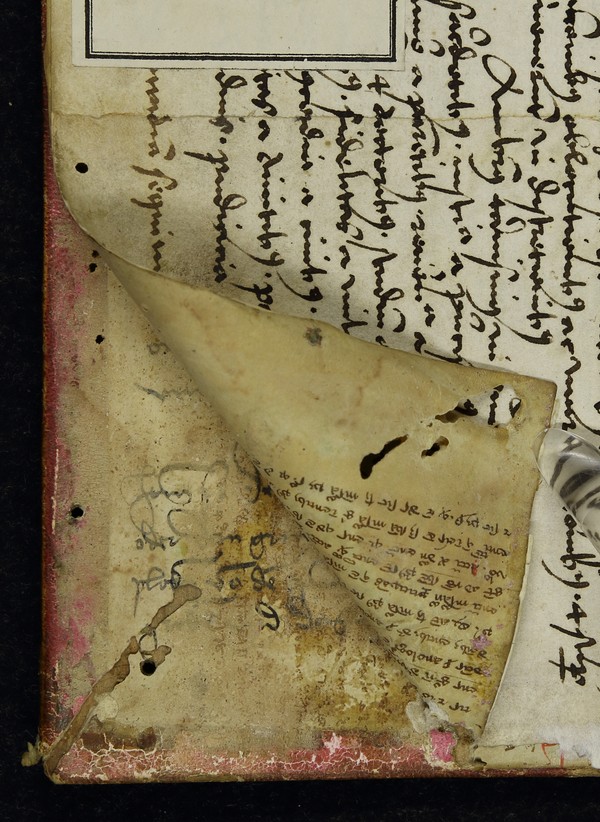
F-yybk: Johannes Dacus, De gradibus formarum, ed. Otto pp. 554-555 and 561
The parchment pastedown in the front cover of Vienna, ÖNB, Cod. 1936 carries the sophisma De gradibus formarum by Johannes Dacus (John of Denmark), a Paris master of arts active around 1280. A sophisma is a disputed school exercise built around a single proposition. The visible corner of the pastedown matches the passage in Alfred Otto's edition (1955) on the analogy of being and on God as the one measure of all beings, p. 561. The one line visible along the joint matches the discussion of prime matter as the first subject, pp. 554-555.
The Fragmentarium record describes Wien, Österreichische Nationalbibliothek, Cod. 1936, as one parchment pastedown, 120 x 170 mm, dated 1251-1350, in cursiva. It gives a written area 60 mm wide and at least 10 lines. The record's title, "Commentary to Aristotle's Metaphysics (?)", was a guess at the genre, and the content is listed as unidentified. The text is a sophisma, not a commentary, though it argues metaphysical questions. The description rightly says that paper is pasted over the parchment and that the text shows only where the glue has lifted. It transcribes phrases from both visible areas, and several of them are the passages identified here. It names no author or work.
- Identification: Identified, high confidence. The comparison covers parts of ten consecutive lines on the curled corner (lines 2-11), following Otto p. 561 in sequence with the differences noted below. Line 1 remains illegible. The run goes from "In omnibus dictis secundum analogiam" and "de omnibus entibus dicitur secundum analogiam", through "Quod autem hec mensura prius", "entia mensuram participant, que est mensura", "prius sunt entia quam accidentia", "Accidentia autem dicuntur entia", "que in eis est" and "Mensura igitur in entibus prius", to "Et sic patet secundum. Quod autem deus sit hec mensura". The joint line agrees with pp. 554-555, "primum substans est materia prima; nam quicquid substat".
- Alternatives: the catalogue's Metaphysics commentary was tested on its wording. Generic hits for these phrases in Aquinas, Albertus Magnus and Duns Scotus do not continue the sequence.
- Differences: in line 7 the manuscript seems to have one word, read "s(ub)st(anti)e", where the edition reads "entis. Sed substantie". This is a variant or an omission and is unresolved. Line 8 appears to read "q(ui)a(?) ens q(uo)d e(st) s(ub)[...]", consistent with the catalogue transcription, where the edition has "propter" before "entitatem". The continuation is unresolved. The manuscript has "que in eis est" without the "non" bracketed in the edition snippets; the meaning of those brackets has not been checked against Otto's editorial conventions. "anologiam" and "analogiam" both occur.
- Transcription: the image-only first reading, the initial source-assisted reading, and the source-assisted review of line 8.
- Canvas 0: a research reader reread lines 2-11 of the curled corner on the image, after seeing the edition text. The coordinator reread lines 8-11. A Codex reviewer inspected the corner and its lower enlargement against the saved edition snippets and catalogue transcription, including the doubtful expansion in line 8.
- Canvas 11: the research reader reread the single joint line on the image. Its middle and end remain very uncertain.
- The first reading's large "-ibus" text belongs to the later paper pasted over the fragment, not to the fragment.
- Accuracy has not been measured.
- Verification: a research reader compared the manuscript readings with Google Books snippets of Otto's edition (volume W6_-U19xpMgC). Together the snippets cover the collated run on p. 561 and the passage on pp. 554-555; they are search snippets, not page images.
- COORDINATOR CHECK: The coordinator read canvas 0 (rotated 180°, native box about 780,1450-1700,2450), lines 8-11, on the image against Google Books snippets of Otto 1955 p. 561; no page image of the edition was available.
- Gaps: no page image of the edition was seen, because the facsimile host was unreachable. Otto's introduction, which describes the manuscripts, was not read. The catalogue's further phrases from the joint ("minorem unionem", "locus est dupliciter") were not located at reading size.
- No human review.
Textual evidence
Manuscript images:
- Canvas 0, "Cod1936_VDS_Detail2", image, 1970 x 2700 native, photographed upside down. The curled corner lies in the native box about 780,1450-1700,2450; read it rotated 180°.
- Canvas 11, "Cod1936_VDSFalz", image, 1074 x 3946 native. The joint line runs at about x 690-810, y 800-3700; read it rotated 90° anticlockwise.


Parentheses mark expanded abbreviations, square brackets supplied or lost letters, and (?) doubt. Line numbers count from the top of the upright crop, and line beginnings are lost at the tear.
| Manuscript | Otto 1955 |
|---|---|
| (c0 l.2) ...[ratio]nem g(e)n(er)is | extra rationem generis (p. 561) |
| (l.3) ...d(ic)tis(?) s(ecundu)m anologi(am) | In omnibus dictis secundum analogiam |
| (l.4) ...[de o]mnib(us)(?) entib(us) d(icitu)r s(ecundu)m analo[giam] | Sed ens de omnibus entibus dicitur secundum analogiam |
| (l.5) ...[pri]m(um)(?). Q(uo)d a(utem) h(ec) m(en)s(ur)a p(ri)us | Et sic patet primum. Quod autem hec mensura prius |
| (l.6) ...e(n)tia m(en)s(ur)am p(ar)ticipa(n)t q(ue) e(st) m(en)s(ur)a | entia mensuram participant, que est mensura |
| (l.7) ...ad r(ati)o(n)em s(ub)st(anti)e(?) p(ri)us s(un)t e(n)tia q(ua)m acc(identi)a | ad rationem entis. Sed substantie prius sunt entia quam accidentia |
| (l.8) [absoluto] vo(cabu)lo. Acc(iden)tia a(utem) d(icu)nt(ur) entia q(ui)a(?) ens q(uo)d e(st) s(ub)[...] | absoluto vocabulo, accidentia autem dicuntur entia propter |
| (l.9) [entita]te(m) q(ue) i(n) eis e(st) s(ed) i(n) | entitatem, que [non] in eis est, sed in substantia |
| (l.10) ...m(en)s(ur)a i(gitur) i(n) entib(us) p(ri)us | Mensura igitur in entibus prius conuenit substantiis |
| (l.11) (et) sic p(ate)t s(ecundu)m. Q(uo)d a(utem) d(eu)s sit h(ec) m(en)s(ur)a | Et sic patet secundum. Quod autem deus sit hec mensura |
| (c11) ...[primum] s(ub)s(tans) e(st) m(ateri)a p(ri)ma(?). na(m) q(ui)cq(ui)d s(ub)stat ... | primum substans est materia prima; nam quicquid substat, ... per naturam eius substat (pp. 554-555) |
Differences. The agreement covers the surviving parts of each line, not whole lines: beginnings are lost at the tear and ends in the curl.
- Line 7: the manuscript has room for one word where the edition reads "entis. Sed substantie". This is unresolved.
- Line 8: the visible continuation appears to be "q(ui)a(?) ens q(uo)d e(st) s(ub)[...]", as in the catalogue reading "quia ens quod est sub[...]". It differs from the edition's "propter"; the complete wording and its connection to line 9 remain unresolved.
- Line 9: the manuscript lacks the "non" bracketed in the edition snippets. Otto's editorial conventions were not checked, so no interpretation of the brackets is asserted.
- Canvas 11: the order "materia prima" against the catalogue's "prima materia" is uncertain on the image.
Spelling variation, such as "anologiam", is not counted as a difference of text.
The source is A. Otto (ed.), Johannis Daci Opera, Corpus Philosophorum Danicorum Medii Aevi I.2 (Copenhagen 1955), De gradibus formarum, pp. 515-570, which edits the text only in part. It was consulted as snippets of Google Books volume W6_-U19xpMgC. A facsimile PDF of CPhD I exists but could not be reached.
Attribution:
- O. Weijers and M. Calma, Le travail intellectuel à la Faculté des arts de Paris: Répertoire des noms commençant par J (suite) (Studia Artistarum 11), list this sophisma, incipit "Eorum que secundum nullam complexionem dicuntur", under Johannes Dacus. They cite Otto's edition and further manuscripts in Basel (F.IV.18), Mantua, Nuremberg (Cent. V 21) and Uppsala (C 604).
- G. Sajó (1954) reports the text, attributed to Johannes Dacus, in a Budapest manuscript at fols. 8v-15r. Magyar Könyvszemle (1939) notes that the author is named at the end of the text there. Both were seen only as Google Books snippets.
What else is in the images, and what is not claimed
The fragment is the parchment pastedown of the front board, almost entirely hidden under a paper leaf with a later large cursive text. Only the lifted corner and the joint strip show it. The other canvases show the back pastedown, edges and spine. They were not examined for further text of this fragment, and the catalogue reports none.
The two visible passages are about six printed pages apart in the edition; their positions on the original leaf are not established.
Not claimed:
- that this is a new witness of the text. It is absent from the Weijers-Calma list, but that shows only that this repertory does not record it.
- any relation to the other manuscripts.
- the date or origin of the copy, beyond the catalogue's 1251-1350, which fits a text of about 1280.