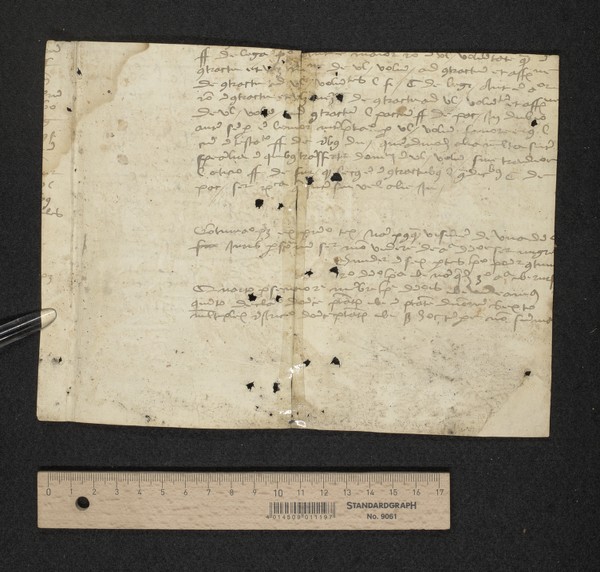

F-ziuq: Henricus de Piro, Super Institutiones, on Institutes 1.7-1.8 and 1.21-1.24
The paper leaves are identified with high confidence as part of the lectura (lecture commentary) on Justinian's Institutes by Henricus de Piro (Henricus Brunonis de Piro, died 1473), printed in the fifteenth century as Super Institutiones. Five of the 22 faces were compared with a printed edition and carry the commentary on Book 1, titles 7-8 and 21-24, in the edition's wording and order.
The Fragmentarium record describes Antwerpen, Erfgoedbibliotheek Hendrik Conscience, Fragm. 101 a-v: eleven partial paper leaves, 166 x 224 mm, in a cursive hand, dated 1501-1600, catalogued as an "Unidentified text on Roman law", with no further description. The subject is as catalogued; the record names neither the author nor the text commented on. The catalogue date has not been reassessed.
- Identification: identified, high. Six passages on five faces agree with the edition in the commentary's own connecting prose: the "continuatio" (the link from one title to the next), the division of the title into parts, the summary, and the notes on the Accursian gloss, each with the same legal citations in the same order. The matched layer is therefore the commentary itself, not a source it quotes. Nicolaus Everardi's Loci argumentorum legales treats the argument from contracts to last wills with the same doctrine but different wording and has nothing corresponding to the other passages, so it is not the text. Small differences of wording from the edition are listed below. Whether these leaves are an independent manuscript witness or were copied from a printed edition is not determined.
- Transcription: source-assisted selected reading of the passages collated. The image-only first reading covers only the first four faces (fragm. a-b and c-d) and left much of the heavily abbreviated cursive unresolved; a research reader reread the quoted lines on the images with the edition at hand and expanded the abbreviations from it, so the reading of fragm. q-r, s-t and u-v has no independent first reading. Accuracy has not been measured.
- Verification: a research reader compared the manuscript images with page images of the Cologne edition of about 1481 for five of the 22 faces (fragm. a-b recto and verso, q-r recto, the last paragraph of s-t recto, u-v recto). The coordinator read fragm. u-v recto lines 1-10 on the image against the research reader's transcription of the print. The other 17 faces were looked at in overview only and were not collated; fragm. c-d is very pale and its verso appears blank. The relation of this copy to the printed editions is not determined, and only one of the three fifteenth-century editions was compared. No human review.
Textual evidence
Manuscript images: fragm. a-b recto, native-pixel box 950,150,2950,1100; fragm. a-b verso, box 800,180,2850,1600; fragm. q-r recto, box 700,650,3061,1500; fragm. s-t recto, box 900,1500,3019,1850; fragm. u-v recto, box 700,150,2965,1500. Abbreviations are resolved silently, in the manuscript and in the print; square brackets mark words lost or not read; a question mark marks an uncertain reading. Leaf numbers of the print are the pencil foliation of the Munich copy.


| Fragm. 101 | Edition, Cologne about 1481 |
|---|---|
| a-b recto, lines 1-10 (end of Inst. 1.7): "Aut est maior ratio in ultimis voluntatibus quam in contractu et valet negative de ultimis voluntatibus ad contractum et affirmative de contractu ad ultimas voluntates l. fi. C. de legatis. Aut est maior ratio in contractu et valet negative de contractu ad ultimas voluntates et affirmative de ultimis voluntatibus ad contractum l. pactum ff. de pactis. In dubio autem semper est levior interpretatio pro ultima voluntate favore eius l. cum in testamento ff. de reb. dub. quemadmodum alia multa sunt specialia in [...] transfertur dominium sine traditione l. a Titio ff. de fur. quod secus est in contractibus l. traditionibus C. de pac." | fol. 15r col. b - 15v col. a: "aut est maior ratio in ultima voluntate quam in contractu et valet negative de ultima voluntate ad contractum et affirmative de contractu ad ultimas voluntates l. fi. C. de legi. Aut est maior ratio in contractu et valet negative de contractu ad ultimam voluntatem et affirmative de ultima voluntate ad contractum l. pactum ff. de pactis. In dubio autem semper est levior interpretatio pro ultima voluntate favore eius l. cum in testo. ff. de re. dubi. quemadmodum alia multa sunt specialia in ultimis voluntatibus. puta quod in eis transfertur dominium sine traditione l. a titio ff. de furtis. quod secus est in contractibus l. traditionibus C. de pact." |
| a-b verso, upper half (Inst. 1.8): "licet Jo. fa. dicat quod id quod servus iniuste acquirit non acquirit domino sic etiam filius quod acquirit iuste acquirit patri sed non illud quod acquirit iniuste ut per usuram de quo per glo. et Bar. in l. cum oportet C. de bonis que liberis. Quod facit in argumentum quod quando rectores universitatum vel scolares iurant servare statuta intelligitur de statutis licitis et honestis de quo hodie est casus in c. i. de iureiur. li. vi. In glo. super verbo cognita in fi. Nota ex hac glo. quod licet domino aliqualiter castigare servos suos sic etiam usufructuarius servum potest corrigere dum tamen non imprimat cicatrices l. locum §. ex eo ff. de usufructu" | fol. 15v col. b: "Licet Jo. fa. dicat quod id quod servus iniuste acquirit non acquirit domino. sic etiam filius quod acquirit iuste acquirit patri sed non illud quod acquirit iniuste. ut per usuram. de quo per glo. et Bar. in l. cum oportet C. de bo. que libe. eorum. Quod facit in arg. quod quando rectores universitatum vel scolares iurant servare statuta: intelligitur de statutis licitis et honestis de quo hodie est casus in c. i. de iureiuran. li. vi. In glo. super verbo cognita in fi. Nota ex hac glo. quod licet domino aliqualiter castigare servos suos. Sic etiam usufructuarius servum potest corrigere. dum tamen non imprimat cicatrices l. locum §. ex eo ff. de usufruct." |
| a-b verso, lower half: "Sic magistro licet corrigere scolares l. et si quecumque §. fi. ff. ad l. Aquil. Sic patri licet corrigere filios l. prima C. de emend. propinq. ubi est bona glo. quod pater vel propinquus potest incarcerare filium inobedientem. Sic et marito licitum est corrigere uxorem ex causa legittima ymo flagellis et fustibus potest maritus eam(?) verberare auth. sed novo iure [et in corpore unde sumitur] C. de repudiis. Sic abbati licet corrigere monachum c. quanto de off. ord. et ibi notatur [...] sic dominus domus potest corrigere familiam suam etiam posset eam incarcerare" | fol. 16r col. a: "Sic magistro licet corrigere scolares l. et si quecumque §. fi. ff. ad l. acqui. Sic patri licet corrigere filios l. i. C. de emen. propin. ubi est bona glo. quod pater vel propinquus potest incarcerare filium inobedientem. Sic et marito licitum est corrigere uxorem ex causa legitima. imo flagellis et fustibus potest eam maritus verberare auten. sed novo iure. et in corpore unde sumitur C. de repudiis. Sic abbati licet corrigere monachum c. quanto de offi. or. et ibi notatur in glo. Sic dominus domus potest corrigere familiam suam etiam posset eam incarcerare l. respiciendum §. furta domestica ff. de pe." |
| s-t recto, last paragraph (opening of Inst. 1.22): "Continuatio. postquam visum est de ingressu tutelarum sequitur modo videre de egressu vel exitu ipsarum quia nihil stabile reperitur in rerum natura §. nuptias in auth. de nuptiis. [...] pupilli pupilleque" | fol. 37v col. a: heading "Quibus modis tutela finitur", then "Continuatur. Postquam visum est de ingressu tutelarum. sequitur modo de egressu vel exitu ipsarum. quia nihil stabile reperitur in rerum natura §. nuptias in auten. de nupciis.", then the lemma "Pupilli pupilleque" |
| q-r recto, second block (opening of Inst. 1.23): "Continuatio patet quia postquam visum est de aliquibus qui alieno [...] id est de his qui sunt sub tutela sequitur videre de aliis qui etiam se regere nequeunt sed oportet eos regi per curatores. [...] masculi puberes. Dividitur in tres partes. primo ostenditur quibus adultis detur curator. 2o ibi furiosi ostenditur qualiter et quibus maioribus detur curator. 3o ibi interdum qualiter pupillis detur curator. Sic summatur. puberibus minoribus xxv annis datur curator ab eisdem iudicibus a quibus tutor dummodo volentes sint et non inviti sed in testamento non datur curator hoc dicit primo. Item maioribus qui morbo aliquo impediuntur hoc 2o. Item pupillis si tutor datus eis non sit omnino efficax hoc 3o usque ad fi. ti. Nota primo quod minoribus xxv annis dandi sunt curatores qui negotia eorum regant" | fol. 38r col. b - 38v col. a: heading "De curatoribus", then "Postquam visum est de aliquibus qui alieno regimine egent. id est de his qui sunt sub tutela. sequitur videre de aliis qui etiam se regere nequeunt sed oportet eos regi per curatores." Lemma "Masculi puberes". "Dividitur in tres partes. primo ostenditur quibus adultis detur curator. secunda ibi furiosi ostenditur qualiter et quibus maioribus detur curator. tertio ibi interdum qualiter pupillis detur curator. Sic summatur. Puberibus minoribus xxv annis datur curator ab eisdem iudicibus a quibus tutor. dummodo volentes sint et non inviti sed in testamento non datur curator. hoc dicit primo. Item maioribus qui morbo aliquo impediuntur. hoc secundo. Item pupillis si tutor datus eis non sit omnino efficax. hoc tertio usque in fi. ti. Nota primo quod minoribus xxv annis dandi sunt curatores qui negotia eorum regant" |
| u-v recto, lines 1-10 (opening of Inst. 1.24): "Continuatio patet ex principio huius tex. Nam postquam visum est de tutoribus et curatoribus necesse erat providere pupillis ne eorum res consumantur et ipsis pupillis cavetur de hoc per satisdationem ideo sequitur videre de satisd. Dividitur in tres partes. primo ostenditur qui debent satisdare et qui non. 2o ibi sed et si ex testamento qualiter consulitur pupillo si plures sint tutores. 3o ibi sciendum autem qualiter consulitur pupillo vel adulto si tutores vel curatores non sint solvendo vel male gesserunt. Sic summatur tutores legitimi satisdant non testamentarii vel dativi hoc dicit primo. Et si plures sint testamentarii vel dativi qui velint administrare tunc unus potest alteri satisdationem offerre" | fol. 39v col. a: heading "De satisdatione tutorum et curatorum", then "Continuatio patet ex princi. huius te. Nam postquam visum est de tutoribus et curatoribus necesse erat providere pupillis ne eorum res consumantur et ipsis pupillis cavetur de hoc per satisdationem. ideo sequitur videre de satisdatione." Lemma "Ne tamen pupillorum". "Dividitur in tres partes. primo ostenditur qui debent satisdare et qui non. secundo ibi sed et si ex testamento. qualiter consulitur pupillo si plures sint tutores. tertio ibi sciendum autem. qualiter consulitur pupillo vel adulto si tutores vel curatores non fuerint solvendo [...] male gesserunt. Sic summatur. tutores legitimi satisdant: non testamentarii vel dativi. hoc dicit primo. Et si plures sint testamentarii vel dativi [...] velint administrare tunc unus potest alteri satisdationem offerre" |
Differences. The manuscript has ultimis voluntatibus where the print has the singular in the first passage; sint for fuerint (Inst. 1.24); an added videre and Continuatio for Continuatur (Inst. 1.22); usque ad for usque in and, as read, an opening "Continuatio patet quia" that the print lacks at Inst. 1.23, where the manuscript words after "alieno" were not read securely. The manuscript omits the printed title headings, leaving blank space, and where it gives the lemma (the opening words of the Institutes passage) it writes it in the line. In the lower half of fragm. a-b verso some citations between "notatur" and "sic dominus" were not read. None of these differences shows by itself whether the leaves depend on a print.
The edition compared is Henricus de Piro, Super Institutiones [Cologne: Konrad Winters, about 1481], Gesamtkatalog der Wiegendrucke 12256, ISTC ip00651000, in the copy of the Bayerische Staatsbibliothek, Munich: fol. 15r, 15v, 16r, 37v, 38r, 38v, 39v, read as page images. The attribution to Henricus de Piro rests on the edition's printed title and on the GW and ISTC entries; the scholarly literature on the author was not consulted. Two further editions exist, [Cologne: Johann Koelhoff the Elder, about 1482] (GW 12257) and Louvain: Egidius van der Heerstraten, 1486/88 (GW 12258); neither was compared.


Order of the leaves and limits
The faces collated show that the lettering of the bundle does not follow the order of the text throughout: fragm. s-t carries the end of one title and the opening of Institutes 1.22, fragm. q-r the opening of 1.23, fragm. u-v the opening of 1.24, and fragm. a-b the end of 1.7 and title 1.8. Other faces open with further "Continuatio patet" paragraphs and were not placed. Narrow stubs at the left edge of some faces carry cut line ends of other leaves and were not read.
No claim is made about the date or origin of the leaves, about how much of Book 1 they contained, or about whether this copy has any value as a witness independent of the printed editions.