

F-18n8: Accursius, Glossa ordinaria on the Digestum vetus, gloss "illatae sunt" to D. 4.9.1.8 (strip 1)
The legal writing on strip 1 of this record is identified with high confidence as part of the Glossa ordinaria of Accursius, the standard thirteenth-century commentary copied in the margins of Justinian's Digest. It is the end of the gloss on the words illatae sunt in Digest book 4, title 9 (Nautae caupones stabularii ut recepta restituant, on the liability of shipmasters, innkeepers and stable-keepers), law 1, paragraph 8: five cut lines running from "est contrarium" through the chain of allegations (short references to other laws) that closes the gloss. The catalogue's "Roman law text" is therefore gloss, not the law text itself. The passage glossed is the very paragraph whose main text survives on the sibling record Ms. 1032, so strip 1 very probably comes from the same leaf. Strip 2 shows no legal writing.
The Fragmentarium record describes Leuven, KU Leuven Bibliotheken Bijzondere Collecties, Ms. 1033: two parchment strips, 45 x 135 mm, in Northern Textualis, dated 1301-1350, catalogued as "Unidentified Roman law text". Its reconstruction summary says the strips were used as a spine lining, were probably recovered from the same binding as Ms. 1032 (F-x60p), and that both carry the offset imprint of a twelfth-century liturgical manuscript. The description fits; it names no work or passage. In the published images the legal hand is visible only on strip 1 "recto"; the other three faces show the liturgical offset or are blank. The catalogue date has not been reassessed.
- Identification: identified, high. On strip 1 "recto" the surviving pieces of lines 1, 2, 3 and 5 agree in wording and order with the Accursian gloss on illatae sunt (D. 4.9.1.8), preserved in a manuscript of 1290-1300 and the prints of 1488 and 1566: "est contrarium", then "-nque. §. quod si servus. et de hiis", then "vel al. ... l. i. et", then "l. sequitur". These are the allegations of Code 6.1 (De servis fugitivis), law Quicunque, and Code 9.39 (De his qui latrones vel aliis criminibus reos occultaverint), followed by a law Sequitur, in the sequence of the print, with each manuscript line taking up where the last stopped. The place agrees with independent evidence: Ms. 1032 from the same binding is a leaf of the Digestum vetus (the first of the three medieval volumes of the Digest) with this gloss, covering D. 4.8.42-4.9.3 pr., and it has the main text "illatae sunt" and the two preceding glosses of the same column. A string of allegations could in principle be quoted in a later commentary; nothing on the strip suggests that, and the position beside the sibling leaf's text speaks for the gloss itself. Differences: no "C." (for Codex) was seen before "de hiis" where all three comparison witnesses have a second "C."; line 4 is unread.
- Transcription: source-assisted reading of the five lines. The image-only first reading saw the pattern of point-separated sigla and a "section-like sign" in line 2 but read no word. A research reader reread all six lines on the image. Its own first reading of line 2, made without a source, was wrong: it took the paragraph sign for supra, "q(uod) si s[er]u[us]" for "q(ui) satisd(are)" and "de hi[is]" for "de proc(uratoribus)". The corrected reading was reached with the printed gloss at hand, after "contrarium" in line 1 led to the gloss on illatae sunt, and each line was then checked again on enlarged crops. Line 4 lies under black offset specks and is not read; line 5 beyond "l. s.q." is faint. Accuracy has not been measured.
- Verification: a research reader compared the manuscript image with page images of the glossed Paris edition of 1566, reading the gloss to D. 4.8.44-4.9.3.1 (columns 659-664) and collating the four legible lines against gloss h in column 663. It also compared the hand with the gloss on Ms. 1032 strip 2 "verso": the same kind of small pale-brown glossing script and the same style of sigla, compatible with one hand, not shown to be the same. The coordinator read lines 1, 2, 3 and 5 of strip 1 "recto" on enlarged crops of the manuscript image ("est contrarium", "-nque. §. quod si seru- . et de hi-", "vel al. ... l. i. et", "l. sequitur") and the words "Sed melius est contrarium: ut C. de ser. fugi. quicunque. §. quod si seruus. & C. de his qui la-" on the page image of column 663 of the 1566 print. A further source-assisted image comparison checked the diagnostic citation sequence in the Venice 1488 print, scan 202, and Vatican Pal. lat. 731, fol. 86v, catalogued to 1290-1300 (details below). These are checks by an AI reader, not human palaeographic review. Gaps: line 4 unread; line 5 only partly secure; no physical join with Ms. 1032 was established; the liturgical offset was not studied.
Textual evidence
Manuscript image: strip 1 "recto" (canvas 0, "fragment 1 recto"), native-pixel box 1050,300,2000,1500. The writing runs at right angles to the strip and reads when the image is turned 90 degrees clockwise. Every line is cut at both ends and two holes interrupt lines 1 and 2. Parentheses mark a resolved abbreviation, square brackets lost letters, (?) an uncertain reading.

| Ms. 1033, strip 1 "recto" | Glossa ordinaria, Paris 1566, col. 663, gloss h |
|---|---|
| 1. ..e(st) (con)t(ra)rium [hole] ..fu(?).. | Sed melius est contrarium: ut C. de ser. fugi. |
| 2. ..nq(ue). §. q(uod) si s[er]u[us] [hole] . (et) d(e) hi[is].. | quicunque. §. quod si servus. & C. de his |
| 3. ..v(e)l al(ios) .. [occ]ul(?). l. i. (et).. | qui latro. vel al. cri. re occul. l. j. & l. ij. |
| 4. (under offset specks, not read) | & j. de usuc. |
| 5. ..l. seq(ui)t(ur)(?). §(?) t(un)c(?).. | l. sequitur. §. tunc. & infra de actionib. & obliga. l. iiij. §. j. |
The gloss as printed begins: "Illatae sunt. sed an ita demum si sciverit, an si ignoraverit? Respon. forte etiam si ignoravit: ut infra furti adver. nau. cau. sta. l. j. §. in duplum. & infra depo. l. j. §. si cista. in fine. Sed melius est contrarium ..." It asks whether the shipmaster answers for goods brought on board without his knowledge.
Differences. No "C." was seen before "de hiis" in line 2; it may have stood at the hole or been omitted. The second "C." is present in both prints and in Pal. lat. 731, so the earlier witnesses do not resolve this difference. Line 4, which by the print should hold "l. ii. et infra de usucapionibus", is hidden; the line is longer than those words need, so the manuscript may have had more there. In line 5 only "l. s.q." is firm. The manuscript lines run to about thirty letters, and the breaks between lines 1, 2 and 3 fall where continuous copying of the printed wording would put them.
Source. Digestum vetus seu Pandectarum iuris civilis tomus primus ... commentariis Accursii ... illustratus, Paris: Guillaume Merlin, Guillaume Desboys and Sebastien Nivelle, 1566, in the scan of the Bayerische Staatsbibliothek copy at the Internet Archive, cols 663-664, read as a page image. The attribution of the gloss to Accursius rests on that edition's title page and on the signatures "Accursius" and "Acc." printed after neighbouring glosses in these columns; gloss h itself is unsigned in the print. The sibling strip Ms. 1032 has the siglum "ac." in the manuscript after a gloss in the same passage.
Earlier witnesses of the gloss
The same diagnostic sequence was checked on images in two earlier witnesses:
- Venice, Baptista de Tortis, 4 August 1488, Digestum vetus with the Glossa ordinaria, BSB 2 Inc.c.a. 2039 a, scan 202, upper outer-right gloss column. The BSB catalogue identifies the work and Accursian apparatus; its IIIF metadata supplies printer and date.
- Vatican, Pal. lat. 731, fol. 86v, lower-right gloss block, page image. The Heidelberg description by Thorsten Huthwelker identifies the Digestum vetus with Accursius's Glossa ordinaria and dates the manuscript to Bologna, 1290-1300. The relevant gloss has the lemma ending sunt illate and stands immediately before the gloss on Et vectorum.
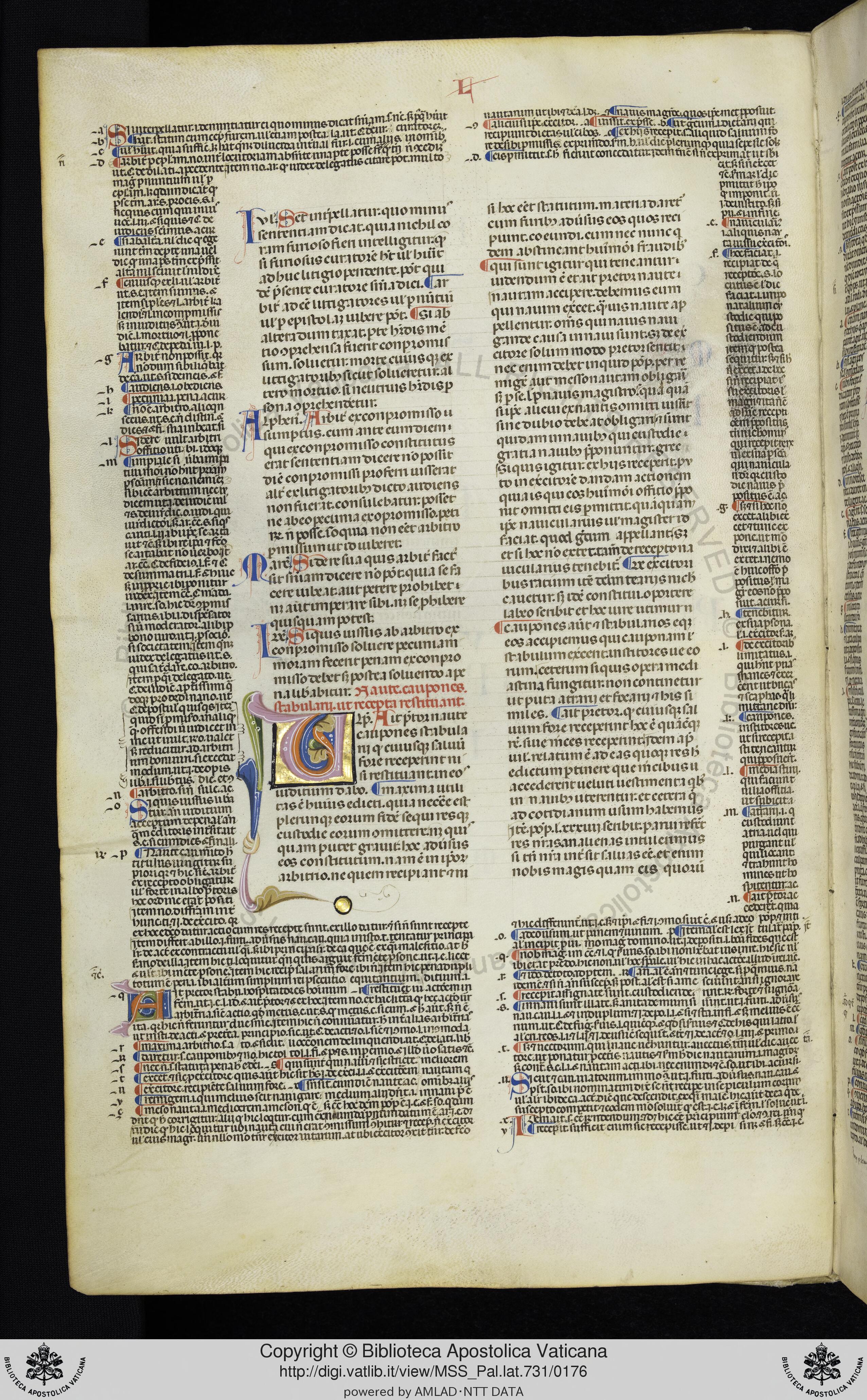
Both have Sed melius est contrarium, the reference to the law Quicunque, its paragraph quod si servus, the title concerning those who conceal robbers, and the subsequent de usuc. reference to l. sequitur, §. tunc, in that order. These are selected, abbreviation-expanded anchors, not complete diplomatic transcriptions. They confirm that the sequence used to identify the strip belongs to the medieval Accursian apparatus and is not peculiar to the 1566 edition. They do not supply new visible letters on Ms. 1033: line 4 remains unread and the reading of line 5 remains tentative. No relationship between the textual families of these witnesses has been established.
The leaf, other items in the images, and limits
Ms. 1032 (F-x60p; this project's report is listed at aaymeloglu.github.io/fragmentarium) is one leaf of the Digestum vetus with the Accursian gloss, D. 4.8.42-49 and 4.8.52-4.9.3 pr. Its strip 5 carries the main text of D. 4.9.1.8 with the words "illatae sunt", and its strip 1 the glosses Nobis magis and Si ante, which stand immediately before the present gloss in the same column. On the "verso" of that strip 5 (image, native box about 2250,130,3384,1900) the gloss column beside the main text holds four or five cut line-pieces directly above the gloss that follows illatae sunt in the print (gloss k). Two of them can be read, weakly, as "fug. qui-" and "-is qui la-". These pieces can be placed in the same gloss: the print has "C. de ser. fugi. quicunque. §. quod si seruus. & C. de his qui latro. vel al.", and Ms. 1033 has "-nque. §. quod si seru- . et de hi-" and "vel al.". These readings suggest complementary pieces of the citation chain; their faintness and the possible "fu" in Ms. 1033 line 1 prevent a categorical claim that no wording overlaps. A research reader read these pieces and the coordinator looked at the same crop and can see "fug. q-" and "qui la-"; how the pieces of the two records line up row by row was not worked out, one further piece on strip 5 is unexplained, and the images have no scale, so the two could not be measured against each other.

That strip 1 of Ms. 1033 belongs to the same leaf is therefore very probable: the text is the gloss wanted at that point of the leaf, the sibling keeps pieces of the same gloss that appear complementary, and the hands are compatible. No physical join between the pieces was fitted, and it is not claimed as established. The textual match alone cannot exclude another copy of the same passage.
Strip 2 shows no legal text: its "recto" (canvas 2) has three lines of a large round hand in mirror image, and its "verso" (canvas 3) is blank with a row of prickings. Strip 1 "verso" (canvas 1) has large inverted letter-remains. These belong to the offset of the liturgical manuscript noted by the catalogue, a separate layer that was not studied here; one offset line on strip 2 appears to read "... dominum. Benedictus dominus d...".
No claim is made about the date or origin of the strip, about the form of the gloss beyond the lines collated, or about any value of the fragment as a witness.