Fragmentarium: identifying the unidentified
52 identifications of medieval manuscript fragments catalogued on Fragmentarium as “unidentified”. Each report links the manuscript to the matching edition and explains the evidence. Research and comparisons were performed by LLMs. Method.
| Identification | |||
|---|---|---|---|
 | B 234 Bd. 12 Ludwigsburg, Staatsarchiv Ludwigsburg Catalogued as: Unknown, 1501 – 1600 CE F-v7a4 | Mass book, probably a plenary missal: Mass readings for Monday after the first Sunday of Lent (Epistle Ez 34:11-14, Gospel Mt 25:31-35; turn-in Mt 25:46 and Tuesday Epistle Is 55:6) and, on a strip, Gospel for Monday after Reminiscere (Jn 8:22-24) The parchment cover leaf (canvas 1) carries the Epistle and Gospel for Feria II post Invocavit, and the turn-in shows the end of that Gospel and the opening of Tuesday's Epistle. The rolled strip (canvas 0) carries John 8:22-24 for Feria II post Reminiscere, with Daniel 9:17 probable in the preceding column. A research reader collated 39 lines with page images of the 1519 Teutonic Order missal (fols. XXVII, XXXIIII), and the coordinator checked canvas 1 col. b lines 1-5 and the placement on scan 91. The texts are standard Vulgate pericopes, so this is a liturgical placement, not a rare text. The manuscript omits 'et' in Ez 34:13 and 'de' in Jn 8:23. The use (rite) is open, the strip is not shown to be from the same book, and a plenary missal is preferred over a lectionary only from the column spacing. The catalogue describes only the 16th-century music fragment, which is out of scope. | |
 | Cod. 1936 Wien, Österreichische Nationalbibliothek Catalogued as: Commentary to Aristotle's Metaphysics (?), 1251 – 1350 CE F-yybk | Johannes Dacus, De gradibus formarum (sophisma), ed. Otto 1955, pp. 554-555 and 561 The corner of the front pastedown visible under the paper (canvas 0) agrees with Otto's edition p. 561, on the analogy of being and God as the measure of beings, in sequence over parts of ten consecutive lines (2-11), with variants; line 1 remains illegible; the joint line (canvas 11) agrees with pp. 554-555 ('primum substans est materia prima; nam quicquid substat'). A research reader reread all visible lines on the images; the coordinator read canvas 0 lines 8-11 against the edition. The source text is Google Books snippets of the edition that together cover the collated run; no page image was available. In line 7 the manuscript seems to have one word where the edition reads 'entis. Sed substantie' (unresolved), line 8 appears to read 'quia ens quod est sub[...]' rather than the edition's 'propter' (continuation unresolved), and the manuscript lacks the bracketed 'non' in the edition snippets (editorial convention unchecked). The catalogue's 'Commentary to Aristotle's Metaphysics (?)' was a genre guess; the fragment is not claimed as a new witness. | |
 | II 27 D 24 Gubbio, Biblioteca comunale Sperelliana Catalogued as: Unidentified fragments in Latin, 1101 – 1200 CE F-mgx2 | Gilbert the Universal, Glossa ordinaria in Lamentationes, book I, on Lam. 1:16 and 1:17 Two in-situ spine tabs carry line ends from the Glossa ordinaria on Lamentations. Tab B is on 1:16 ('[docto]rum ecclesiam s(ibi) c[ommissam] ... fonte a[moris] ... [la]crimas p(ro)ducat') and tab A is on 1:17 Allegorice ('[q]ua p(ossi)t hostium / uince(re) & sua defende(re) / polluta fed[i]t[at]e car[nalium] ... hostes q(uibus)'). A research reader compared all seven visible lines with the Lyon 1545 Glossa page images (scans 392-393) and with snippets of Andree's edition (pp. 256, 260); the coordinator checked tab A lines 1-2 against scan 393. The wording follows the Glossa, not its source Paschasius ('hostes revincere, suaque defendere dogmata'). Martin of Leon, who reuses the 1:16 sentence, was not found to contain the 1:17 passage, a result that rests on MDZ OCR and the PL text only and weakens this alternative without conclusively excluding it. Andree's apparatus was not seen; the opening words of tab A l. 4 and tab B l. 2 are uncertain; F-dkld is a different volume. | |
 | MAG-P 64.74 Antwerpen, Universiteitsbibliotheek Antwerpen Bijzondere Collecties Catalogued as: Unidentified religious treatise in Anglo-Norman verse, 1301 – 1325 CE F-rjkx | Marcus, Visio Tnugdali (Vision of Tundale), Anglo-Norman translation in octosyllabic couplets, Lucifer to the field of joy (ed. Wagner 1882, pp. 36-41) The two leaves translate, in the Latin's order, the Visio Tnugdali from the description of Lucifer to the gate and field of joy with the fount of life, phrase by phrase and in sequence on all four faces. A research reader compared the reread columns with Wagner's 1882 edition, using page images for pp. 36, 38 and 41. The coordinator found phrase-by-phrase correspondence for canvas 3, col b, box 760,340-1420,1200, against p. 41 lines 2-8. The identification is of the work translated: no edition of this French text was found, so it was compared with the Latin. The translation is free and amplifying (especially on prelates), is in octosyllabic couplets, and differs in form from the edited Dublin TCD 312 alexandrine version. It is not recorded in the sources checked (ARLIMA, Easting 1997, Gardiner 1993, Picard 1989). Dean and Boulton 1999, Palmer 1982, Cavagna 2017 and Jonas were unavailable, and no novelty is claimed. | |
 | HS.2582/168 Gent, Universiteitsbibliotheek Gent Catalogued as: Legendary | Miracles of St James and saints' lives of St Clement and St Eustace, 1301 – 1350 CE F-q5ti | Anonymous preaching compilation of exempla in 20 chapters (prologue 'In hoc consequenti opusculo ordinantur in certis titulis'), section IV De sanctis, subchapters 1-6 and 34-39 (= Cambridge CCCC MS 327, ff. 175v-176r, 179v-180v) The bifolium agrees in chapter sequence and in the compiler's own wording with section IV of the compilation in Cambridge, Corpus Christi College MS 327: the Gregory framings with the additions 'et estu immenso' and 'vir mirabili gratia dotatus', the false reference 'in xvi libro de sacramentis', and 'fructus vere patientie'. A research reader collated four passages from both faces with the Parker on the Web page images (ff. 175v, 176r, 180r) and checked the sequence through Becket and Giles on ff. 179v and 180v. The coordinator found line-by-line agreement for f. 25v col. b (canvas 1, box 1850,5100-4450,6150) against f. 176r, the rubric between the items differing ('vi cap.' against 'Similis precedenti'). The rubrication differs throughout (Gent numbers chapters within the section, Cambridge across the work, offset 89), and the wording differences are minor. The work is unedited and anonymous; the other recorded copies (Florence BNCF Conv. Soppr. D.8.1128, Les Enluminures TM 427, BL Sloane 4029) were not seen. | |
 | Cod. 3637 Wien, Österreichische Nationalbibliothek Catalogued as: Commentarium super Petri Hispani summulas logicales, 1251 – 1325 CE F-kcu7 | Anonymous, Compilationes supra Summulas Petri Hispani ('Omnes homines') or a close derivative, divisio textus on Tracts IX-XI (de Rijk 1972 numbering); wording fuller than the Nuremberg copy The front strip agrees clause by clause with the Compilationes' divisio of Peter of Spain's Tracts IX-X in Nuremberg GNM Hs 27773, fol. 128ra. The back strip shares only the structure and lemmata of its Tract XI outline (sophisma at 'Secundum predicta queritur', then 'Solet autem poni'). A research reader compared both strips with the Nuremberg page image, and the coordinator found clause-by-clause agreement for the front strip (canvas 0, box 1420,1100-2620,2900, against fol. 128ra). The fragment's wording is fuller: it adds 'quia opposita iuxta se posita magis elucescunt' and reads 'explanat' for 'exponit', so it is an expanded or interpolated copy or a close derivative. Only one witness was compared; Vienna ÖNB Cod. 2389, reported by de Rijk as interpolated, could settle the redaction. | |
 | Fragm. 308 Antwerpen, Erfgoedbibliotheek Hendrik Conscience Catalogued as: Medical treatise, 1401 – 1500 CE F-nfu2 | Hippocrates, Regimen acutorum, book IV with Galen's commentary (Latin), Textus XIX-XX and XXIV-XXVII (Giunta 1527 numbering) The red text is the Hippocratic lemma and the black is Galen's commentary. Face A carries the end of Textus XIX and the start of XX, and face B the end of the commentary on XXIV and Textus XXV-XXVII. A research reader compared XIX, XX, XXV and XXVII with page images of the Venice 1527 Giunta edition (MDZ bsb10139648, scans 709-712), and the coordinator found line-by-line agreement for Textus XXVII (canvas 1, box 600,2780-1480,3500, against scan 712). In XIX the manuscript reads 'sed ab assumpt[ione]' where the edition has 'sed ad defectionem'. The translator was not checked, no claim is made about the Latin version or print tradition, and the abraded mid-face commentary was not compared. | |
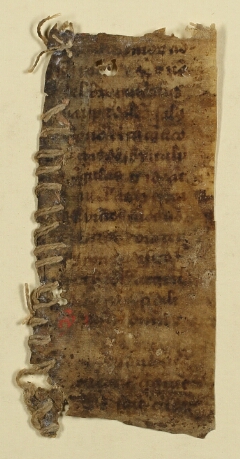 | Fragm. lat. 367a Leipzig, Universitätsbibliothek Catalogued as: Unidentified (probably Breviarium), 1334 – 1401 CE F-lodh | Liturgical psalter (Gallican), Psalm 68:15-22; probable Psalms 59, 61-62 and 67 on the other faces On the face 367a-1: 1v ten line beginnings read in order as Psalm 68:15-22, with a two-line red initial at v. 17 where the Benedictine office divides the psalm for Wednesday Matins. A research reader reread the lines on the image and compared them with a transcription of the Stuttgart Gallican text; no page image of an edition or medieval psalter was used, and the monastic division was checked only in a modern table. Where it can be told the reading has the Clementine form 'respice in [me]'. The other three faces (Ps 67:20-24, the opening of Ps 59 under 'fer. iiij', Ps 61:11 onward) are probable only, supported by both strips implying the same 54-line column. The identification is of the Psalm 68 face alone; book type is inferred and monastic use remains provisional. | |
 | Fragm. 315 Antwerpen, Erfgoedbibliotheek Hendrik Conscience Catalogued as: Unidentified canon law text, 1301 – 1400 CE F-ypxa | Hostiensis (Henricus de Segusio), Lectura in Decretales Gregorii IX, on X 3.30.33-34 (De decimis: end of c. Cum non sit in homine, and c. Nuper abbates) Twenty of the 21 surviving line ends and line beginnings on both faces agree in wording and order with Hostiensis's Lectura through nine successive lemmata. A research reader compared both faces on the published images with the page image of the Strasbourg 1512 edition (vol. 2, fol. 114r) and with text-recognition snippets of the Venice 1581 edition. Johannes Andreae's Novella rewords these comments and cites Hostiensis by name at the points the fragment preserves; it was excluded on the page image of the Venice 1581 edition (vol. 3, leaves 146v-147r) for the comments on Per censuram ecclesiasticam, De iure and Nisi cum ipsis. The ordinary gloss was excluded on a page image. No difference of wording in the surviving words; about one line's worth of text between lines 6 and 7 of the first face was probably absent from the manuscript (inferred from spacing), and the first line of the second face is cut through and unplaced. No manuscript of the Lectura was compared and no human review has been made. | |
 | Neerl. 413/45 Antwerpen, Ruusbroecgenootschap Catalogued as: Unidentified Middle Duch text, 1401 – 1500 CE F-3l5z | Geert Grote, Getijdenboek (Middle Dutch hours), Hours of the Eternal Wisdom, Compline: end of hymn Ihesus regniert in den vreden and antiphon O gloriose coninc onder dinen heilighen (Van Wijk 1940, p. 111) Two strips and a scrap are parts of one leaf: the recto line ends and the verso line beginnings on the strips, with the opposite ends of the same lines on the scrap, agree in wording and order with the hymn and Nunc dimittis antiphon of Compline of the Wisdom Hours in Van Wijk's edition, p. 111. A research reader reread strips verso lines 2-10, recto lines 1-6 and the scrap on enlargements against the DBNL transcription of the edition; the printed page was not seen. Differences are small (bis altoes without die, dinen for dine, waerdighe- for verwerdighen, weter for weder); verso line 8 and recto lines 1, 4-5 are rubbed and only compatible. Other Middle Dutch versions of Suso's Cursus were not compared, a prayer book with only the Wisdom Hours is not excluded, and the third strip (canvases 2-3) is illegible and unplaced. | |
 | Fragm. 127 Antwerpen, Erfgoedbibliotheek Hendrik Conscience Catalogued as: Unidentified liturgical manuscript | Mark 15:43-46 ; Psalm 68, 1451 – 1500 CE F-ne56 | Missal, Holy Week: Tuesday, end of the Passion according to Mark (15:43-46); Wednesday, lesson Isaiah 63:5, 7 and gradual Ne avertas (Ps 68:18, 2). Use not determined Sixteen line beginnings on the recto fall in order on Mark 15:43-46 and sixteen line ends on the verso on Isaiah 63:5 and 7 (without verse 6, as in missals) followed at once by the gradual Ne avertas with verse Salvum me fac. This is a substantial catalogue refinement: the catalogue already named Mark 15:43-46 and Psalm 68; the missal identification, the two days, the Isaiah lesson and the precise gradual are new. The complete book's plenary format is not established by the strip. A research reader reread every line on the native images and compared them with the OCR text of the Arbuthnott missal (1864), pp. 133-134, and with a Google Books snippet of a Lateran missal edition. The manuscript has omnibus que where Arbuthnott prints super omnia quae; Arbuthnott is a witness of the common formulary, not the fragment's use. The use is not determined, the rubric after the Passion is not securely read, and no manuscript missal was collated. | |
 | MdS 58 Ba 6/F2-6 Orselina-Locarno, Biblioteca Madonna del Sasso Catalogued as: Unidentified religious text (?), 1251 – 1400 CE F-x6c5 | Psalter text, Psalm 49:5-10 (Gallican or Roman wording) on the strip in the "ant" images; the second strip probably Psalm 49:15-20. Kind of book open (psalter, breviary or Bible) On the strip shown in the "ant" images seven consecutive line fragments fall on Psalm 49:5-10 in order at one-line intervals of 33 to 40 letters, with coloured initials on the verse openings Et, Audi and Non. The strip in the "post" images is only probably Psalm 49:15-20, on "]ero od[", "]um S" one line later and a red stroke where Peccatori would stand. A research reader reread every line on the native images and compared them with an online transcription of the Stuttgart Vulgate, not a page image. The readings iumenta and holocau- exclude the version from the Hebrew; Gallican and Roman wording cannot be separated. The kind of book (psalter, breviary or Bible) is open, and the hidden sides and the two covered strips were not seen. Even if the second strip's proposed text is correct, placement of the two strips in one column is compatible with the text sequence but unproved. | |
 | MdS 58 Ba 27 Orselina-Locarno, Biblioteca Madonna del Sasso Catalogued as: Unidentified philosophical (?) text, 1301 – 1400 CE F-3wqe | Eberhard of Béthune, Graecismus, XIX 118-121 (lower strip, Frammento 3, only; upper strip unidentified) The four lines of the lower strip are the middles of four consecutive verses of Graecismus XIX 118-121 (ex se reliq-, orno como s-, -das huic quoque s-, -es dicas gale-) and show no difference from Wrobel's text in the surviving letters. A research reader reread all lines on enlarged crops of canvas 2 and compared the lower strip with the OCR text of the archive.org scan of Wrobel's edition, not with the page image. Verse 118 has ex se, where the apparatus records in se for one manuscript (P); the other recorded variant places are mostly outside the strip. The upper strip (Frammento 2), in a small cursive with scholastic vocabulary, is unidentified: that it is commentary on the Graecismus is a guess, and whether the two strips are one leaf is open. Only a slice about 23 mm wide of each strip is visible and no manuscript of the Graecismus was collated. | |
 | Archief Sint-Leonarduskapittel te Zoutleeuw, nr. 1132 Leuven, Rijksarchief te Leuven Catalogued as: Unidentified canon law text, 1250 – 1300 CE F-cckq | Tabula utriusque iuris attributed to Johannes de Erfordia, article Appellatio (on tacit renunciation of an appeal) Three passages, two consecutive, agree with Bremen, SuUB, msa 0137, f. 27v (page images; coordinator compared about fourteen lines), and most of the recto was placed at f. 26r by the research reader. Not the same form of the text: the case is reworded (ad papam ... ad ordinarium), citations, sigla and order differ. A second witness, Bruges Grootseminarie 46/57 f. 31v, agrees with Bremen against the leaf and adds Sext citations; recension of the leaf not decided. Leipzig Ms 885 f. 22r, assigned by Kurtscheid 1914 p. 280 to the first redaction, also matches the renunciation sequence but shares Bremen's episcopo wording and lacks e. ut debitus. Thus an early-versus-late explanation of the leaf's variants is not established. No edition used; attribution follows catalogues and Kurtscheid. Excluded on page images: Monaldus (Pal. lat. 695) and the short article of Pal. lat. 804. | |
 | HS.0301 Gent, Universiteitsbibliotheek Gent Catalogued as: Unidentified computus text, 901 – 1000 CE F-bcte | Bede, De temporum ratione, chapter 43 (fol. F) The readable portions of fol. F recto follow Giles vol. 6 pp. 232-233 in order, and the first lines of the verso continue the chapter; coordinator checked lines 10-19 on the image; Codex compared the quoted passages with the printed page images and re-examined both faces at native resolution. No reliable extended verso transcription obtained. Variants include calculatorum and discernerent; not compared with Jones's edition. The first image-only reading used canvases that do not show fol. F. The sideways leaf in the same images (Priscian, Institutiones XIV) belongs to record F-fwl6. Stub before fol. D unread. | |
 | Tra.MF.2019.09.01 Utopia, armarium codicum bibliophilorum Catalogued as: Unidentified Tractatus de articulis fidei, 1301 – 1400 CE F-7nce | Aldobrandinus de Toscanella, Scala fidei (sermons on the Apostles' Creed): Tertia die resurrexit and Sedet ad dexteram Two passages, one on each leaf (about 13 and 20 lines), agree with Vatican, BAV, Pal. lat. 449, ff. 167ra and 172va, page images read by a research reader and compared by the coordinator; small variants. Work unprinted; Schneyer I nos. 350-380 (snippets), no. 364 incipit as on the fragment. Attribution after Schneyer and Kaeppeli 1938. Other columns not compared. | |
 | Lat. 13 Antwerpen, Ruusbroecgenootschap Catalogued as: Unidentified spiritual treatise, 1401 – 1425 CE F-szlk | Servasanctus de Faventia, Antidotarius animae: the castle of the soul, chapters on feast days, on restraining touch and on the sixth gate The two leaves are consecutive and follow the Louvain print (Johannes de Westfalia, GW M41855), fols. xlv verso to xlvii verso, in order: three stretches and several rubrics compared with page images of the Wolfenbüttel copy by a research reader, the sixth-gate opening by the coordinator. Includes the author's Faenza miracle. Found only after the second leaf was read and Google Books search matched "porta interioris affectus"; the first pass, on one leaf, took it for a Decalogue treatise. Small variants. The exempla come from Martinus Polonus and Gregory. | |
 | Handschriften en Zeldzame Drukken, nr. 14 Oudenaarde, Stadsarchief Oudenaarde Catalogued as: Unidentified biblical commentary, 1251 – 1300 CE F-03xq | John of Abbeville, sermons for saints' days: Sicut exaltavit Moyses serpentem and Ego quasi vitis (Nativity of the Virgin) All four columns are one continuous passage agreeing with Charleville-Mézières BM 218, ff. 38r-40r (IRHT microfilm page images), about 120 lines in three stretches read by a research reader; the coordinator compared two places on the images. Schneyer 3 p. 529 nos. 271-272 (snippets). Work unprinted. The side labelled v precedes the side labelled r. A sermon collection, not a biblical commentary. | |
 | NAL 2317 Paris, Bibliothèque nationale de France Catalogued as: Homiliarium (unidentified), 1001 – 1050 CE F-kr2n | Pseudo-Haymo, Liverani homiliary (anonymous Carolingian reworking of Haymo of Auxerre): homilies on Mark 8:1-9 (Barré 55, Liverani XLII), Matthew 7:15-21 (Barré 56, Liverani XLIV, end) and Luke 16:1-9 (Barré 57, Liverani XLV, start) Four passages on fols. 4r, 4v, 5r and 5v agree in sequence and distinctive wording with the collection printed by Liverani in 1863 and with Paris, BnF, Latin 3806, fols. 137r-138r; a research reader compared two with Liverani through Google Books snippets and two with page images of Latin 3806. The leaf differs in detail from both witnesses (reworded incipit of the steward homily, some sentences absent, readings shared now with one, now with the other), so the recension is undetermined. The bifolium belongs to the same manuscript as NAL 2317 ff. 6 and 7 (F-1szi, F-vpe8). The catalogue had already noted that fol. 4r is close to Haymo, PL 118, 637-639. The coordinator read the fol. 4v column b passage on the image; Liverani was not seen as page images; no human review. | |
 | NAL 2317 Paris, Bibliothèque nationale de France Catalogued as: Commentarium biblicum (unidentified) | Super Mt. 6,25-31, 951 – 1000 CE F-1szi | Pseudo-Haymo, Liverani homiliary (anonymous Carolingian reworking of Haymo of Auxerre): homily on Matthew 6:24-33 (Barré 67, Liverani LIII), ravens and lilies The ravens passage on fol. 6r and the Solomon and lilies passage on fol. 6v ('lilium in uirginibus rosam in martiribus uiolam in confessoribus') agree in sequence and wording with Paris, BnF, Latin 3806, fols. 163v-165r, read as page images by a research reader, and with Liverani's 1863 print read through Google Books snippets; the coordinator read the lilies passage on the image. The leaf is a homily, not the biblical commentary of the catalogue title. Its lilies section is shorter and partly reworded against both witnesses, and two of its glosses were not found in either, so the recension is undetermined. It belongs to the same manuscript as NAL 2317 ff. 4-5 and 7 (F-kr2n, F-vpe8). Liverani was not seen as page images; no human review. | |
 | NAL 2317 Paris, Bibliothèque nationale de France Catalogued as: Commentarium biblicum (unidentified), 976 – 1000 CE F-vpe8 | Pseudo-Haymo, Liverani homiliary (anonymous Carolingian reworking of Haymo of Auxerre): homilies on Luke 7:11-16 (Barré 68, Liverani LIV, end) and Luke 14:1-11 (Barré 69, Liverani LV, start) Three passages of the Nain homily (mother as the Church, bearers of the bier as flatterers, 'Dedit illum matri sue') and the opening of the Luke 14 homily ('peritissimus piscator ... auceps uel uenator') agree in sequence and wording with Paris, BnF, Latin 3806, fols. 170r-171r and 175r-175v, read as page images by a research reader, and with Liverani's 1863 print read through Google Books snippets; the coordinator read 'Mater autem huius defuncti ... filios gignere non cessat' on the image. The leaf is from a homiliary, not the biblical commentary of the catalogue title, and belongs to the same manuscript as NAL 2317 ff. 4-5 and 6 (F-kr2n, F-1szi). The Luke 14 homily lacks the proem both witnesses have and opens 'Quociescumque legimus', nearer Haymo's own text, so the recension is undetermined. Liverani was not seen as page images; no human review. | |
 | Latin 11411 Paris, Bibliothèque nationale de France Catalogued as: Medical text (unidentified), 1101 – 1200 CE F-4usd | Pseudo-Galen, Liber de dynamidiis (Juntine 'Liber alter de dynamidiis'): De catharticis to De opio (f. 104) and recipes Contra vitia faciei to Electuarium dianthu (f. 105) Four passages on three faces (agaric and cnicus, opium and omphacomel, impetigo and morphea recipes, Diamoron for the throat) agree in wording and order with the 1625 Giunta print, read as page images by a research reader; the coordinator read f. 105r lines 10-20 on the image against the print text. The leaf has an older form than the corrected print: it keeps 'Diamoron batinum' and 'mororum bati', lacks the print's glosses, and on f. 105r has one recipe the print lacks and lacks two it has. Two passages were also compared with images of Cologny, Cod. Bodmer 58 (14th c.), which shares the leaf's wording against the print. Oribasius Latinus, Synopsis I 17, was tested and rejected. Most lines rest on the image-only first reading, the recension is undetermined, and there has been no human review. | |
 | Fragm. 101 a-v Antwerpen, Erfgoedbibliotheek Hendrik Conscience Catalogued as: Unidentified text on Roman law, 1501 – 1600 CE F-ziuq | Henricus de Piro, Super Institutiones, on Inst. 1.7-1.8 and 1.21-1.24 Six passages on five of the 22 faces (fragm. a-b recto and verso, q-r recto, s-t recto last paragraph, u-v recto) agree in wording, order and legal citations with the Cologne c. 1481 edition (GW 12256), read by a research reader from page images of the Munich copy; the coordinator checked fragm. u-v recto lines 1-10 on the image. Differences are minor (sint/fuerint, an added videre, Continuatio/Continuatur, usque ad/in, singular or plural of ultima voluntas), and the manuscript leaves the title headings blank. The other 17 faces were only surveyed, the lettering of the leaves does not follow the text order, and only one of three incunable editions was compared. Whether the leaves were copied from a print or are an independent manuscript witness is not determined. No human review. | |
 | HS.2582/298 Gent, Universiteitsbibliotheek Gent Catalogued as: Unidentified philosophical text, 1501 – 1525 CE F-eflq | Johannes Versor, Quaestiones super libros Posteriorum Aristotelis, book II qq. 1, 2, 8 (reworded against the Cologne prints) All four pages of the bifolium follow Versor's questions on Posterior Analytics II in question titles, order of arguments and conclusions and long runs of wording; seven passages were set against page images of the Quentell print of about 1487 (BSB bsb00044403, scans 100, 101, 110), and question 8 was read again in the 1497 print. A research reader reread five of the passages on the image with the source at hand and the coordinator read the magnanimity passage (fol. 2v col. a); two passages rest on the image-only first reading; no human review. The manuscript rewords and shortens the printed text throughout and drifts in places towards Thomas Aquinas's wording, so it is a version or reworking of Versor, not a straight copy. Thomas (source layer) and the Cologne Copulata novae logicae (running exposition without these questions; it also has the Hercules gloss) were read at the same place and excluded as the containing work. Not tested: Welker 1486 Nova logica, non-Cologne editions, Harderwijck, Tartaretus; lower inner columns are lost. | |
 | Ms.Brown.It.1 Victoria, B.C., University of Victoria Libraries Catalogued as: Medical recipes and poems | includes poetic list of women's faults, 1415 – 1500 CE F-x61h | Cibaldone (anonymous Italian verse regimen, "Libro terzo dello Almansore"), end of the chapter on bathing, fol. 38r col. a The Italian verses on the recto are the last three and a half stanzas of the Cibaldone and end the work, followed by the scribe's explicit. A research reader compared nineteen manuscript lines with page images of the last two pages of the first edition, [Vicenza, about 1475], Florence BNC copy: same stanzas in the same order, but the manuscript has its own spelling, lacks one couplet and keeps rhymes the print lacks; whether it descends from a print or from a manuscript of the poem is not determined. Lines 1-15 were reread on the image; lines 16-19 were corrected from the print. The Frederick powder on the recto is a longer version of a recipe printed by Sudhoff in 1915 (OCR only), and the list of women's faults on the verso reuses three known sayings but is unidentified as a whole. No human review. | |
 | RARA Musik L 46 Odense, Syddansk Universitetsbibliotek Catalogued as: Text on churches, 1570 – 1600 CE F-v0qx | Johannes Matthaeus, Concionum dispositiones (Wittenberg, 1581; 2nd ed. 1590), end of the outline "De templorum dedicatione" (handwritten copy of pp. 865-868) Four paper pieces are a pen copy of the last four pages of a printed book, with its running titles, page numbers 865-868 and signatures Kkk and Kkk2. A research reader compared six passages from all four pages with page images of the 1581 Wittenberg edition (part 2, pp. 408-412), where the text agrees closely, including the Epilogus, the Greek doxology and the print's slip "1. Pet. 3"; the coordinator compared the Epilogus and doxology on the fragment image with the 1581 page image of p. 412. Differences: page and line division, and a few words (significabat for significat, purgarit for purgaverit, ita for ibi facere). The page numbers fit the catalogued collation of the 1590 edition (VD16 E 4591: 8 leaves, 868 pages, 2 leaves), which was not seen, so the edition copied is inferred and the variants are unassigned. Aretius, De encaeniis, and Legenda aurea c. 182 are Matthaeus's sources, not the work copied; no human review. | |
 | MdS 16 Ga 8/F1-4 Orselina-Locarno, Biblioteca Madonna del Sasso Catalogued as: Unidentified glosses on Decretum Gratiani, 1301 – 1400 CE F-ja1n | Johannes Faventinus, Summa super Decretum Gratiani, pars I, D. 86 (comment on c. 8 Qui venatoribus to c. 24 Tanta nequitia) Four passages on the spine strips (hunting in the arena, the Elisha narrative, the publicans with Misericordia plenitudo virtutum and Morte luitur, and the scheme of dispensation at Tanta nequitia) agree in wording and order with two manuscripts of the unprinted Summa, BAV Borgh. lat. 71 f. 57ra-57va and Reims BM 684 (openings f. 35v-36 and 36v-37), read on page images by a research reader; the coordinating model checked the publican passage against the Vatican page and the dispensation passage against the Reims page; no human review. The hunting passage is Stephen of Tournai's and the publican passage is Rufinus's in wording Stephen does not share, joined in one text and followed by a dispensation scheme that neither edition has at D. 86; the Elisha story is in both sources and separates nothing. Most of the fragment's differences from the Vatican copy recur in the Reims copy; two readings (exigunt ... sectantur with autem; movet for adducit) are matched in neither. The Summa Lipsiensis copies the dispensation scheme but differs in the hunting and publican passages; Simon of Bisignano, Sicardus, Tractaturus magister and Huguccio were not tested. Two panels are unread, and the script looks earlier than the catalogue's fourteenth century, recorded without redating. | |
 | Ms. 1032 Leuven, KU Leuven Bibliotheken Bijzondere Collecties Catalogued as: Unidentified Roman law text, with gloss, 1301 – 1350 CE F-x60p | Justinian, Digestum vetus with the Accursian Glossa ordinaria, Digest 4.8.42-49 and 4.8.52-4.9.3 pr. (five of six strips placed, in one leaf) Five of the six strips are placed in one two-column leaf (strip 3 is unplaced): line ends and beginnings on strips 2, 4, 5 and 6 agree in wording and sequence with Digest 4.8.45-49 on one page and 4.8.52, the rubric of 4.9 and 4.9.1-3 pr. on the other, with red initials at the inscriptions of Ulpian, Paulus and Julian. Five marginal glosses to D. 4.9.1 agree in wording and order with the Accursian ordinary gloss, and one is signed 'ac.' in the manuscript. A research reader compared the images with a transcription of Mommsen-Krueger for the text and with page images of the Paris 1566 glossed edition for the gloss; the coordinator read strip 2 'verso' and strip 6 'recto' against D. 4.9.1.1-2 and 1.7. Differences are slight: an apparent 'et' in the rubric, a probable omission supplied under one line, and two small variants in the gloss. Strip 3 and one face of strip 1 are unplaced, one column is abraded and barely read, the gloss was compared in one sixteenth-century print only, and Ms. 1033 was not examined. | |
 | MdS 63 Aa 6 Orselina-Locarno, Biblioteca Madonna del Sasso Catalogued as: Unidentified text with gloss, 1301 – 1400 CE F-cjzj | Accursius, Glossa ordinaria on the Authenticum, Collatio IX: end of Ut iudices non expectent sacras iussiones (Nov. 125) and rubric to c. 1 of Ut litigantes iurent in exordio litis (Nov. 124); gloss only The exposed strip is a gloss column: seven consecutive glosses (end of Sententiam, Iurent, De sportulis, Et ut que, Suffragium, Lites, Appellationes) match the 1566 Volumen legum parvum with Accursius, col. 471, in order and cross-references, and several are signed ac. in the fragment. A research reader compared the image with the page image of the print; no human review. Only line-ends of 6 to 12 letters are visible and one printed edition was compared; small differences of order and wording are recorded. The main text on the other face is not identified: a few words from a blurred photograph suggest the end of Nov. 120, a lead only. | |
 | Ms. 1268 Leuven, KU Leuven Bibliotheken Bijzondere Collecties Catalogued as: Van der kerken, 1451 – 1500 CE F-w36h | Jacobus de Voragine, Legenda aurea, Southern Middle Dutch translation of c. 1357 attributed to Petrus Naghel (Gulden legende), chapter on the dedication of a church (Vander wiinghen der kerken): end of the canonical hours to the seven sprinklings of the altar Recto columns a and b, the last lines of verso column a and the upper strip of verso column b agree in wording and sequence with the Gulden legende as edited by W. Kuiper from Brussels KBR 15140 (ff. 398vb-399va), including 'Ten anderen sal men besien hoemense consacreert', the six acts of the altar consecration, the four kinds of charity with Genesis 28, and Christ's seven ways. A research reader compared the images with the edition's text of that one manuscript, not with manuscript images; the coordinator read recto column b lines 1-9 on the image. The leaf has Flemish spellings and a few single-word variants ('daermense met', 'bi huwelike', no 'eens', apparently no 'VII werven', 'lesen wi'). The catalogue's suggestion of Duranti's Rationale was tested on structure and by one Corpus Corporum search and is not supported; the Rationale was not collated at length. Most of the verso is too dark to read, and it is not established whether the leaf is already a recorded witness of the translation. | |
 | Ms. 1317 Leuven, KU Leuven Bibliotheken Bijzondere Collecties Catalogued as: Unidentified spritiual treatise, 1451 – 1500 CE F-n8nv | (Pseudo-)Hugh of St Victor, Expositio in regulam sancti Augustini, Middle Dutch translation with the lemmata of the Rule, chapters 6-7 (PL 176, cols 899-904) On all eight pages the Dutch follows the Latin of the Expositio sentence by sentence, lemma and commentary alike: the growth of sin and the psalm verse (col. 900), secret and public correction with 'pater des cloesters' for 'patri monasterii' (col. 903), and Gehazi and Naaman (col. 904). A research reader compared the images with PL 176, as page images for cols 901-904 and machine-read text for cols 899-900, rereading three of the eight pages; the coordinator read fol. [3]r on the image. The wording agrees closely with the Rooklooster translation edited by I. M. Kramp from Antwerp, Plantin-Moretus M 380, in five passages seen only as Google Books search snippets, with Flemish spelling and single-word differences ('ghenouchten' for 'gewoenten', 'pater' for 'uader', 'wreedelike rechten' for 'wreetliker daer ouer ordeelen'); the translation version is left open. The text sequence shows leaves [2] and [5] are consecutive and both precede [3] and [4], which does not fit the catalogue's numbering within one quire; this was not checked on the paper. | |
 | MS Typ 704 (18) Cambridge, MA, Harvard University, Houghton Library Catalogued as: Homiliary | Maximus of Turin, Homilia XC De poenitentia et jejuniis Ninivitarum I, sermon on penitence, and Gregory, Oratio ad plebem de mortalitate, 1101 – 1200 CE F-t273 | Caesarius of Arles, Sermo 144 (ed. Morin), In letaniis, De agenda paenitentia et Ninevitis, complete (inc. Evangelica lectio fratres carissimi dum legeretur); the sermon between the catalogue's Maximus and Gregory texts The catalogue already identified the end of Maximus of Turin, Hom. XC, and the opening of Gregory's De mortalitate; the new part is the sermon between them, headed only 'Item unde supra', which is Caesarius, Sermo 144, complete from recto col. a line 15 to verso col. b line 21. A research reader compared the whole sermon with Morin's text in the OCR of the PL Supplementum 4 reprint (33 small variants, same order throughout) and read pp. 324-326 of Caillau's 1836 printing on page images; the coordinator read the opening on the image. The leaf's wording is that of the homiliary transmission (ut arbitror, purpuris deperire, short ending 'inculpabilis nemo est et immunis a reatu'), shared in part with Liverani's 1863 print from Roman and Florentine manuscripts, seen as snippets only. Morin held that Caesarius reworked an older unknown source; the leaf names no author. The homiliary type carrying this sequence is not established, Morin's own pages were not read as images, and recto col. b and verso col. a lines 1-33 rest on the first reading. No human review. | |
 | Cod. 3647 Wien, Österreichische Nationalbibliothek Catalogued as: Unidentified, 1276 – 1500 CE F-n5r2 | Bible, Canticle of Moses (Audite caeli), Deuteronomy 32:1-27, Vulgate; book type (psalter with canticles, breviary or Bible) not established The strip keeps 4-6 letters of each of 28 lines a face; about 40 of the 56 line fragments fall in Deut 32:1-27 in unbroken order at a steady interval of about 50 characters, and the four coloured initials stand at the openings of verses 8, 12, 23 and 26. A research reader reread every line on the native images and compared them with a Vulgate transcription, and with page images of the Clementine text in Dereser 1788 for verses 7-11, 16-18 and 22-25; the coordinator read a selection of lines on both faces. No difference of wording is visible, and the strip cannot show the form of the Vulgate text (at v.17 'is e', as read, agrees with daemoniis and not daemonibus; one reading of three letters). About fifteen lines are uncertain, the catalogue's verso is the textual recto, and the kind of book is not established. No human review. | |
 | Fragm. 140 a-b Antwerpen, Erfgoedbibliotheek Hendrik Conscience Catalogued as: Unidentified canon law text, 1301 – 1325 CE F-a07w | Aegidius de Fuscarariis, Ordo iudiciarius, cc. LXIX (Conclusio causae, second half) - LXX (Forma sententiae diffinitivae, opening); ed. Wahrmund pp. 124-126 Both pieces come from one two-column leaf and agree with Wahrmund's edition in wording and order over about 33 partial lines on each of two consecutive columns, including the author's opinion on the assessors' fee, the citations in sequence, the red chapter rubric and the model sentence of the archpriest of Bologna. A research reader reread every line on enlarged images and compared them with page images of pp. 124-126, text and apparatus; the coordinator checked passages on both faces of strip A against p. 125. Differences are few (rubric as in the edition's MS B, 'cuius malitie' as in M and V, 'et habebis', and as read 'dicte mulieris' as in P); they are recorded without a claim about the fragment's place in the tradition. Piece B supplies the other half of the first nine lines of strip A's columns, and the catalogue's recto/verso labels for B are opposite to those for A. Some rubbed lines were read only in part; no human review. | |
 | Neerl. 413/21 Antwerpen, Ruusbroecgenootschap Catalogued as: Unidentified Middle Dutch text, 1401 – 1500 CE F-xukl | Psalms 149:1-4 and 149:8-150:3 in Geert Grote's Middle Dutch translation (as in his Getijdenboek, ed. Van Wijk 1940, pp. 46-47), on each of two leaves; probably a book of hours, kind of book and unity of the leaves not established On three of four faces the surviving middle of ten to twelve consecutive lines agrees in wording and order with Psalms 149-150 in Van Wijk's edition of Grote's hours ('die dochteren van [Syon hoghe vr]ouwen', '[eendrachtigh]en versamenden sa[nghe]', 'en die sachtmo[dighen]', '[hei]lighen louet de[n] / te sinre crachte[n] / crachten louet'); the psalter of the 1360 Bible translation words the same verses differently and is excluded. A research reader reread those lines on enlargements of the low-resolution native images with the source beside them and compared them with the DBNL transcription of the edition and Google Books snippets, not page images; the coordinator read fol. [2]r lines 6-12 and fol. [2]v lines 6-11 and agrees. Differences are dialectal (hem, wel, -voudicheit for the edition's oen/sich, wal, -uoldicheit). Whether the two leaves come from one codex is open, and Grote's psalms also circulated in complete psalters (Van den Berg 1942, p. 262), so a book of hours is probable, not shown; BNM-I was unreachable (login), and the Fragmentarium and MMFC records list no literature. No human review. | |
 | Fragm. 3b Wien, Österreichische Nationalbibliothek Catalogued as: Fragment (text unidentified), 1101 – 1150 CE F-33ow | Gregorian sacramentary, Advent orations: Suscipiamus, Excita ... saluari, the six 'Aliae orationes de adventu' (Excita ... operare, Conscientias, Prope esto, Concede ... ut magnae, Mentes nostras, Preces populi tui), Porrige nobis, Deus qui nos conspicis; kind of book open A strip 4-6 letters wide: all 36 letter groups (20 lines on the recto, 16 on the verso) fall in order, one per line, in this series of Advent prayers, with 16-36 supplied letters between groups, and the text continues across the turn of the leaf. A research reader reread every line on the native images and compared them with page images of Wilson's Hadrianum (pp. 113, 116-117) and Mohlberg's St Gall 348 (p. 216); the coordinator reread recto lines 5-14 and verso lines 6-15. The strip has the Hadrianum order 'promisisti usque in finem saeculi'; the last two prayers are from the Gelasian Advent series, and the opening pair is not in the Hadrianum's mass order. It is not the same manuscript as Fragm. 3a of the same host volume (9 mm lines against 5-6 mm, different hand). Whether the book was a sacramentary, missal or collectar is open; the evidence is positional, on letter groups only. | |
 | HS.2583/243 Gent, Universiteitsbibliotheek Gent Catalogued as: Unidentified legal text, with gloss, 1301 – 1350 CE F-1kdv | Justinian, Codex 7.62.31-32 (De appellationibus), with marginal gloss; second strip probably C. 7.65.8 Strip [1] recto has five consecutive line ends of C. 7.62.31 pr. and the verso four of five line beginnings of C. 7.62.32.1-1a, one column later, read by a research reader on the images and compared with page images of Krueger 1877, the Leipzig 1831 edition and a glossed Paris 1559 edition; the coordinator read the key words on both faces. Only spelling differences were seen; verso line 3 could not be confirmed. Strip [2] recto probably has C. 7.65.8 (two pieces, with an unexplained blank between them) and its verso is not placed. The gloss is too rubbed to identify; the Accursian gloss at this point is compatible with the one clear word, spectabil-. | |
 | Ms. 1033 Leuven, KU Leuven Bibliotheken Bijzondere Collecties Catalogued as: Unidentified Roman law text, 1301 – 1350 CE F-18n8 | Accursius, Glossa ordinaria on the Digestum vetus, gloss "illatae sunt" to D. 4.9.1.8 (strip 1) Strip 1 "recto" carries five cut lines of the Accursian ordinary gloss on illatae sunt (D. 4.9.1.8): "est contrarium / -nque. §. quod si servus. et de hiis / vel al. ... l. i. et / ... / l. sequitur", agreeing in wording and order with the Paris 1566 print, col. 663 gloss h, which a research reader read on the page image; the coordinator read lines 1, 2, 3 and 5 on the manuscript crops. No "C." was seen before "de hiis", line 4 is unread under the liturgical offset, and line 5 is faint beyond "l. s.q.". This is the paragraph and gloss column of the sibling leaf Ms. 1032 (F-x60p), and the gloss column of that leaf's strip 5 keeps other words of the same gloss ("fug. qui-", "-is qui la-", weakly read) that appear complementary, so the strip very probably belongs to that leaf; the hands are compatible but no physical join was fitted. Strip 2 shows no legal text, the liturgical offset was not studied, and source-assisted image comparison also confirms the diagnostic citation sequence in Venice 1488, BSB scan 202, and Vatican Pal. lat. 731, fol. 86v (catalogued Bologna, 1290-1300). Both earlier witnesses have the second C. before de hiis; the fragment's apparent omission remains unresolved. No new letters were recovered and no textual-family relationship is claimed. | |
 | Fragm. 418 a-b Antwerpen, Erfgoedbibliotheek Hendrik Conscience Catalogued as: Unidentified Latin text, 1251 – 1300 CE F-qycu | Avicenna, Canon medicinae (Latin of Gerard of Cremona), III, fen 3, tract. 1, end of ch. 1 (De anatomia oculi) and rubric of ch. 2 Strip A keeps only the first or last few letters of the bottom 24 lines of two columns; 22 of 24 line ends on one side and all 24 line beginnings on the other, ending in the rubric [com]plexionum eius, stand in the order and spacing of Canon III.3.1.1-2 in the Padua 1479 print. A research reader compared them with the print's page images; the coordinator read the first eleven line beginnings of canvas 0 on the native image and lines 1-19 of that side on the print's pages. One doubtful reading (similiter for the print's simile) could not be decided; only one print was compared and the attribution of the translation to Gerard of Cremona is the conventional one, not checked. Strip B carries only a marginal scheme. The catalogue's 'probably a treatise on optics' is corrected to medical anatomy of the eye. | |
 | HS.2582/177 Gent, Universiteitsbibliotheek Gent Catalogued as: Unidentified theological text, 1301 – 1350 CE F-su3k | Pharetra doctorum et philosophorum, section De amore inimicorum Entries of the clearer face, with source labels, the cross-reference quere supra de amore proximi and the Decretum note, agree with the Mentelin print (not after 1472), Munich copy fols. 39v–40v, page images directly compared. Author groups stand in a different order on the leaf. Not the pseudo-Bonaventure Pharetra; Manipulus florum excluded. Faded face read by a second model only. | |
 | Archief Schepenbank Mechelen aan de Maas, nr. 2 Hasselt, Rijksarchief te Hasselt Catalogued as: Unidentified medical treatise, 1301 – 1400 CE F-rl44 | Johannes Serapion the Elder, Breviarium medicinae, tract VII, chapter XX; upper-cover leaf Upper-cover faces match the recipe sequence and distinctive cumin/pepper commentary in Serapion, Venice 1497, fols. 71v–72r. Avicenna shares the cumin prose but not the surrounding sequence. Manuscript and edition images directly checked; lower-cover leaf remains unchecked. Separate assisted reading preserved. | |
 | VIIIB20/89 Leuven, Archief van de Abdij van Park Catalogued as: Unidentified treatise on logic, 1300 – 1350 CE F-z56d | Petrus Hispanus (non-papa), Summa "Absoluta cuiuslibet" (grammar): on devocatio and on ille as demonstrative or relative Lower recto and whole verso of one leaf follow Kneepkens's 1987 edition pp. 8-10 in order at seven points (devocatio defined; ille qui scripsit Georgica scripsit Eneida; semini tuo qui est Christus; tu es ille Eneas quem genuit Venus), with small variants of wording. Compared with Google Books search-inside snippets, saved in audits; edition pages not seen; other leaf too faded. Grammar, not logic as catalogued. Assisted readings preserved. | |
 | Fragm. 358 Antwerpen, Erfgoedbibliotheek Hendrik Conscience Catalogued as: Unidentified commentary on Gregorius IX, <i>Decretales</i>, 1276 – 1325 CE F-au0s | Bernard of Parma, Casus longi super Decretales, book III: casus on X 3.4.11–12 and X 3.5.5–6 Consecutive casus on both faces agree in wording and sequence with the casus printed beside X 3.4.11–12 and X 3.5.5–6 in the Turin 1588 glossed Decretals (OCR text compared; page images and a separate Casus longi edition not collated). Author by the standard ascription of those casus. Assisted reading preserved. | |
 | fragment nr. 15 Gent, Bisschoppelijk Archief Gent Catalogued as: Unidentified medical treatise, 1201 – 1250 CE F-rygw | Galen, De sanitate tuenda (medieval Latin De regimine sanitatis), book VI, translation attributed to Burgundio of Pisa. Two continuous main-text passages on fol. [1]v match Pinzi 1490, vol. II, fols. 179v–180r, including connecting prose and symptom sequence. Both manuscript/edition image pairs checked by two Codex readers. Printed Galen/Rufus caveat and scholarly translation attribution recorded separately. Marginal glosses unresolved; no human review. | |
 | Rps 65/V (pastedowns) Toruń, Biblioteka Uniwersytecka Catalogued as: Unidentified commentary on the Book of Genesis, 1375-1400 F-1exy | Nicholas of Lyra, Tractatus de differentia nostrae translationis ab hebraica littera, Genesis section Active/passive generation argument and Genesis 3 transition agree with the Rouen 1507 print images n15–16; complete endpoints remain unverified. | |
 | reeks 538, Fragm. 42 Brugge, Stads- en OCMW-archief Catalogued as: Unidentified text on Latin etymology, 1401-1450 F-2e1n | Johannes Balbus, Catholicon, letter C Catapuera, Catapulta and Cataracta definitions and sequence compared with edition n211; additional Catalecticus group inspected. Full range and leaf order unchecked. | |
 | Cod. 4070 (binding) Wien, Österreichische Nationalbibliothek Catalogued as: Homily (unidentified), 15th century F-cfry | Nicholas of Lyra, Postilla litteralis super Epistolam ad Hebraeos, chapter 5 Pontifical-office explanation and office-seeking warning match the 1603 print, cols.841–842, with local wording differences. Complete endpoints remain unverified. | |
 | HS.2582/290 Gent, Universiteitsbibliotheek Catalogued as: Unidentified treatise on natural philosophy, 14th century F-eo5z | Richard of Middleton, Quaestio disputata de gradu formarum; leprous-parent and asses arguments Leprous-parent and asses arguments match the published excerpts in Hocedez, with manuscript/print differences and an uncertain cancellation. Full collation and witness novelty remain unresolved. | |
 | IIIB1.429 (cover) Leuven, Archief van de Abdij van Park Catalogued as: Gloss on unidentified canon law text, 14th century F-s8db | Guido de Baysio, Rosarium super Decreto, C.10 q.1 c.13 Connected manuscript passage matches the 1481 print, image 0415 (206a). Faded material leaves the broader c.14/q.2 span unverified. | |
 | Handschriften en Zeldzame drukken, Hs. 20/5 Oudenaarde, Stadsarchief Catalogued as: Unidentified medical text with gloss, 14th century F-lmfj | Hippocrates, De regimine acutorum, with Galen commentary in the Latin Articella tradition Lemma and sustained commentary checked against 1491 Articella n181, with additional passages and a clause transposition. Translator, book numbering and full endpoints unresolved. | |
 | Boekbanden, BB 0027 Oudenaarde, Stadsarchief Catalogued as: Unidentified Roman law text, 14th century F-o1p7 | Bernardus Compostellanus iunior, Lectura in primum librum Decretalium, De electione De novo and Querelam/Removeri passages checked against actual 1516 print images n125–127, fols.55v–56v. Local abbreviation and lemma uncertainties remain. | |
 | Ob.6.II.2164-2173 (cover) Toruń, Biblioteka Uniwersytecka Catalogued as: Unidentified theological treatise, 1350-1400 F-8bfm | Robert Holcot, Super Sapientiam Salomonis, end of lectio II and part of lectio III Three connected commentary passages compared with actual 1494 print images n40–41. Wording variants retained; unread binding areas and complete endpoints unchecked. |
234 fragments examined. Dates record the original identification, not later reviews. Research progress · Research ledger.
Images are served by the holding libraries through IIIF and are not stored in this repository; rights remain with the institutions named on each Fragmentarium record. Source and data: https://github.com/aaymeloglu/fragmentarium.